


Listen to the article
Russia Uses Victory Day Commemorations to Spread War Propaganda in India, Officials Warn
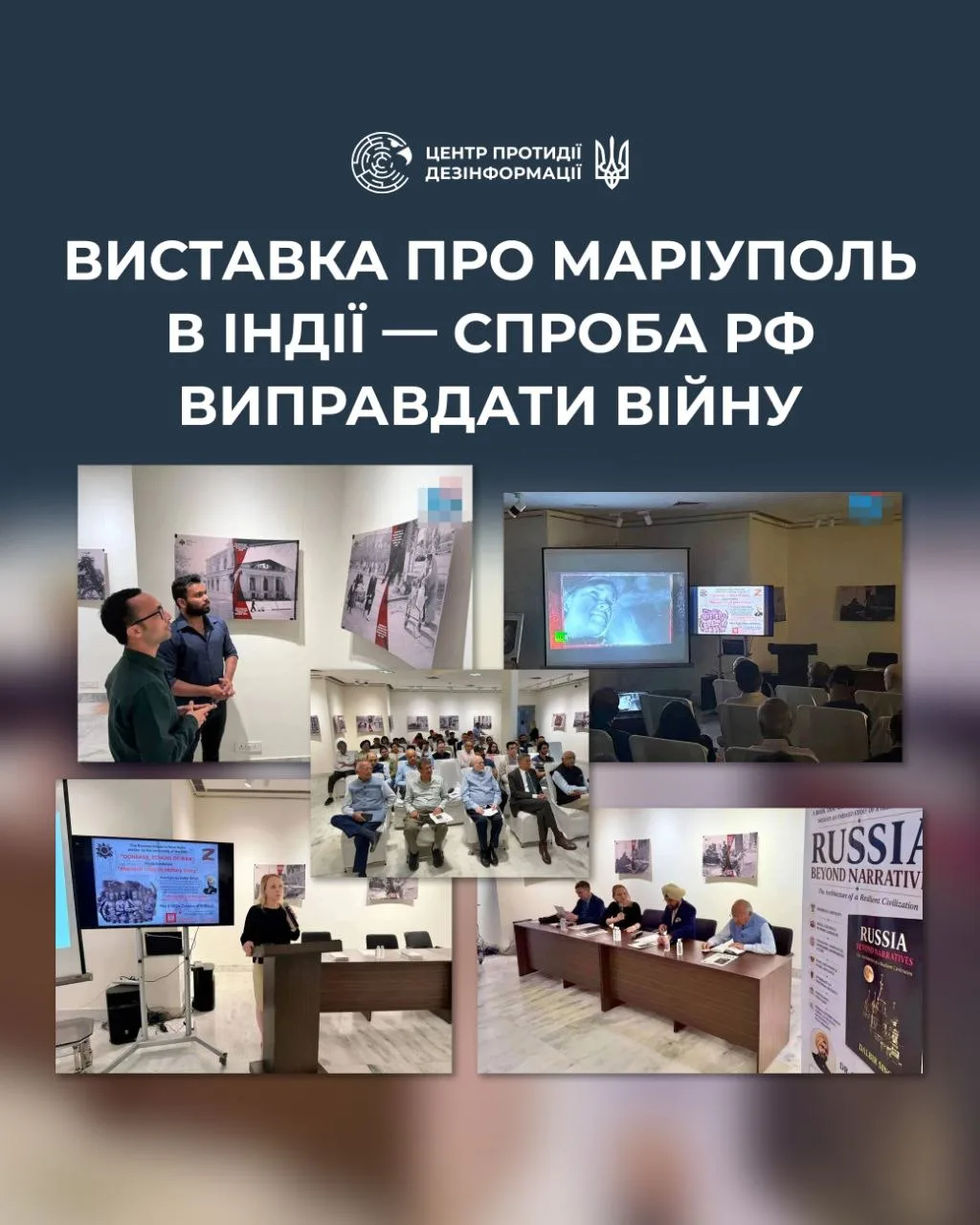
Russian officials have opened a controversial photo exhibition in New Delhi titled “Mariupol — City of Military Glory,” which Ukrainian security experts describe as a deliberate propaganda effort to justify Moscow’s invasion of Ukraine. The exhibition, hosted at the “Russian House” cultural center in India’s capital, juxtaposes archival World War II photographs with contemporary images of occupied Mariupol taken between 2022 and 2024.
According to Ukraine’s Center for Countering Disinformation (CCD), which operates under the National Security and Defense Council, this exhibition represents a calculated component of Russia’s ongoing information warfare campaign. The center warns that such displays are designed to mislead international audiences about the nature of Russia’s actions in Ukraine.
“The Kremlin uses these events to misinform foreign audiences and create a basis for justifying the occupation of Ukrainian territories,” the CCD stated in its report, as cited by Ukrainian National News (UNN).
Security experts point out that the exhibition deliberately attempts to draw parallels between the Soviet Union’s legitimate fight against Nazi Germany during World War II and Russia’s current military campaign in Ukraine. This narrative framing serves to portray Russia’s invasion as a continuation of historical anti-fascist struggles rather than what international observers have widely condemned as an unprovoked act of aggression.
“Through such exhibitions, Russia seeks to impose on the world the thesis of the alleged ‘historical continuity’ of its war against Ukraine, although in reality, it is an act of aggression and a violation of international law,” the CCD emphasized.
The timing of the exhibition coincides with Russia’s annual Victory Day commemorations on May 9, which celebrate the Soviet Union’s triumph over Nazi Germany in 1945. Since launching the invasion of Ukraine in February 2022, the Kremlin has increasingly instrumentalized Victory Day celebrations and World War II symbolism to bolster domestic support for its military actions and to sway international opinion.
Mariupol, a strategic port city in southeastern Ukraine, has become a powerful symbol in the conflict. Russian forces subjected the city to a devastating siege in the early months of the war, reducing much of its infrastructure to rubble and causing a severe humanitarian crisis. The Azovstal steel plant in Mariupol became internationally known as the last Ukrainian stronghold before the city fell to Russian control in May 2022.
The exhibition in New Delhi holds particular significance as it targets Indian audiences. India has maintained a relatively neutral stance on the Russia-Ukraine conflict, abstaining from United Nations resolutions condemning Russia’s invasion while calling for diplomatic solutions. Russia has sought to leverage its historically strong ties with India to counter Western isolation.
This is not the first instance of Russian information operations targeting international audiences. The CCD recently reported other propaganda activities, including the distribution of counterfeit Ukrainian currency featuring “Great Victory” slogans in border areas, further illustrating Moscow’s multifaceted approach to information warfare.
International organizations, including the European Union’s East StratCom Task Force and NATO’s Strategic Communications Centre of Excellence, have documented Russia’s extensive use of historical narratives to justify its actions in Ukraine. These efforts frequently involve drawing false equivalencies between contemporary Ukrainian governance and Nazi ideology, despite Ukraine’s democratic institutions and the lack of evidence supporting such claims.
As the conflict continues into its third year, the battle for international public opinion remains a critical dimension alongside military operations, with both sides working to shape global perceptions of the war’s causes, conduct, and consequences.
Fact Checker
Verify the accuracy of this article using The Disinformation Commission analysis and real-time sources.

14 Comments
This report highlights the concerning lengths the Russian government is willing to go to in order to justify its invasion of Ukraine. Exploiting historical events and cultural narratives for propaganda purposes is a dangerous tactic that must be resisted.
Absolutely. Russia’s disregard for facts and its willingness to distort history to serve its political agenda is deeply troubling. The international community must remain vigilant and continue to expose these propaganda efforts.
The use of Victory Day commemorations to spread pro-war propaganda is a cynical and manipulative tactic by the Russian government. It’s crucial that the international community sees through these attempts to rewrite history and justify the invasion of Ukraine.
Agreed. Russia’s blatant disregard for the truth and its willingness to exploit historical events for political gain is deeply troubling. We must remain vigilant and continue to expose these propaganda efforts.
This is a disturbing example of how Russia is manipulating historical narratives to justify its invasion of Ukraine. The parallels they’re trying to draw are highly misleading and concerning.
It’s crucial that the global community remains vigilant and calls out these propaganda efforts. Fact-based reporting and analysis are essential to countering Russia’s disinformation campaign.
The Russian government’s use of Victory Day commemorations to spread propaganda about the Ukraine invasion is deeply troubling. It’s a blatant attempt to manipulate historical events for political gain, which the international community must strongly condemn.
Agreed. This is a cynical and transparent attempt by Russia to justify its illegal and unjustified invasion of Ukraine. The global community must continue to call out these propaganda tactics and ensure the truth is widely disseminated.
Russia’s use of these exhibitions to mislead international audiences about its actions in Ukraine is deeply troubling. It’s a stark reminder of the importance of critical thinking and fact-checking when consuming information, especially around sensitive geopolitical issues.
Agreed. The international community should condemn these propaganda tactics and ensure accurate information about the conflict is readily available to counter Russian disinformation.
This is a concerning development, as Russia appears to be exploiting cultural events and historical narratives to advance its propaganda agenda in the Ukraine conflict. It’s crucial that the international community remains vigilant and counters these tactics with factual information.
Absolutely. The use of such exhibitions to mislead and justify Russia’s actions is a clear abuse of cultural heritage and historical memory. We must stand firm against these attempts to rewrite history and distort the truth.
This is an alarming report on Russia’s use of propaganda exhibitions to justify its invasion of Ukraine. While commemorating WWII is understandable, the attempt to draw parallels with the current conflict is highly concerning and misleading.
It’s concerning to see Russia exploiting historical events to spread disinformation about its actions in Ukraine. The international community must remain vigilant against such propaganda efforts.