


Listen to the article
Ukrainian Journalist Exposes Russian Disinformation and Western Media Blind Spots
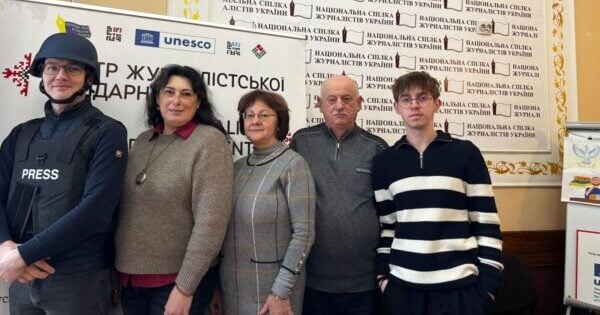
In the western Ukrainian city of Lviv, Natalia Voitovych manages a lifeline for journalists covering Europe’s largest land war since World War II. As coordinator of the Lviv Journalists’ Solidarity Center, she has witnessed firsthand how Russia’s information warfare distorts international understanding of Ukraine’s fight for survival.
“Russian propaganda has had a strong presence in Western information spaces,” Voitovych explains. “This is an information war.”
Her critique of Western media coverage highlights a fundamental misunderstanding that persisted for years: the characterization of Russia’s 2014 invasion as an internal Ukrainian conflict. “Many European outlets treated the conflict for years as an internal Ukrainian issue—a ‘civil conflict’ or ‘separatist’ war—rather than as Russian aggression against Ukraine,” she says. “That misframing was one of the biggest problems.”
The consequences of this mischaracterization became catastrophically clear when Russia launched its full-scale invasion in February 2022. Many Western analysts, influenced by Russian narratives about Ukraine’s weakness, predicted a swift Russian victory. “When Russia’s full-scale invasion started in 2022, some European and Western media initially said Ukraine was a small country, and Russia was a big country, so Ukraine could not defend itself,” Voitovych recalls.
These predictions were quickly upended by Ukraine’s fierce resistance. Ordinary citizens—from bakers to painters to teachers—volunteered to defend their homeland. “When the invasion began in 2022, people joined the defense in enormous numbers,” she says. “There were long lines of volunteers.”
Voitovych has documented the evolution of Russian propaganda tactics throughout the conflict. Initially, Russia claimed it was “protecting” Russian speakers, despite the fact that Russian was widely spoken and respected across Ukraine, including in Lviv. “Even in Lviv, we had multiple schools that taught Russian as a minority language. In the streets of Lviv, people spoke Russian, and nobody forbade it,” she notes.
When that narrative lost credibility, Russian propagandists shifted to historical revisionism, claiming Ukraine was “their territory” despite centuries of distinct Ukrainian cultural development. “They claim Ukraine was ‘founded’ by Lenin,” Voitovych says with evident frustration. “However, Kyiv is far older than Moscow by centuries. It is illogical to say that a place with an older city, a long history, and an established culture was ‘created’ recently by the Soviet Union.”
This systematic disinformation campaign began years before the full-scale invasion, when President Vladimir Putin consolidated power in Russia. “When Putin came to power, I am not a historian, but my understanding is that he did three major things,” Voitovych explains. “First, he targeted independent journalists and moved to silence them. Second, he consolidated power by aligning with and empowering the richest men—oligarchs—so wealth and political loyalty reinforced each other. Third, he built a system of patriotic messaging designed to make Russians feel proud and to mobilize them around the state.”
The repression of Russian journalism has intensified dramatically since the invasion. Voitovych’s organization tracks the fates of Ukrainian journalists held captive by Russia, including Viktoriia Roshchyna, whose treatment in detention has raised serious concerns. “Russia treats journalists in a fundamentally criminal way because, for them, journalists are a target that must be eliminated,” she says.
While Ukraine has improved its press freedom ranking from 106th in 2022 to 62nd in 2025 according to Reporters Without Borders, Russia has fallen to 171st place. This divergence reflects Ukraine’s commitment to independent journalism despite the challenges of wartime.
The Journalists’ Solidarity Center that Voitovych coordinates is part of a nationwide network established to support reporters working in extremely dangerous conditions. The initiative began in March 2022, when journalists fleeing occupied territories sought refuge in Lviv.
“When the full-scale invasion led to mass displacement, journalists from occupied or heavily attacked areas began fleeing, and Lviv became a hub,” she explains. “We distributed aid, helped journalists find places to live, and supported them so they could continue working.”
Today, the network includes six hubs across Ukraine where journalists can access protective equipment, workspace during power outages, and professional training. “Russia is attacking Ukraine’s energy system. For example, Lviv can experience blackouts. When there is no electricity or internet at home, journalists can come to the hub to work,” Voitovych says.
The centers also provide crucial safety training and protective gear for reporters heading to the front lines. This support has proven vital for maintaining independent coverage of the war, especially as Russia deliberately targets journalists.
For Voitovych, one of the most important challenges is preserving the human dimension of the conflict. “When we show the deaths of soldiers, it often becomes statistics,” she reflects. “However, when we show a person’s death through their story, it is different. It is the death of a son. It is the death of a father. It is the death of a brother.”
This humanizing perspective is essential as the war enters its fourth year with no end in sight. While Ukraine has demonstrated remarkable resilience against overwhelming odds, Voitovych worries about pressure for territorial concessions. “If we make territorial concessions, it will be a disaster. You cannot give the aggressor what they want. If we agree to give them our territory, they will not stop,” she warns.
As Ukraine continues its struggle for survival, Voitovych and her colleagues at the Journalists’ Solidarity Center work tirelessly to ensure that the world sees beyond statistics and military updates to the human reality of the conflict. Their efforts represent a crucial front in Ukraine’s fight—not just for territory, but for truth itself.
Fact Checker
Verify the accuracy of this article using The Disinformation Commission analysis and real-time sources.

10 Comments
It’s troubling to hear how Western media outlets have at times propagated Russian narratives about Ukraine’s supposed weakness. Accurate, fact-based reporting is essential to counter these distortions and provide a clear picture of the situation.
Voitovych’s comments underscore the importance of journalists being vigilant in identifying and debunking Russian disinformation campaigns. Maintaining journalistic integrity is crucial in the face of such concerted propaganda efforts.
I agree. The media has a responsibility to cut through the fog of war and provide the public with a reliable, unbiased understanding of the conflict.
Voitovych’s critique of Western media coverage is a sobering reminder of the challenges journalists face in reporting on complex, geopolitical conflicts. Maintaining objectivity and resisting the influence of disinformation is essential for providing the public with accurate, reliable information.
Well said. The media’s role in countering Russian propaganda and exposing the realities of the situation in Ukraine is crucial for public understanding and informed decision-making.
It’s concerning to hear how Russian propaganda has distorted the West’s understanding of the conflict in Ukraine. Voitovych’s insights highlight the importance of accurate, unbiased reporting to counter disinformation campaigns.
I agree. The media has a crucial role to play in exposing the realities of Russia’s aggression against Ukraine, rather than repeating misleading narratives.
The mischaracterization of the 2014 invasion as an ‘internal Ukrainian conflict’ is a concerning example of how Russian propaganda can distort international perceptions. Voitovych’s insights highlight the need for greater media scrutiny and a more nuanced geopolitical analysis.
The characterization of the 2014 invasion as an ‘internal Ukrainian conflict’ or ‘civil war’ is a concerning example of how Russian disinformation can influence international coverage. It’s important to recognize the true nature of this conflict as Russian aggression.
Absolutely. Voitovych’s insights highlight the need for greater scrutiny of media sources and a more nuanced understanding of the geopolitical dynamics at play.