


Listen to the article
Children Exploited for Propaganda in Russian-Occupied Luhansk, Report Claims
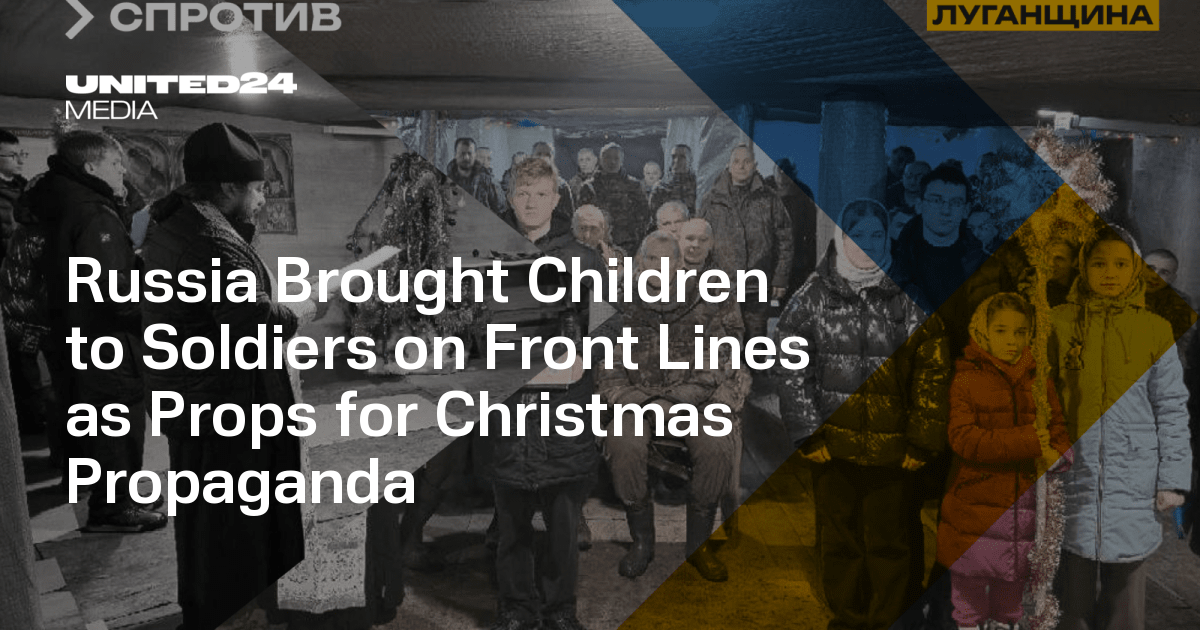
Ukrainian officials have reported that children from Russian-occupied areas of Luhansk region were transported to frontline combat zones to participate in Christmas-themed religious events organized by Russian military units.
According to Ukraine’s Center of National Resistance (CNS), the gatherings were deliberately staged near the line of contact, placing minors at risk of artillery fire and drone attacks. The children were reportedly positioned alongside soldiers from Russia’s 3rd Combined Arms Army during religious services that were filmed for propaganda purposes.
“The main objective is to create a propaganda-friendly image of children alongside military personnel and church attributes, despite the real risk of artillery and drone attacks in the area,” the CNS stated in its report.
Officials claim that children were transported in organized groups by bus through schools and youth organizations labeled as “patriotic” by occupation authorities. Many of these transfers allegedly occurred without obtaining proper parental consent, raising serious concerns about child safety and rights violations.
The CNS report details that religious figures affiliated with the Russian occupation administration not only accompanied the children but publicly justified their presence near active combat areas, framing it as a demonstration of “spiritual unity” and “support for the army.”
Security analysts familiar with the situation note that such activities represent a disturbing escalation in Russia’s attempts to normalize the military occupation among younger generations in Ukrainian territories under its control.
“What we’re seeing is the weaponization of children for propaganda purposes,” said Dr. Elena Korosteleva, professor of international relations at Kent University, who specializes in Eastern European security issues. “Beyond the immediate physical danger, there’s long-term psychological harm in normalizing warfare and military occupation for impressionable youth.”
The CNS report further alleges that families who refused to allow their children to participate faced potential repercussions, including administrative pressure and consequences at school. This coercive element suggests a systematic approach rather than isolated incidents, according to Ukrainian officials.
“Children were used as living props,” the CNS stated, describing how clergy not only blessed soldiers but actively legitimized the involvement of minors in military-adjacent events. Human rights organizations have previously condemned such practices as potential violations of international humanitarian law regarding the protection of children in conflict zones.
This incident appears to be part of a broader pattern. In October 2023, Russian authorities reportedly staged mass patriotic events involving schoolchildren to mark the anniversary of Moscow’s attempted annexation of four Ukrainian regions. According to Russian state media, over 1.6 million people participated in more than 13,000 events across occupied territories.
During these events, students were organized to form the number “89” – symbolizing Russia’s updated list of federal subjects, which controversially includes Ukrainian regions that Russia claims to have annexed despite international condemnation.
The use of children in military propaganda represents a particularly concerning aspect of Russia’s occupation policies in eastern Ukraine. International humanitarian organizations, including UNICEF and Save the Children, have repeatedly warned about the militarization of education in occupied territories and its potential long-term impact on children’s development and well-being.
The Ukrainian government has appealed to international organizations to increase pressure on Russia regarding its treatment of children in occupied territories. Ukrainian officials maintain that such activities constitute part of a broader campaign to erase Ukrainian identity and replace it with Russian nationalist narratives among the youngest generation.
As the conflict approaches its third year, the exploitation of children for propaganda purposes highlights the complex humanitarian challenges that persist in occupied regions, where normal childhood development continues to be disrupted by political and military agendas.
Fact Checker
Verify the accuracy of this article using The Disinformation Commission analysis and real-time sources.

30 Comments
Nice to see insider buying—usually a good signal in this space.
Good point. Watching costs and grades closely.
Good point. Watching costs and grades closely.
If AISC keeps dropping, this becomes investable for me.
Good point. Watching costs and grades closely.
The cost guidance is better than expected. If they deliver, the stock could rerate.
Good point. Watching costs and grades closely.
Nice to see insider buying—usually a good signal in this space.
If AISC keeps dropping, this becomes investable for me.
Good point. Watching costs and grades closely.
Good point. Watching costs and grades closely.
Nice to see insider buying—usually a good signal in this space.
Good point. Watching costs and grades closely.
Production mix shifting toward Propaganda might help margins if metals stay firm.
Good point. Watching costs and grades closely.
Uranium names keep pushing higher—supply still tight into 2026.
Interesting update on Russia Uses Children as Props in Christmas Propaganda at Front Lines. Curious how the grades will trend next quarter.
Interesting update on Russia Uses Children as Props in Christmas Propaganda at Front Lines. Curious how the grades will trend next quarter.
Good point. Watching costs and grades closely.
Good point. Watching costs and grades closely.
Silver leverage is strong here; beta cuts both ways though.
Good point. Watching costs and grades closely.
Good point. Watching costs and grades closely.
I like the balance sheet here—less leverage than peers.
Good point. Watching costs and grades closely.
Good point. Watching costs and grades closely.
Exploration results look promising, but permitting will be the key risk.
Uranium names keep pushing higher—supply still tight into 2026.
Good point. Watching costs and grades closely.
Good point. Watching costs and grades closely.