


Listen to the article
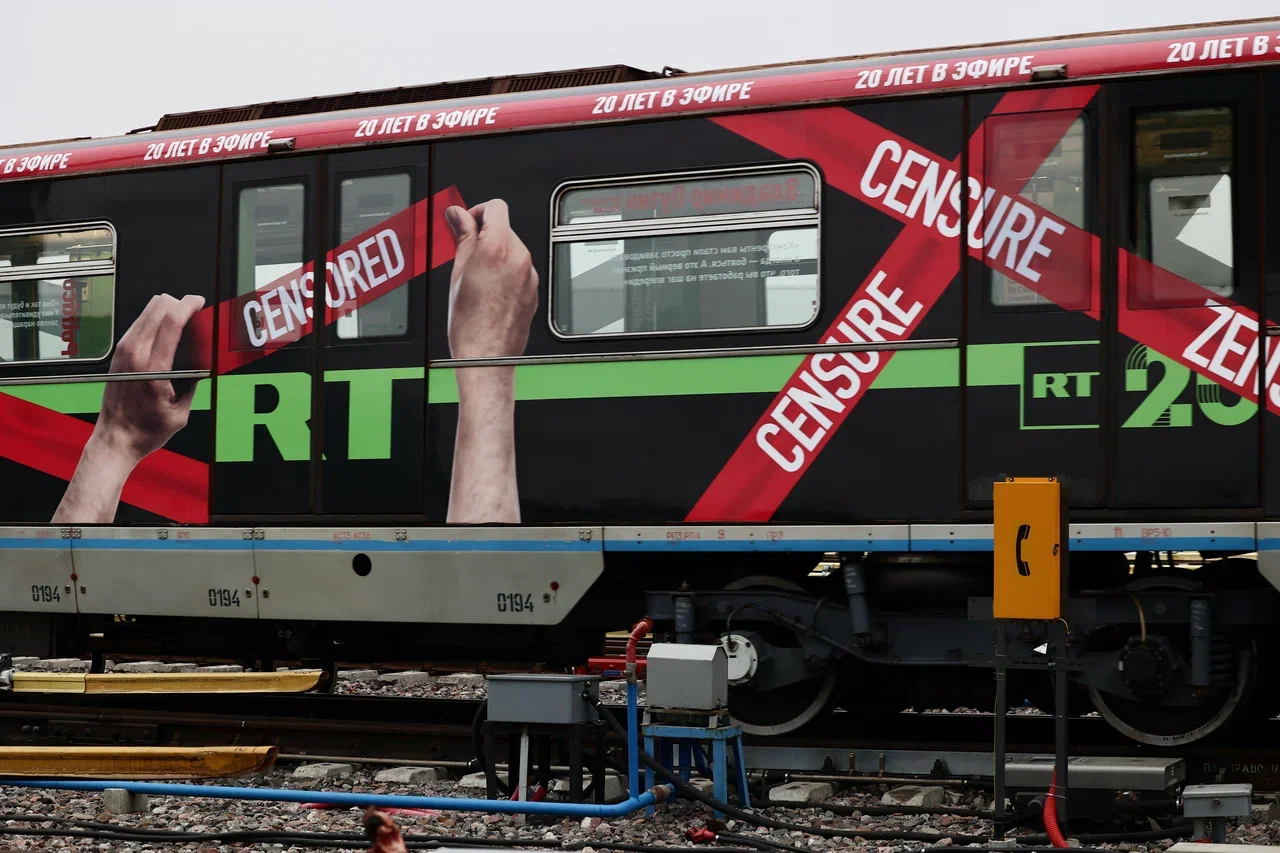
Russian state media network RT has launched a provocative “Propaganda Train” on the Moscow Metro as part of its 20th anniversary celebrations, embracing the controversial label often applied to the outlet by Western critics.
The specially wrapped train, which began operating on the busy Arbatsko-Pokrovskaya Line this month, represents a bold, self-referential marketing move by the network. The train is scheduled to remain in service until June 2026, carrying Moscow commuters through the city’s underground transit system while displaying RT’s messaging.
The train features three distinctly themed carriages that showcase different aspects of the network’s operations and history since its 2005 launch. The first carriage, “The Newsroom,” highlights RT’s broadcasting infrastructure and production capabilities. The second, provocatively titled “Censorship,” appears to address Western allegations about the network’s role in Russian state information operations. The third carriage, “Live Broadcast,” focuses on the network’s on-air programming and reporting.
Inside the carriages, passengers encounter unique themed elements designed to reinforce RT’s brand identity. The standard grab-rails have been replaced with custom versions shaped like megaphones and RT-branded microphones. Wall graphics throughout the train feature quotes about the network from international media outlets and political figures, alongside statements from Russian President Vladimir Putin, who has been a staunch supporter of the channel.
The metro train wrap is just one element of RT’s extensive anniversary campaign, which began earlier this year. Previous celebrations included a gala event at Moscow’s prestigious Bolshoi Theatre, complete with projection mapping displays on the historic building’s façade. The network also installed a large megaphone structure on Manezhnaya Square in central Moscow, which incorporated quotes about the channel and housed a functional broadcast studio for live programming.
RT’s decision to embrace the “propaganda” label represents a notable shift in messaging strategy. Rather than refuting accusations commonly leveled by Western governments and media watchdogs that it serves as a propaganda arm of the Kremlin, the network appears to be leaning into the controversy with a post-ironic approach aimed at neutralizing criticism.
The campaign comes at a significant moment for Russian state media. Following Russia’s full-scale invasion of Ukraine in 2022, RT has faced increasing restrictions in Western markets. The European Union suspended RT’s broadcasting license, while the network has encountered various sanctions and limitations in the United States, United Kingdom, and other countries. These measures have forced RT to adapt its distribution strategies and focus more heavily on digital platforms and markets where it maintains access.
Despite these challenges, RT claims substantial global reach. According to the network’s statements, it now operates a multilingual television news service in ten languages and includes the Ruptly video news agency in its media portfolio. The organization claims to reach more than 900 million potential viewers across over 100 countries, although independent verification of these figures is difficult to obtain.
Media analysts note that RT’s anniversary campaign reflects the network’s dual objectives: strengthening domestic Russian support for state media while attempting to maintain and expand its international influence despite Western restrictions. The provocative train campaign particularly serves the domestic audience, reinforcing the narrative that RT represents Russian interests against alleged Western information dominance.
The Moscow Metro, with its approximately 7 million daily riders, provides RT with a high-visibility platform to promote its messaging directly to Moscow residents and visitors, ensuring the network maintains a prominent public presence in the Russian capital throughout its anniversary year and beyond.
Fact Checker
Verify the accuracy of this article using The Disinformation Commission analysis and real-time sources.

7 Comments
The ‘Censorship’ carriage in particular seems designed to push back against Western criticisms of RT. I’m curious to see how this plays out and if it changes any perceptions of the network.
RT is clearly leaning into the ‘propaganda’ label, which is a risky move. It will be interesting to see if this generates more scrutiny or simply reinforces their existing narrative.
From a PR standpoint, this seems like an odd choice. Embracing the ‘propaganda’ label could backfire and draw even more criticism to RT’s operations. I wonder what their end goal is here.
I’m not surprised RT is taking this approach – they’ve always been quite brazen in their messaging. But the themed train cars are a clever way to get their content in front of a captive audience.
The ‘Propaganda Train’ is certainly an eye-catching concept. But I worry it may end up being more of a distraction than an effective messaging tool for RT. Time will tell how this is received.
Interesting PR move by RT to embrace the ‘propaganda’ label. I wonder how commuters will react to the themed train cars – will they find it informative or just more Kremlin messaging?
It’s a bold strategy, but one that likely plays well with RT’s domestic audience. The self-referential branding is certainly eye-catching.