


Listen to the article
Russia Intensifies Historical Warfare Against Finland as Tensions Rise
Russia has shifted its imperialist rhetoric toward Finland, employing distorted historical narratives as a weapon to delegitimize its Nordic neighbor following Finland’s 2023 NATO accession. Security experts warn that this escalation bears troubling similarities to the propaganda campaign that preceded Russia’s invasion of Ukraine.
Former Russian President Dmitry Medvedev recently sparked controversy by declaring on social media that the Bolsheviks’ recognition of Finnish independence in 1917 was a “blunder” that should be reversed, adding that Finland must pay for its “vile Russophobia.” His comments directly targeted Finnish President Alexander Stubb, dismissively referring to him as “some guy called Stubb.”
The provocation came in response to Stubb’s measured New Year’s message, which stated: “Our relations with Russia have changed permanently. What remains unchanged is that Russia is our neighbor. Both Finland and Europe aim to have functioning and peaceful relations with Russia. But, ultimately, it all depends on Russia’s actions.”
In Moscow’s current political climate, even such restrained comments are treated as grave insults. Medvedev, once portrayed by Western observers as a liberal modernizer during his 2008-2012 presidency, has emerged as Russia’s chief Finland-basher. Last year, he published an essay titled “The New Finnish Doctrine: Stupidity, Lies, Ingratitude,” which accused Finland of “ruining” decades of good relations.
The essay highlighted Finland’s complex World War II history, including its “co-belligerent” status with Nazi Germany and participation in the siege of Leningrad, while accusing modern Finland of ingratitude for supposed Soviet generosity. Medvedev claimed that by joining NATO, Finland’s “pro-American puppet authorities” forfeited any “political pardon” from Moscow.
More alarmingly, he suggested Russia could renounce treaties recognizing Finland’s independence, sovereignty, and borders, while pursuing litigation for alleged wartime damages – actions that “could lead to the collapse of Finnish statehood once and for all.”
This rhetoric is part of a broader campaign to foster anti-Finnish sentiment within Russia while intimidating Finns. Russian state television regularly features pundits threatening Finland with conquest, while physical provocations have included attacks on critical infrastructure. In late December, a cargo ship flying a Caribbean flag damaged an undersea data cable connecting Helsinki and Tallinn, prompting Finnish authorities to detain the vessel and investigate possible “aggravated criminal damage.”
While Finnish officials have responded firmly to concrete incidents, they’ve generally downplayed the likelihood of military confrontation, emphasizing their resilience while avoiding portraying their country as a geopolitical flashpoint.
Swedish security expert Patrik Oksanen has been less restrained. In a recent study for Sweden’s Psychological Defence Agency, he detailed Russia’s escalating campaign to portray Finland as a Nazi collaborator through “orchestrated legal actions, destruction of monuments, political statements and open threats.” The parallels with Russia’s characterization of Ukraine as “Nazi” before the 2022 invasion are impossible to ignore.
The campaign involves Russia’s entire state apparatus – security services, courts, Foreign Ministry, prosecutors, politicians, government officials, think tanks, Kremlin-aligned “activists,” media outlets, and social media accounts – working in concert to delegitimize Finland.
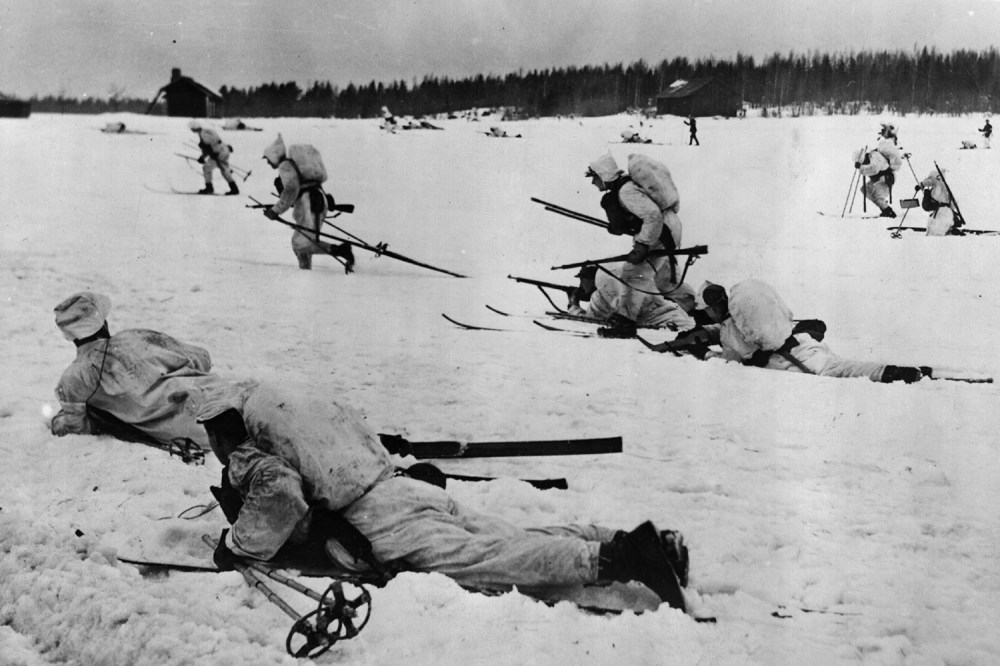
The historical distortions stem from Russia’s black-and-white narrative about World War II, which leaves no room for complexity. This narrative ignores Stalin’s initial quasi-alliance with Hitler, Soviet atrocities in Eastern Europe, and the fact that Stalin launched an unprovoked invasion of Finland in 1939-40. It portrays anyone who ever opposed the Soviet Union as Nazi collaborators, regardless of context.
Finnish historian Henrik Meinander describes Russia’s efforts as a “grotesque but unsurprising example” of modern Russia’s “Stalinist history policy.” The strategy, according to Oksanen, aims to make “Russian modern imperial ambitions appear legitimate and its opponents morally reprehensible.”
The campaign could easily escalate from rhetoric to action – with sanctions based on spurious legal rulings, vandalism of monuments, or provocations designed to suggest rising far-right sentiment in Finland. While such actions may seem merely symbolic, they can damage a country’s international standing and spread anxiety, polarization, and confusion among its citizens – giving Russia strategic advantages without firing a shot.
Fact Checker
Verify the accuracy of this article using The Disinformation Commission analysis and real-time sources.

23 Comments
Silver leverage is strong here; beta cuts both ways though.
Interesting update on Russia Intensifies Disinformation Campaign Against Finland. Curious how the grades will trend next quarter.
The cost guidance is better than expected. If they deliver, the stock could rerate.
Good point. Watching costs and grades closely.
Uranium names keep pushing higher—supply still tight into 2026.
Good point. Watching costs and grades closely.
Nice to see insider buying—usually a good signal in this space.
If AISC keeps dropping, this becomes investable for me.
Good point. Watching costs and grades closely.
Silver leverage is strong here; beta cuts both ways though.
Good point. Watching costs and grades closely.
Good point. Watching costs and grades closely.
Uranium names keep pushing higher—supply still tight into 2026.
Good point. Watching costs and grades closely.
Good point. Watching costs and grades closely.
Exploration results look promising, but permitting will be the key risk.
Nice to see insider buying—usually a good signal in this space.
Silver leverage is strong here; beta cuts both ways though.
The cost guidance is better than expected. If they deliver, the stock could rerate.
Good point. Watching costs and grades closely.
Good point. Watching costs and grades closely.
Nice to see insider buying—usually a good signal in this space.
Good point. Watching costs and grades closely.