


Listen to the article
Russia’s Media Regulator Takes Action Against News Agency Over TV Series Review
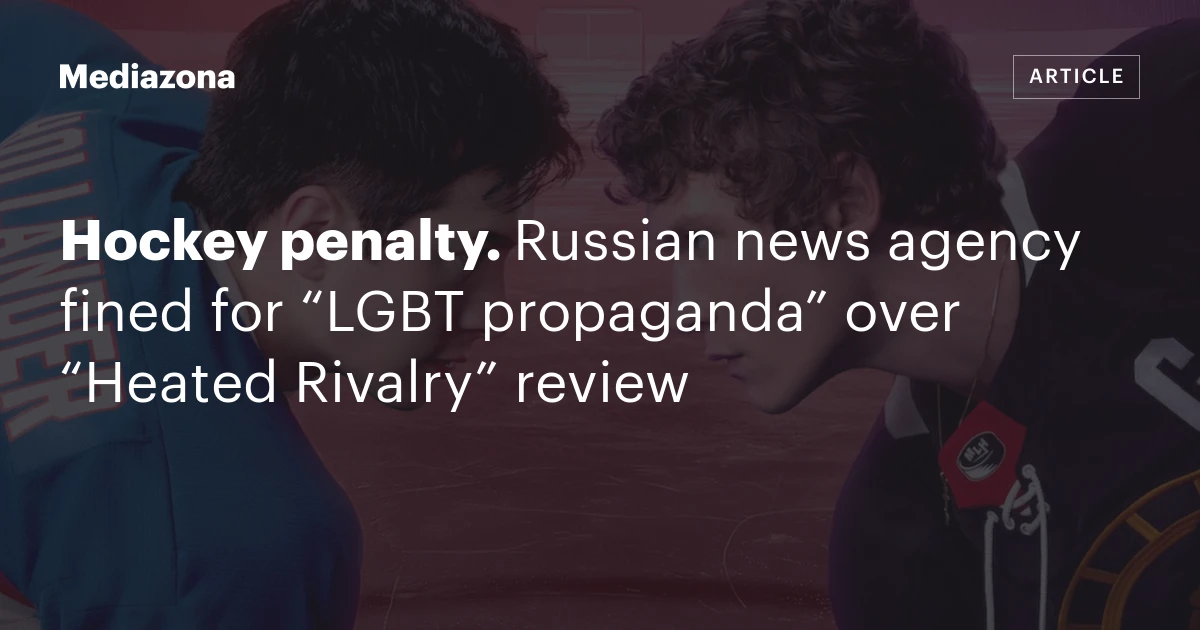
A Saratov court has fined news agency SarBK 1 million rubles for publishing content that allegedly violated Russia’s strict media regulations. The administrative action, initiated by Roskomnadzor’s Volga Federal District office, targeted an article titled “Why Did ‘Heated Rivalry’ Become Popular?” which appeared briefly on the SarBK website on February 6, 2026, before being removed.
The case represents the latest instance of Russia’s tightening control over media content, particularly relating to LGBTQ+ themes, which have faced increasing restrictions in recent years.
In a related development, Andrei Bashkaikin, SarBK’s IT director, was personally fined 50,000 rubles on April 7, 2026, by Vadim Krikunov, a magistrate of Judicial District No. 4 in Saratov’s Oktyabrsky District. The parallel charges against both the organization and its technical director highlight the multi-level approach Russian authorities are taking to enforce content regulations.
Speaking anonymously to Mediazona, a SarBK employee characterized the article as a “harmless review” of a television series that was published briefly as part of a link exchange program. “It was published for a short time, but we quickly took it down,” the employee stated. “It’s a harmless review, the kind of which is all over the internet.”
The employee declined to name the series explicitly, but court documents identified it as “Heated Rivalry,” a Canadian production that premiered on streaming platforms Crave and HBO Max in November 2025. The series adapts Rachel Reed’s novel about a secret romantic relationship between two professional hockey players: Russian character Ilya Rozanov (portrayed by Connor Storrie) and Canadian character Shane Hollander (played by Hudson Williams).
The action against SarBK comes amid Russia’s broadening crackdown on content featuring LGBTQ+ themes. In 2022, Russia expanded its “gay propaganda” law to prohibit any positive or neutral depictions of LGBTQ+ relationships across all media, not just those aimed at minors. The Russian Supreme Court’s 2023 ruling designating the “international LGBTQ+ movement” as an extremist organization has further restricted content creators and media outlets.
Media analysts suggest that Roskomnadzor, Russia’s communications regulator, has intensified scrutiny of both domestic and international content that might violate these regulations. The substantial fine against SarBK—equivalent to approximately $10,000 at current exchange rates—sends a clear message to smaller regional media outlets about the costs of non-compliance.
The case also highlights the challenges facing Russia’s dwindling independent media landscape. Regional news agencies like SarBK must navigate increasingly complex content restrictions while maintaining financial viability in a difficult economic environment. Link exchange programs, which the SarBK employee mentioned, represent common traffic-building strategies for smaller outlets but can expose them to regulatory risks when content isn’t thoroughly vetted against current restrictions.
The television series at the center of the controversy, “Heated Rivalry,” has received critical acclaim internationally for its portrayal of professional sports culture and LGBTQ+ representation. The show’s narrative focusing on a Russian character in a same-sex relationship appears to have triggered particular scrutiny from Russian authorities.
International media freedom organizations have expressed concern about the continued tightening of expression in Russia. According to recent reports, authorities can now move against media outlets within as little as 48 hours of content publication, leaving little time for editorial review or legal consultation.
The fine against SarBK represents one of the largest penalties imposed on a regional media outlet for content violations in recent months, signaling potentially harsher enforcement of media regulations throughout Russia’s regions, not just in major metropolitan centers.
As the case proceeds, SarBK has not publicly commented on whether it plans to appeal the decision or how it will adapt its content policies going forward.
Fact Checker
Verify the accuracy of this article using The Disinformation Commission analysis and real-time sources.

10 Comments
This case highlights the challenges facing independent media outlets in navigating Russia’s increasingly restrictive media environment. The multi-level enforcement approach is quite heavy-handed.
Agreed, the targeting of both the organization and individual staff members is quite concerning. It signals an aggressive stance from the authorities.
Concerning to see Russia taking such punitive actions against media outlets for fairly benign content. Speaks to a worrying trend of tightening control over information flows.
The parallel charges against the organization and its technical director seem designed to create a chilling effect on media reporting. A troubling development for journalism in Russia.
This news raises questions about the state of press freedom and freedom of expression in Russia. It will be important to follow how this case and others like it develop.
A million ruble fine for a ‘harmless review’ of a TV series seems like an excessive punishment. I wonder what the broader context and implications are here.
Absolutely, the severity of the penalty suggests this case is about more than just the content of the review. Likely part of a wider crackdown on media freedoms.
This case underscores the challenges facing independent media in Russia as the government tightens its grip on information. I wonder how this will impact reporting on sensitive topics.
Interesting that Russia is cracking down on media content, especially related to LGBTQ+ themes. Curious to learn more about the background and reasoning behind these regulations.
Yes, it seems like a concerning trend of tightening control over media and free expression. I wonder how this will impact journalism and access to information in Russia.