


Listen to the article
Iranian AI Video Depicts Missile Striking Statue of Liberty Amid Propaganda Push
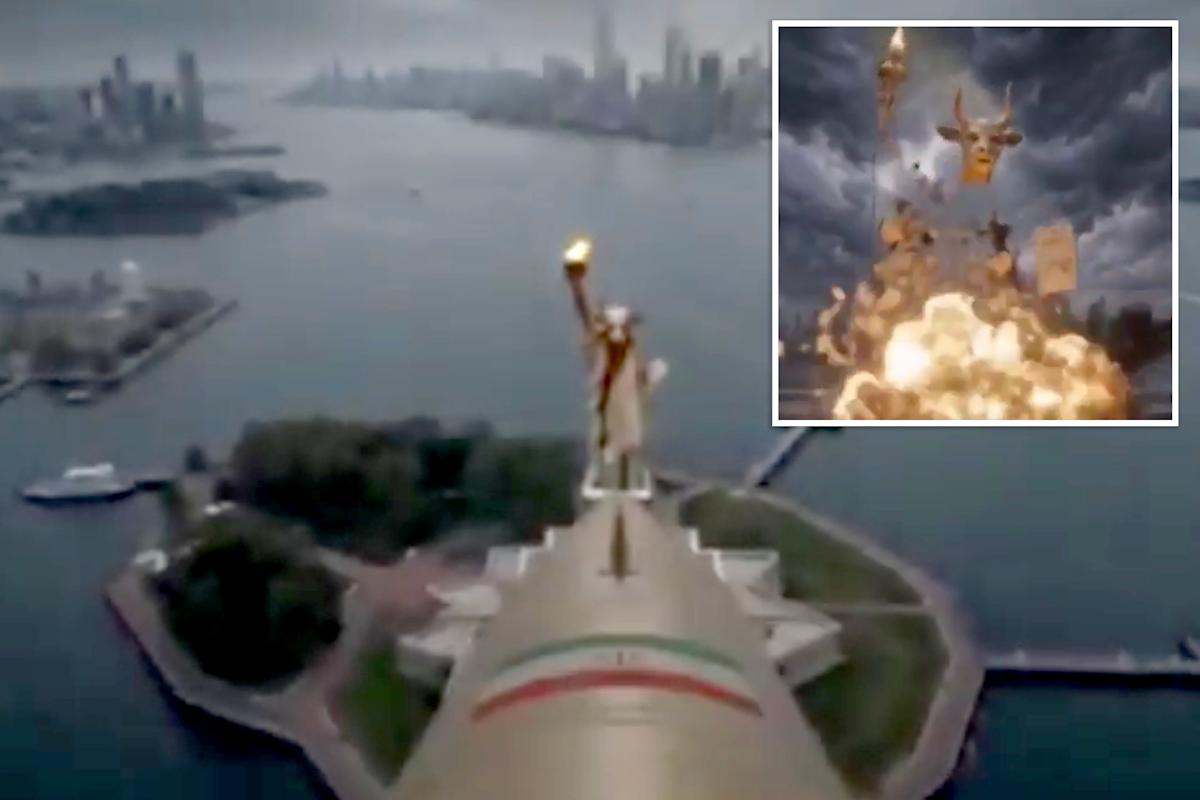
A controversial AI-generated propaganda video attributed to Iranian state broadcaster IRIB has surfaced showing a missile destroying the Statue of Liberty, the latest in Iran’s sophisticated digital influence campaign aimed at Western audiences. The minute-long clip, which concludes with the menacing slogan “One vengeance for all,” was later amplified by Russian state media outlet RT.
The sophisticated digital production incorporates imagery designed to resonate with American anti-war sentiments, featuring sequences that reference Native American dispossession, the atomic bombings of Japan, the Vietnam War, and recent Middle Eastern conflicts. This framing portrays the United States as a global aggressor rather than a defender of freedom.
In a particularly provocative segment, the video shows the Statue of Liberty with its head replaced by that of Baal, a Biblical false idol, while holding the Talmud. The statue is then destroyed by a missile bearing the Iranian national colors as it enters New York Harbor. This imagery builds on recent conspiracy theories stemming from a resurfaced 2009 email exchange involving Jeffrey Epstein.
The video also makes explicit reference to “Epstein’s pedo island,” a theme Iranian propaganda has repeatedly leveraged to suggest President Trump escalated tensions to distract from the scandal. This narrative attempts to connect with conspiracy-minded audiences across the political spectrum.
Intelligence analysts note that Iran’s propaganda strategy appears specifically calibrated to influence left-leaning Americans and anti-war advocates, potentially increasing domestic opposition to U.S. military involvement in the Middle East. The approach represents a sophisticated understanding of U.S. political divisions and how to exploit them.
“The propaganda includes memes and cartoons that aren’t meant to be perceived as real but are very good at spreading political messaging,” explained Darren Linvill, a researcher from Clemson University who studies disinformation campaigns. “The deepfakes portray a version of reality that seems genuine and often paint Iran as more successful in the conflict. Both are being shared widely among communities that are critical of the war and hungry for this messaging.”
The video also features AI-generated figures of Ayatollah Ali Khamenei and Qassem Soleimani, the former commander of Iran’s Quds Force who was killed in a U.S. drone strike in 2020. These images serve to reinforce the Iranian regime’s narrative of righteous resistance against American aggression.
Earlier this year, pro-regime crowds in Tehran burned an effigy of Baal with a Star of David on its forehead and an attached picture of President Trump, demonstrating the consistency of the imagery across Iran’s propaganda channels.
This video emerges amid increasing tensions in the Middle East, as Iranian officials seek to portray the United States as responsible for decades of regional conflict. The production quality and distribution strategy indicate a growing sophistication in Iran’s information warfare capabilities.
Iran is not alone in deploying surreal AI-generated content for geopolitical messaging. Last week, Chinese state television outlet CCTV broadcast a five-minute AI-generated video featuring martial arts-fighting Persian cats representing Iran and a human with an eagle’s head symbolizing the United States, illustrating Beijing’s perspective on the Strait of Hormuz crisis.
Experts warn that these increasingly sophisticated AI-generated propaganda pieces, which often appear across multiple platforms simultaneously, represent an evolution in information warfare techniques. Their surreal nature and cultural references make them more likely to be shared organically, potentially reaching millions of American viewers while masking their origins as foreign state propaganda.
The videos represent a concerning development in how adversarial nations are leveraging emerging technologies to shape foreign public opinion and potentially influence policy outcomes through grassroots pressure rather than traditional diplomatic channels.
Fact Checker
Verify the accuracy of this article using The Disinformation Commission analysis and real-time sources.

10 Comments
This video appears to be a concerning attempt to shape public opinion through the use of advanced technology and provocative imagery. While freedom of speech is vital, the spread of misinformation and glorification of violence is deeply troubling. Careful scrutiny of the sources and motives behind such content is warranted.
Portraying the US as a global aggressor through AI-generated propaganda is a concerning tactic. While artistic expression is protected, this video seems designed to inflame tensions rather than inform. Fact-checking and objective analysis are needed.
This video plays on provocative imagery and conspiracy theories to stoke anti-American sentiment. While free speech allows such content, it’s important to be critical and fact-check claims, rather than amplifying divisive propaganda.
Agreed. Disseminating disinformation, even under the guise of free expression, can have dangerous consequences. Responsible journalism and media literacy are crucial to counter these manipulative tactics.
The imagery and messaging in this video seem intentionally designed to provoke an emotional response rather than inform. While free speech is important, the spread of disinformation and glorification of violence is worrying. Rigorous fact-checking is needed.
The use of advanced technology to create this type of provocative content is worrying. While freedom of speech is vital, spreading misinformation and glorifying violence is unacceptable. Careful scrutiny of the sources and motives behind these videos is warranted.
Sophisticated digital propaganda that plays on conspiracy theories and anti-American sentiment is a growing concern. While creative expression has its place, the dissemination of misinformation and incitement of violence is unacceptable. Responsible media and critical thinking are essential.
This video appears to be a sophisticated attempt to shape public opinion through digital manipulation. While creative expression has its place, spreading inflammatory propaganda is concerning. Responsible media and critical thinking are essential to counter such tactics.
Absolutely. We must be vigilant against the misuse of technology to amplify divisive narratives. Maintaining a balanced, fact-based discourse is crucial for a healthy public discourse.
Disturbing to see this kind of inflammatory propaganda. While free speech is important, spreading misinformation and glorifying violence is concerning. I hope the authorities look into the sources and intent behind these videos.