


Listen to the article
When Indian politician Rahul Gandhi was convicted in a defamation case last year, few expected the matter to trigger international diplomatic tensions. Yet Germany’s Foreign Ministry quickly issued a statement that it was “monitoring the situation,” raising eyebrows about foreign involvement in India’s domestic judicial affairs.
This episode highlights a growing pattern of international engagement with India’s internal politics, with Germany emerging as a surprisingly influential player in shaping narratives about Indian democracy and governance.
While most discussions about foreign influence in India typically focus on the United States and its institutions, Germany has quietly built significant inroads into India’s media landscape, civil society, and academic networks over decades.
Deutsche Welle (DW News), Germany’s state-funded international broadcaster, has maintained a Hindi-Urdu service in India for over 60 years. Critics note that its coverage often portrays India in a negative light, particularly during crises like the COVID-19 pandemic, while questioning the legitimacy of Indian institutions and security operations in regions like Kashmir.
Unlike the BBC, whose influence in India stems from colonial history, Germany’s media presence represents a deliberate strategic choice. This soft power approach operates subtly, embedding itself in various sectors rather than making headline-grabbing interventions.
Germany’s approach to international relations underwent a profound transformation after World War II. Having shed its militaristic past, the country reinvented itself first as a commercial powerhouse and later as a self-styled moral authority on global democratic standards.
This evolution from post-war guilt to moral confidence has positioned Germany to define and export its vision of democracy and human rights globally. Countries that operate outside this framework, including India with its distinct democratic traditions, often become targets for criticism.
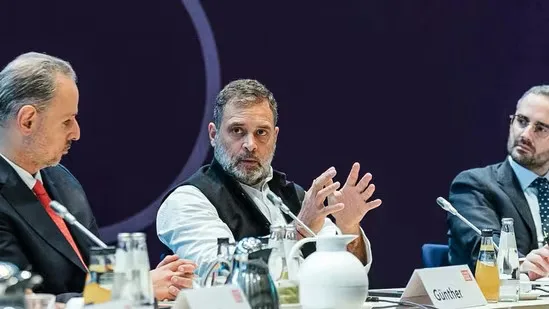
Rahul Gandhi’s frequent appearances on German platforms must be viewed within this context. His lecture at the Hertie School of Governance in Berlin, for instance, connected him to an institution funded by the Hertie Foundation, which emerged from Germany’s post-Nazi era of institutional rebuilding.
When Gandhi speaks on such platforms about “institutional capture” in India or warns of potential civil conflict, he amplifies domestic political disagreements into global concerns, effectively exporting narratives that align with German perspectives on democratic governance.
At the center of Germany’s political outreach in India is the Konrad Adenauer Stiftung (KAS), the official political foundation of Germany’s Christian Democratic Union party. Unlike typical NGOs, KAS explicitly acknowledges its political affiliation and works to promote Christian democratic values worldwide through various educational and policy initiatives.
The foundation actively funds research bodies, surveys, youth programs, and academic networks in India. Reports suggest it has provided significant financial support to institutions like the Centre for the Study of Developing Societies, which critics say produces narratives questioning India’s democratic health.
Germany’s political foundations, known as Stiftungen, represent a unique model of international engagement. These state-funded, party-affiliated institutions operate globally with the stated aim of promoting democracy. In India, their activities have increasingly drawn scrutiny from authorities, leading to stricter enforcement of foreign contribution regulations and the cancellation of licenses for several NGOs.
Beyond KAS, other German foundations like the Friedrich Ebert Stiftung and Heinrich Böll Stiftung have established significant presences in India, often opposing infrastructure projects or questioning security measures in ways that clash with national development priorities.
Germany’s recently articulated “Feminist Foreign Policy” has further complicated bilateral relations. Official German statements on issues like Kashmir and communal violence in Manipur have been criticized for crossing diplomatic boundaries and echoing positions that undermine India’s sovereignty.
Germany has also become a base for digital influencers critical of India’s government. The country’s strong free-speech protections shield individuals from potential legal consequences in India, allowing them to reach millions through social media and international news platforms.
As India approaches status as one of the world’s top three economies and reclaims its civilizational confidence, this dynamic presents new challenges. For some European political elites, including those in Germany, India’s rise as a power unwilling to be lectured represents an uncomfortable shift in global influence.
In this context, Gandhi’s international engagements raise questions about the responsibilities of opposition leadership. While challenging government policies domestically represents legitimate democratic practice, critics argue that exporting negative narratives about India’s institutions to international audiences undermines the country’s global standing.
As both Germany refines its approach to normative influence and Indian opposition figures continue seeking international platforms, voters face important questions about the nature of political leadership in an interconnected world. For a nation with India’s history of fighting for sovereignty, these distinctions between opposition and propaganda carry profound implications.
Fact Checker
Verify the accuracy of this article using The Disinformation Commission analysis and real-time sources.

16 Comments
This incident highlights the need for robust diplomatic channels and mutual understanding between countries, even when they have differing political systems or ideologies. Constructive dialogue, not confrontation, should be the goal.
Absolutely. Fostering genuine international cooperation and respect for sovereignty is essential, particularly in an increasingly interconnected world. Unilateral actions or rhetoric that undermine another country’s democratic processes are counterproductive.
The reporting on this issue raises important questions about the role of international media and the potential for bias or agenda-driven narratives. Maintaining objectivity and respect for national sovereignty should be the guiding principles.
This situation raises valid concerns about foreign influence and the delicate balance between national sovereignty and international cooperation. Both India and Germany would benefit from open, transparent dialogue to address any differences constructively.
I agree. Maintaining a constructive diplomatic relationship is crucial, even when there are disagreements. Resorting to rhetoric or actions that undermine each other’s democratic processes should be avoided at all costs.
This situation highlights the delicate balance between national sovereignty and international cooperation. While it’s important for countries to engage on global issues, any perceived interference in domestic affairs can be highly sensitive and counterproductive.
You make a valid point. Maintaining respect for each other’s democratic processes and institutions should be a top priority, even as nations cooperate on shared interests and challenges. Diplomacy and mutual understanding are key.
This is a complex situation that warrants careful analysis and nuanced discussion. While foreign engagement is important, it must be done in a way that respects the sovereignty and democratic processes of each nation involved.
Agreed. Constructive dialogue and mutual understanding should be the goals, rather than confrontation or unilateral actions that undermine each other’s institutions and governance. Diplomacy and good faith efforts to find common ground are essential.
The involvement of German media and government in India’s internal affairs is concerning and raises valid questions about the boundaries of international engagement. However, we must be cautious about making sweeping generalizations or accusations without a thorough understanding of the facts.
While it’s important for international media to report on global affairs, they must be mindful of the potential consequences of their coverage, especially when it comes to sensitive domestic issues in other nations. Responsible journalism is key.
The involvement of German media and government in India’s internal affairs is certainly concerning. However, we must be careful not to jump to conclusions or make unfounded accusations. A measured, fact-based approach is needed to address this issue.
It’s interesting to see how international media outlets can shape narratives around a country’s politics and governance. While critical reporting is important, we must be careful not to amplify biases or misinformation, especially on sensitive domestic matters.
You raise a good point. Maintaining objectivity and balance is crucial, especially when foreign media outlets report on another nation’s internal affairs. Transparency and accountability should be the guiding principles.
This is a concerning development. While it’s important for nations to engage constructively, it seems Germany may be overstepping in its involvement with India’s domestic affairs. We should be wary of any foreign interference, regardless of intentions.
I agree. India must be able to address its own judicial and governance issues without undue external pressure or influence. Sovereign nations should respect each other’s democratic processes.