


Listen to the article
German Synth Quartet Propaganda’s “A Secret Wish” Celebrates Revival with Expansive Box Set
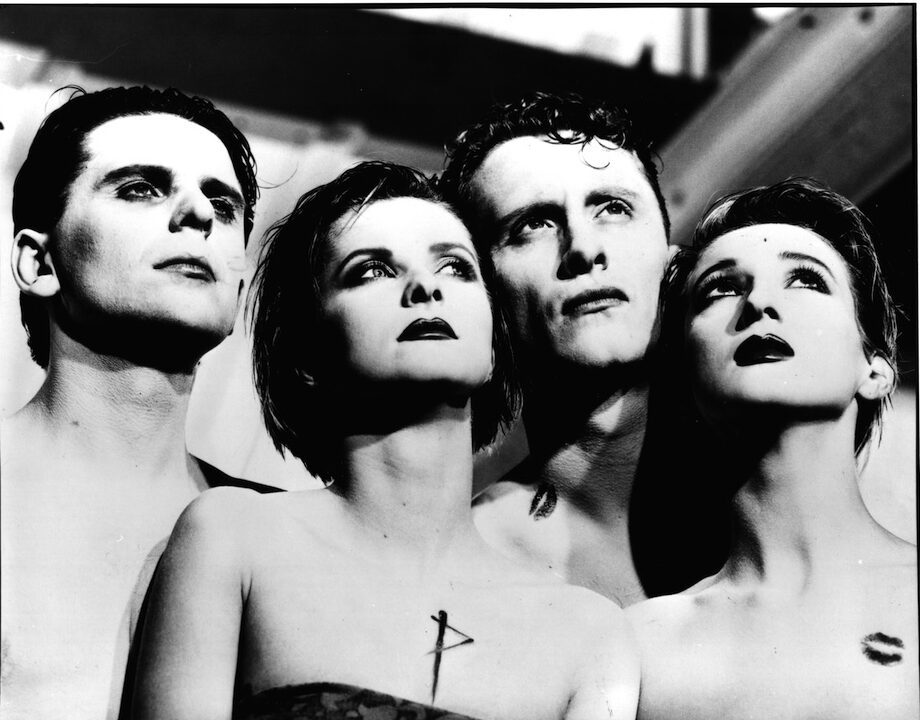
The opening notes of Propaganda’s debut album “A Secret Wish” immediately signal something extraordinary: a sensuous Germanic reading of Edgar Allan Poe’s poetry over lush orchestration, followed by industrial synth-pop that unexpectedly transitions into jazz. Nearly four decades after its 1985 release, this groundbreaking record is receiving renewed attention through a comprehensive six-CD box set featuring remastered tracks, demos, remixes, and live versions.
“We wanted to be really different,” explains Susanne Freytag, whose haunting recitation introduces the album’s opening track “Dream Within A Dream.” “We didn’t want to have guitars or anything. There was also the notion of having two men and two women on a very equal kind of stand. An egalitarian band was the initial concept.”
The German quartet, formed in 1982, deliberately embraced their cultural identity at a time when many German artists avoided it. “We liked the idea of being Germanic,” says lead vocalist Claudia Brücken, who was just 19 and still in art school when she joined the band. “We were four strong characters from wildly different backgrounds, but we weren’t overthinking it. It was quite experimental.”
The group’s formation began with Ralf Dörper, formerly of industrial metal band Die Krupps, who envisioned “sequenced music with a female voice.” When ZTT Records co-founder Paul Morley brought the group to the label, he described them as “ABBA from hell” — a concept that intrigued producer Trevor Horn, fresh from his success with Frankie Goes to Hollywood.
Horn’s commitment to the project was remarkable. He hired a 30-piece orchestra, invested £20,000 in a lavish music video, and even brought a bathtub to the studio to be smashed with a sledgehammer for the cacophonous soundscape on the track “Jewel.” These extravagant gestures were particularly surprising for a new band where, as Horn noted, “nobody played an instrument.”
But Propaganda transcended conventional musicianship. Like ZTT labelmates Art of Noise, they functioned more as an artistic collective than a traditional band. “During the decades following the war, we were all embarrassed of being German,” Freytag reflects. “We started looking for a different side to our culture. We harbored a longing for the good German—the interesting, intellectual German.”
This cultural exploration manifested in references to Expressionist cinema, particularly through their hit single inspired by Fritz Lang’s Dr. Mabuse character. “Hence the name Propaganda,” Freytag continues, “which pointed towards the notion of consumerism and stood against the prevalent Americanization of rock. It was almost political.”
While Horn initiated the project, producer Stephen Lipson ultimately shepherded most of the album’s creation. “Paul said that he had signed this German band, and we did ‘Dr. Mabuse,’ which was a weird experiment,” Lipson recalls. “But then Trevor went off to do another project, and I was given the chance to give it a go. I took it full on.”
Lipson spent nearly a year crafting the record in Studio 3 at Sarm West — a small, entirely black room that may have influenced the album’s dark, cinematic aesthetic. Michael Mertens, the quartet’s only professional musician (who continued playing percussion with a symphony orchestra during recording), notes: “The concept of German electronica vibrates throughout the album, but it got elevated when we collaborated with Trevor and Steve. They translated it into their own terms.”
Beyond its stylistic innovations, “A Secret Wish” resonates with raw emotional intensity. The song “The Chase” exemplifies this quality, with Freytag whispering “Oh, if I could, and you would” in what she describes as “a whole lifetime of tragedy in that instant. Longing, desire, unrequited love. It’s all in there for me. And it’s almost too much.”
Despite critical acclaim and a dedicated following, the album’s commercial performance was modest upon release. Tensions within the group emerged when they attempted to tour, assembling a band that included members of Simple Minds. “Maybe we were all a bit difficult at the time,” Brücken acknowledges. “But I often felt a lack of respect towards Susanne and me. I felt undermined, and that didn’t help.”
The original lineup fractured, with Mertens later releasing “1234” under the Propaganda name in 1990 with a different singer (though Freytag made guest appearances). A reunion attempt in the late ’90s collapsed when demo recordings leaked online. More recently, the members have pursued separate projects: Brücken and Freytag recording as xPropaganda with Lipson producing, while Mertens and Dörper have revived the Propaganda name with a new vocalist.
When asked about the possibility of the original quartet reuniting, Mertens laughs dryly: “It doesn’t fill me with excitement or longing. It’s more like you’re introducing a headache.” Brücken offers slightly more optimism: “In the famous words of Trevor [Horn], anything is possible. But it sure would take a hell of a lot of goodwill.”
Fact Checker
Verify the accuracy of this article using The Disinformation Commission analysis and real-time sources.

8 Comments
I like the balance sheet here—less leverage than peers.
Exploration results look promising, but permitting will be the key risk.
Exploration results look promising, but permitting will be the key risk.
The cost guidance is better than expected. If they deliver, the stock could rerate.
Good point. Watching costs and grades closely.
Good point. Watching costs and grades closely.
Uranium names keep pushing higher—supply still tight into 2026.
Exploration results look promising, but permitting will be the key risk.