


Listen to the article
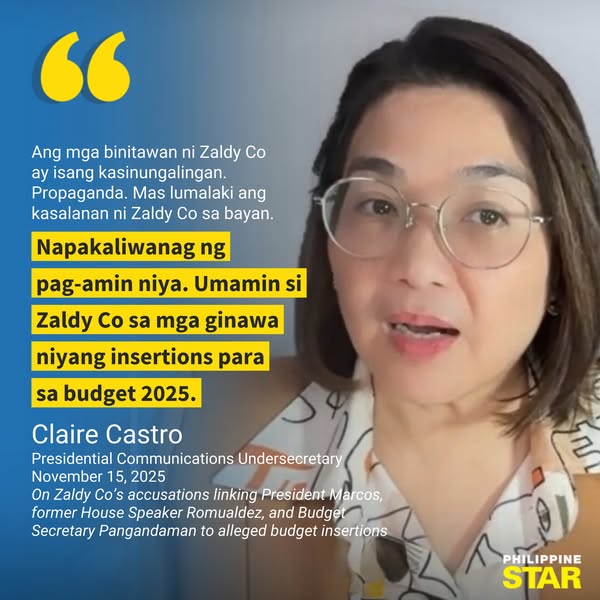
Recent accusations linking President Ferdinand “Bongbong” Marcos Jr. to alleged budget irregularities have been firmly rejected by the administration, with Presidential Communications Undersecretary Claire Castro labeling the claims as “propaganda.”
In a statement issued Saturday, Castro directly addressed allegations made by former Ako Bicol Representative Zaldy Co, who had suggested the President was involved in unauthorized budget insertions and cash payouts. The accusations come at a sensitive time for the Marcos administration, which has been promoting transparency and anti-corruption measures as central pillars of its governance platform.
“These baseless accusations are nothing more than politically motivated propaganda designed to undermine the administration’s credibility,” Castro said. She emphasized that all budget allocations under the Marcos presidency have followed proper legislative procedures and executive oversight.
The controversy stems from Co’s recent public statements suggesting impropriety in certain budget allocations. While specific details of Co’s allegations remain somewhat unclear, they appear to involve claims about discretionary fund distributions that allegedly bypassed standard budgetary protocols.
Political analysts note that such accusations are not uncommon in Philippine politics, where budget controversies have historically been flashpoints between administration and opposition figures. The Philippines has a complex budgeting process where allegations of “insertions” – items added to the budget without thorough deliberation – periodically emerge as political issues.
The timing of Co’s allegations is particularly significant as the government prepares for midterm budget reviews. Economic experts have been closely monitoring the Marcos administration’s fiscal policies, which have focused on infrastructure development and post-pandemic recovery initiatives.
Ako Bicol, the party-list group that Co previously represented, has maintained a varied relationship with the current administration, sometimes supporting government initiatives while maintaining independence on other policy matters. Co served in the House of Representatives and was known for his involvement in budget deliberations during his term.
The Presidential Communications Office has indicated that it may release more detailed rebuttals to Co’s specific claims in the coming days. “The administration maintains an open-book policy regarding all fiscal matters,” Castro added, “and we welcome proper scrutiny through appropriate channels rather than through unsubstantiated public accusations.”
Budget Secretary Amenah Pangandaman, though not directly addressing Co’s allegations, recently affirmed that the administration follows strict protocols for budget allocations. “Every peso in our national budget undergoes multiple layers of review and approval,” Pangandaman stated at an unrelated economic forum last week.
Political observers suggest that these allegations reflect broader tensions in Philippine governance between traditional political practices and the Marcos administration’s stated commitment to modernized, transparent governance structures.
The controversy has drawn limited reaction from opposition leaders thus far, with most appearing to wait for more concrete evidence before taking positions. Senator Risa Hontiveros, often a critic of administration policies, said her office is “monitoring the situation closely” but declined further comment pending additional information.
For President Marcos, who won the 2022 election with promises of unity and economic revival, these allegations represent one of several governance challenges his administration faces alongside inflation concerns and regional security issues. The administration has consistently maintained that its economic governance practices represent a departure from historical patterns that sometimes allowed for discretionary spending without adequate oversight.
As the story develops, financial markets appear to be taking a wait-and-see approach, with minimal impact on Philippine peso trading or government bond yields in recent days – suggesting that investors are not yet viewing these allegations as a significant governance risk.
The Presidential Communications Office has invited media representatives to a briefing early next week, which may provide further clarification on the administration’s response to these accusations.
Fact Checker
Verify the accuracy of this article using The Disinformation Commission analysis and real-time sources.

10 Comments
This seems like a complex issue with political undertones. I would encourage the public to seek out reliable, non-partisan sources of information to form their own opinions, rather than relying solely on statements from government officials or political opponents. Transparency and accountability are essential for maintaining public trust.
This sounds like a classic case of political finger-pointing. It’s important to let the facts speak for themselves and avoid getting caught up in partisan rhetoric. I’d be curious to see a more detailed and impartial analysis of the budget allocation process under the Marcos administration.
The administration’s strong rejection of these claims is not surprising, but I think it’s important to keep an open mind and allow for a fair and independent investigation. Allegations of budget irregularities, even if politically motivated, should not be dismissed outright. The public deserves clarity on how taxpayer funds are being allocated.
Allegations of budget irregularities are always concerning, but it’s wise to reserve judgment until a thorough investigation can be conducted. Transparency and accountability should be the top priorities, regardless of political affiliations. I hope both sides can come together to address this issue constructively.
I agree, this is a sensitive issue that requires a balanced and objective approach. It will be important for all stakeholders to participate in a transparent review process to get to the bottom of the matter.
While the administration’s defense of its budget practices is understandable, I believe a more transparent and collaborative approach would be beneficial. Inviting independent scrutiny and engaging constructively with political opponents could help to restore public confidence, regardless of the ultimate findings.
This is a complex issue with potentially serious implications. I think it’s important for the administration to provide a clear, detailed, and verifiable account of the budget allocation process to address these concerns head-on. Dismissing the allegations as ‘propaganda’ may only serve to fuel further speculation and mistrust.
While the administration’s dismissal of these claims as ‘propaganda’ is understandable, I think it’s crucial that they provide clear, verifiable evidence to back up their position. Allegations of budget impropriety should always be taken seriously and investigated thoroughly, regardless of the political implications.
While I understand the administration’s desire to defend its reputation, it’s crucial that they engage with these allegations in a substantive and transparent manner. Dismissing them as ‘propaganda’ may only serve to heighten public skepticism. A thorough, impartial review of the budget process could go a long way towards restoring trust.
I agree, a measured and evidence-based approach is essential here. Regardless of the political implications, the public interest should be the top priority.