


Listen to the article
In a groundbreaking analysis that cuts across three of the world’s major political landscapes, an upcoming two-part investigation will examine the ideological foundations shared by prominent nationalist leaders from Russia, France, and the United States.
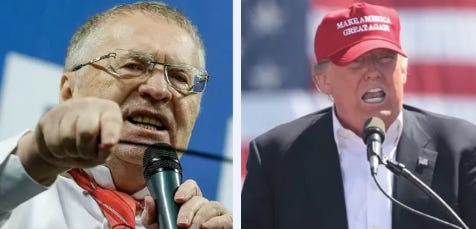
The study centers on Vladimir Zhirinovsky, the Russian ultranationalist who advocated for imperial restoration; Jean-Marie Le Pen, the French ethnic nationalist who spent decades challenging the liberal republic; and Donald Trump, the American populist who transformed Western democratic politics. Rather than focusing on surface-level similarities, the analysis delves into their shared doctrines, architectural frameworks, and political reasoning.
“What would happen if you took three of the most consequential nationalist politicians of the last half-century and asked a simple question: what do they actually share?” poses the researcher behind this initiative. The goal is to identify common ground at a fundamental level and then construct what a unified political program might look like if these shared philosophies were deliberately assembled.
This unique perspective comes from an individual with rare multinational experience. The researcher holds citizenship in all three countries—Russia, France, and the United States—and has lived extensively in each, providing an insider’s view rather than that of a casual observer or academic outsider.
While studying political science in Russia, the researcher gained significant insight into why Zhirinovsky, often dismissed by Western media as merely a provocateur, resonated so deeply with millions of Russians who felt he vocalized their unspoken beliefs.
“The more time I spent inside each of these political cultures—not reading about them, but living adjacent to them—the more I noticed that the same argument was being made in three different languages, three different registers, and three different national costumes,” the researcher explains.
This immersive experience revealed striking similarities across these seemingly disparate political movements. “The enemies were structurally identical. The emotional logic was identical. The proposed remedies, stripped of their local color, were nearly identical,” the researcher notes.
The observation prompted an evolution in thinking. Rather than simply wondering why these movements resembled each other, the question became more ambitious: What would a political party look like if it explicitly acknowledged and built upon this convergence?
The first installment of this two-part series will map the ideological common ground between these three nationalist leaders. The second will propose a comprehensive political structure—including the party organization, program details, and underlying doctrine—based on those shared foundations.
This analysis comes at a critical time in global politics, as nationalist movements continue to gain traction across democratic societies. Understanding the common ideological threads that connect these movements could provide valuable insight into their appeal and resilience.
Political scientists have long noted superficial similarities between nationalist movements across borders, but few analyses have attempted to construct a unified theoretical framework that explains these parallels. This approach offers a novel perspective by examining these movements not as isolated phenomena but as expressions of a shared political philosophy that transcends national boundaries.
The researcher emphasizes that this perspective comes from direct experience rather than theoretical analysis: “I did not arrive at this from the outside. I arrived at it from three insides at the same time. That is the only credential that matters here.”
As nationalist movements continue to shape electoral outcomes and policy debates worldwide, this analysis could provide a valuable framework for understanding their underlying appeal and potential future evolution. By identifying the core principles that unite these movements across vastly different cultural and political contexts, the study may offer insights into the broader forces reshaping democratic politics in the 21st century.
Fact Checker
Verify the accuracy of this article using The Disinformation Commission analysis and real-time sources.

18 Comments
While the goal of identifying common ground is laudable, I worry that this study could be used to further empower and legitimize these nationalist agendas. We must be cautious about how such findings are interpreted and applied.
A fair concern. It will be critical for the researchers to present their findings objectively and avoid validating or amplifying these nationalist ideologies.
This analysis seems like an important contribution to understanding the resurgence of nationalist movements. Exploring the underlying connections between these prominent figures is a valuable academic exercise.
Absolutely, gaining deeper insight into the ideological foundations of modern nationalism is crucial for policymakers and the public to navigate these complex political shifts.
While the goal of this analysis is to identify shared foundations, I worry it could also serve to validate and embolden these nationalist agendas. We must be vigilant about how such findings are interpreted and used.
That’s a valid concern. The researchers will need to take great care in presenting their findings in a way that avoids being co-opted by or lending legitimacy to these nationalist ideologies.
I’m intrigued by the prospect of uncovering the common philosophical threads that bind these nationalist figures together. Understanding their shared doctrines and reasoning could illuminate broader ideological trends.
Absolutely. This investigation has the potential to provide important context around the rise of nationalist movements globally and the drivers behind their growing influence.
Interesting analysis on the ideological connections between prominent nationalist leaders. I’m curious to see what common doctrines and political reasoning emerge across these diverse national contexts.
Yes, it will be insightful to understand the shared foundations underlying their distinct nationalist movements.
This is an ambitious and timely research project. Analyzing the deep-rooted connections between such influential nationalist leaders could yield valuable insights, but must be done with rigor and care.
Agreed. The researchers will need to approach this sensitive topic with nuance and objectivity to ensure the findings are used constructively to inform public discourse.
I’m skeptical about the ability to construct a unified political program from these shared nationalist philosophies. Their differing national contexts and policy priorities may make true unification challenging.
That’s a fair point. Translating ideological alignment into a coherent transnational program could prove difficult given the diverse political landscapes involved.
This study sounds like a fascinating and timely exploration of the ideological underpinnings of modern nationalist movements. I’m eager to see what common threads emerge from this cross-national analysis.
Agreed, uncovering the core philosophies and frameworks shared by these influential nationalist leaders could yield important insights into the broader political landscape.
This investigation could provide valuable insights into the rise of modern nationalist politics globally. Examining the core philosophies and frameworks of these influential figures is an important undertaking.
Agreed, uncovering the commonalities between these nationalist leaders will shed light on the broader ideological trends shaping politics today.