


Listen to the article
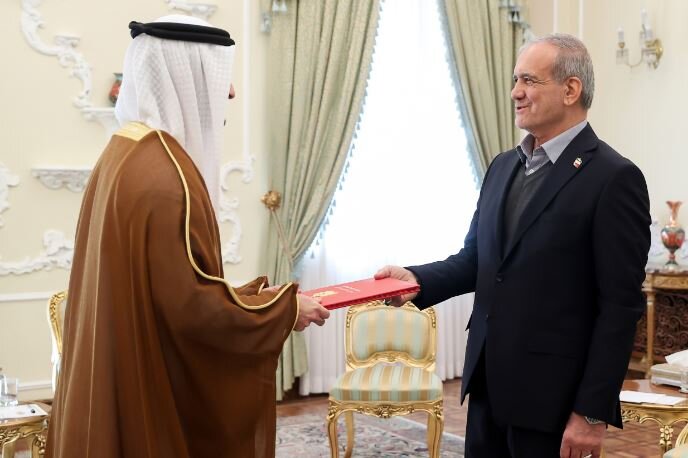
In a diplomatic formality steeped in significance, Iranian President Masoud Pezeshkian received credentials from four new ambassadors on Tuesday, using each exchange to articulate Iran’s foreign policy priorities amid ongoing regional tensions.
The ceremony, held in Tehran, included envoys from Oman, Austria, Ghana, and the United Arab Emirates, with each interaction reflecting Iran’s complex positioning in global affairs and its push to strengthen bilateral relationships while countering what Pezeshkian described as “Western propaganda” against the Islamic Republic.
During his meeting with Oman’s new ambassador, Sayyid Yarab bin Qahtan bin Nasser Al Busaidi, Pezeshkian emphasized the “excellent level” of relations between the neighboring countries, referring to Omanis as “brothers” to the Iranian people. This language highlights the special role Oman has played in Middle Eastern diplomacy, often serving as a neutral mediator between Iran and Western powers.
“Our relationship with Oman is built on deep historical ties and mutual respect,” Pezeshkian stated, expressing confidence that bilateral relations would continue with “strength, solidity, and foresight.” He also stressed the importance of implementing agreements reached during his recent visit to Muscat, demonstrating Iran’s eagerness to expand economic cooperation with the Gulf nation.
Al Busaidi conveyed the Sultan of Oman’s “special attention” to relations with Iran and wishes for the country’s peace and progress. Oman has historically maintained cordial relations with Iran even during periods of heightened tensions between Tehran and other Gulf states, making it a crucial diplomatic channel.
The tone shifted slightly when Pezeshkian received Austria’s new ambassador, Friedrich Stift. While acknowledging the positive history between Tehran and Vienna, the Iranian president urged the diplomat to present an “accurate and fair picture” of Iran to European audiences and help “neutralize incorrect anti-Iranian propaganda” – a reference to Iran’s longstanding grievances about Western media coverage and political rhetoric.
Pezeshkian also used the opportunity to defend Iran’s controversial nuclear program, insisting it remains “entirely peaceful” – a claim that continues to be disputed by Western powers despite the now-defunct 2015 nuclear agreement.
Ambassador Stift, for his part, expressed regret over recent military actions against Iran and the U.S. withdrawal from the Joint Comprehensive Plan of Action (JCPOA) under former President Donald Trump. He reaffirmed Austria’s commitment to dialogue and its readiness to host diplomatic talks, underscoring Vienna’s historical role as a neutral venue for international negotiations, including those that led to the original nuclear deal.
In his exchange with Ghana’s new ambassador, Makarios Akinbinab Akanbong, Pezeshkian highlighted opportunities to enhance economic and political relations between the two countries, specifically mentioning the need to activate their joint economic commission. This focus on Africa reflects Iran’s broader strategy to cultivate partnerships beyond its immediate neighborhood as it faces continued Western sanctions.
The Ghanaian ambassador delivered a message of solidarity, conveying his president’s “strong condemnation of the recent military attacks against Iran” – likely referring to Israeli strikes following Iran’s missile attack on Israel in October. Akanbong pledged Ghana’s continued support for Iran in international forums, emphasizing that disputes must be resolved through diplomacy rather than military confrontation.
These diplomatic engagements come at a critical time for Iran as it navigates a complex regional landscape marked by its ongoing proxy conflicts with Israel, tensions with Saudi Arabia, and the uncertain future of nuclear negotiations with Western powers. Through these formal exchanges, Pezeshkian appears to be simultaneously extending olive branches to friendly nations while maintaining Iran’s defiant stance toward its perceived adversaries.
Fact Checker
Verify the accuracy of this article using The Disinformation Commission analysis and real-time sources.

15 Comments
Interesting to see Iran strengthening diplomatic ties, especially with Oman which has played an important mediating role in the region. Curious to learn more about how these bilateral relationships could impact mining, energy, and commodity sectors.
Yes, Iran’s outreach to neighboring countries like Oman is notable. Improved regional stability could potentially boost investment and development in the mining and energy industries.
This news highlights the complex geopolitical dynamics surrounding Iran. As an energy and mineral-rich country, developments in its foreign policy bear close monitoring for impacts on global commodity markets.
Strengthening ties with Oman and other regional partners could open up new opportunities for Iran’s mining, metals, and energy sectors. However, addressing concerns about misinformation and upholding international standards will be crucial.
Strengthening bilateral ties, especially with neutral mediators like Oman, could help Iran navigate regional tensions and pursue economic opportunities. However, transparency and addressing misinformation will be crucial.
Agreed. Open communication and adherence to international standards will be key if Iran seeks to attract foreign investment in its mining and energy sectors.
While the diplomatic language is measured, this news suggests Iran is asserting its regional influence. Investors in mining, metals, and energy should follow these developments closely for potential impacts on supply, prices, and trade.
This news highlights Iran’s efforts to assert its regional influence and counter perceived Western narratives. As an energy and mineral-rich nation, these diplomatic developments could have implications for global commodity markets and supply chains.
Agreed. Iran’s regional positioning and relationships will be an important factor to monitor for investors and companies operating in the mining, metals, and energy sectors.
The diplomatic language around “brothers” and “mutual respect” suggests Iran is trying to position itself as a regional leader. This could have implications for commodity supply chains and trade agreements in the Middle East.
Good point. Iran’s regional influence and relationships will be an important factor to watch for investors and companies in the mining, metals, and energy sectors.
Iran’s focus on fighting “Western propaganda” is understandable given the geopolitical tensions, but it will be important to maintain transparency around its economic and resource development activities. Misinformation can undermine investor confidence.
Well said. Credibility and open communication are essential, especially for industries like mining that have significant social and environmental impacts.
Iran’s efforts to counter “Western propaganda” are understandable given the geopolitical tensions, though it will be important to maintain transparency and address any valid concerns about misinformation. Mining and energy projects require public trust.
Agreed, credibility and honest communication are critical, especially for industries like mining that can have significant environmental and social impacts.