


Listen to the article
Opposition Leader Vows to Cut Funding for Far-Right Hungarian Think Tank with Romanian Presence
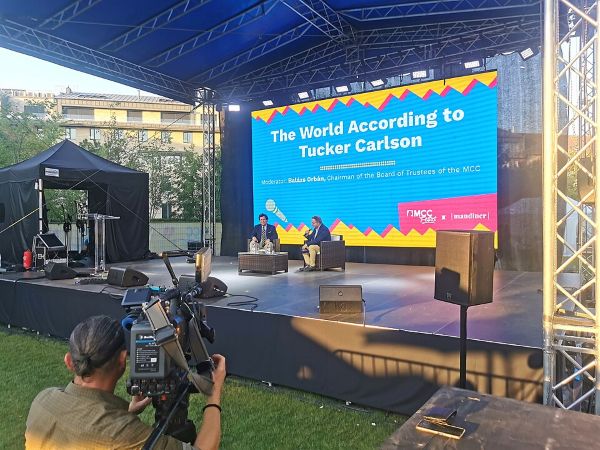
Péter Magyar, leader of Hungary’s Tisza party and a prominent opposition figure poised to challenge for the Prime Ministership, announced on April 14 that his future government would terminate funding for the Conservative Political Action Conference (CPAC) Hungary event and the Mathias Corvinus College (MCC). Magyar cited concerns that such funding under Viktor Orbán’s administration may violate Hungarian laws prohibiting the mixing of party funding with public expenditure.
The announcement has sent ripples through Hungary’s political landscape and into neighboring Romania, where MCC maintains a significant presence among ethnic Hungarian communities. According to reports from G4Media and Radio Târgu Mureș, Magyar’s declaration represents a direct challenge to one of the key instruments of Orbán’s cultural and ideological influence in the region.
Magyar’s rise in Hungarian politics has been meteoric. Once a member of Orbán’s inner circle, he has emerged as the Prime Minister’s most formidable challenger after breaking ranks with the ruling Fidesz party earlier this year. His Tisza party has rapidly gained support by positioning itself as a moderate alternative to Orbán’s increasingly authoritarian governance.
The controversy surrounding MCC has deepened following revelations from Zalán Alkonyi, a researcher and historian at the institution in Budapest. Alkonyi disclosed that he faced considerable pressure to produce pro-Fidesz propaganda during the final months of Hungary’s electoral campaign, raising questions about MCC’s role as an academic institution versus a political instrument.
Further concerns emerged after an investigation by the Hungarian news portal HVG uncovered connections between Moscow’s influence networks and foreign experts employed by MCC. These findings have intensified scrutiny of the organization’s funding and objectives, particularly in light of Orbán’s well-documented friendly relations with Russian President Vladimir Putin.
In Romania, MCC has established a significant footprint through the Mathias Corvinus Collegium Foundation in Cluj-Napoca. The organization has strategically expanded into cities with substantial ethnic Hungarian populations, including Târgu Mureș and Sfântu Gheorghe. Officially, MCC offers extracurricular programs focusing on leadership, economics, and international relations for talented students.
However, critics argue that MCC’s true purpose extends beyond education. Many see it as an instrument designed to cultivate a new intellectual elite in Transylvania loyal to Fidesz ideology, promoting sovereignist views and skepticism toward the European Union. A 2025 investigation by Romanian education portal Edupedu.ro concluded that MCC’s activities operate outside Romania’s national education framework.
The foundation has also made significant property investments, including acquiring the historic Melody Hotel in Cluj-Napoca, which now serves as an educational center. These assets allow MCC to host large events featuring international speakers aligned with Orbán’s political vision.
The funding structure of MCC reveals its close ties to Budapest. The organization receives substantial financial support from Hungarian state resources and companies with strong governmental connections, including oil and gas company MOL and pharmaceutical giant Gedeon Richter. This financial pipeline has enabled MCC to rapidly expand its influence throughout Transylvania’s Hungarian communities.
Magyar’s pledge to cut funding represents the most serious threat to MCC’s operations since its inception. If implemented, such a policy could significantly reduce Hungary’s soft power projection into Romania and potentially reshape political dynamics among ethnic Hungarian communities there.
The controversy highlights broader tensions in Central and Eastern Europe regarding foreign influence, education policy, and minority rights. It also underscores the increasingly interconnected nature of Hungarian and Romanian politics where ethnic Hungarian communities are concerned.
As Magyar continues his challenge to Orbán’s leadership, the future of organizations like MCC remains uncertain, with potentially far-reaching implications for Hungary’s political landscape and its relationships with neighboring countries.
Fact Checker
Verify the accuracy of this article using The Disinformation Commission analysis and real-time sources.

18 Comments
This is a high-stakes move by the opposition leader in Hungary. Shutting down Mathias Corvinus College, which has been accused of spreading Fidesz propaganda, could have far-reaching effects on the political and educational landscape. It will be crucial to ensure that any replacement institutions maintain academic integrity and independence.
Absolutely. Preserving the independence and impartiality of educational institutions should be a top priority, regardless of political affiliations.
The allegations against Mathias Corvinus College are concerning, and the opposition leader’s pledge to shut it down is a bold step. However, the potential impact on academic freedom and the broader educational system in Hungary will need to be carefully considered. Striking the right balance between addressing political bias and maintaining a vibrant, diverse educational landscape will be crucial.
You make a thoughtful point. This is a complex issue that requires a nuanced approach to ensure the integrity of Hungary’s educational system.
The decision to shut down Mathias Corvinus College is a significant step in the opposition’s efforts to address perceived political interference in Hungarian education. While the allegations of Fidesz propaganda are concerning, the long-term consequences of this move will need to be closely monitored.
You make a valid point. The long-term implications of this decision, both positive and negative, will be important to understand as it unfolds.
The decision to shut down Mathias Corvinus College is a bold move by the opposition leader. It demonstrates a commitment to tackling perceived political influence and propaganda within educational institutions. However, the long-term effects remain to be seen.
You raise a fair point. While the move may be well-intentioned, the implications could be complex. It will be important to monitor the aftermath closely.
This is a fascinating development in the Hungarian political landscape. The allegations of Fidesz propaganda at Mathias Corvinus College are serious, and it will be intriguing to see how this plays out if the opposition leader follows through on his pledge. Transparency and accountability will be key.
I share your interest in how this situation unfolds. The potential impact on Hungarian politics and education could be significant.
This is an interesting development in the ongoing political struggle in Hungary. The allegations against Mathias Corvinus College are serious, and the opposition leader’s pledge to shut it down is a bold move. However, the potential impacts on academic freedom and the broader educational landscape will need to be weighed carefully.
I agree that the potential impacts on academic freedom are an important consideration here. Striking the right balance between addressing political bias and preserving the integrity of educational institutions will be crucial.
The decision to close Mathias Corvinus College is a complex one. While the allegations of political bias are concerning, the long-term implications of such a move will need to be carefully considered. Maintaining a diverse and vibrant educational landscape is important.
That’s a fair point. The potential unintended consequences of this decision should not be overlooked. A measured and thoughtful approach will be important.
Shutting down Mathias Corvinus College is a bold move, but one that seems justified given the concerns over its alleged role in spreading Fidesz propaganda. It will be important to ensure that any replacement institutions maintain academic integrity and political neutrality.
Absolutely. Ensuring the independence and impartiality of educational institutions is crucial for a healthy democracy.
This is a significant development in Hungarian politics. The closure of Mathias Corvinus College, which has been accused of spreading Fidesz propaganda, could have far-reaching implications. It will be interesting to see how this plays out and what the long-term impact is on the political landscape.
I agree, the college’s alleged role in spreading Fidesz propaganda is concerning. Shutting it down could help address issues of political bias and manipulation.