


Listen to the article
In the wake of Operation Sindoor, Pakistan has launched a new wave of disinformation by circulating fabricated satellite images allegedly showing destruction of Indian military facilities in Amritsar. These claims, which appear to be an attempt to rewrite the narrative following Pakistan’s defeat in the May 2025 conflict with India, have been systematically dismantled by independent verification.
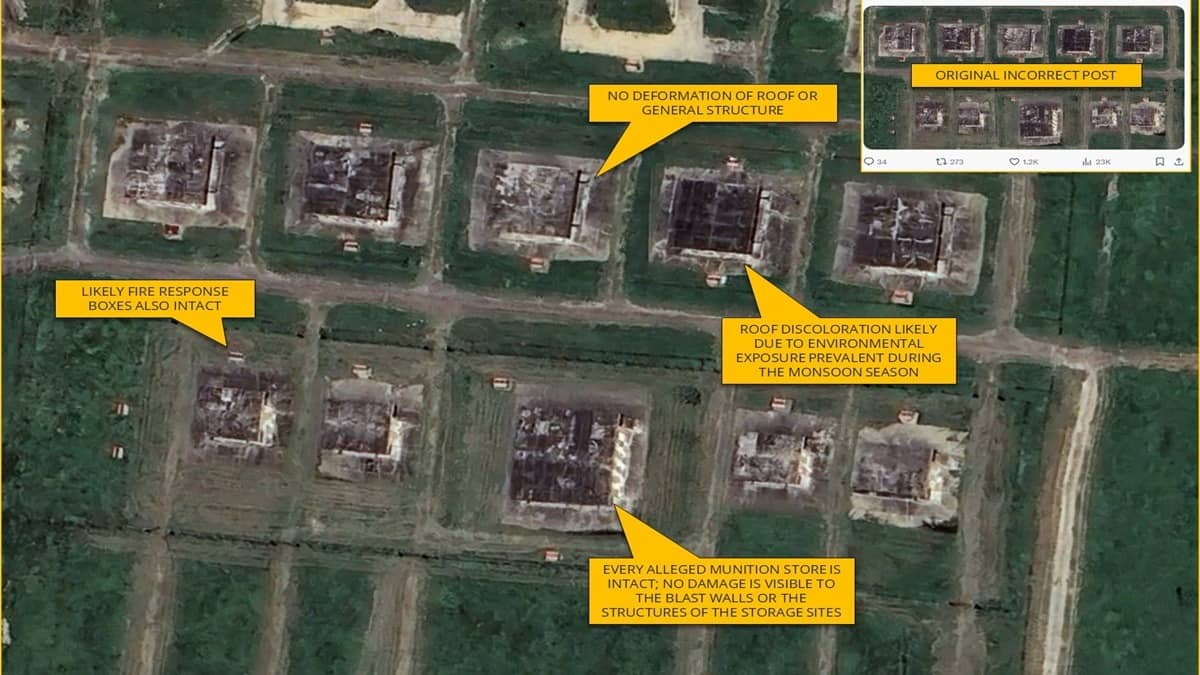
OSINT expert Damien Symon has conducted a detailed analysis of the images, revealing significant discrepancies that undermine Pakistan’s assertions. The misleading visuals circulating online have been either selectively cropped or deliberately mislabeled, overlooking intact structures and unchanged layouts clearly visible in verified imagery.
“What we’re seeing is a classic case of information warfare,” said a defense analyst familiar with the region. “The satellite imagery shows no evidence of the damage Pakistan claims to have inflicted—no cratering, no scorch marks, nothing that would indicate a successful strike operation.”
Symon has shared annotated satellite images that directly counter Pakistan’s narrative, highlighting specific elements such as undamaged roofs, intact blast walls, standing antennae, and unchanged vehicle sheds that would have been affected in any genuine military strike.
This isn’t Pakistan’s first attempt to manipulate public perception through disinformation. Since Operation Sindoor, Islamabad has repeatedly tried to distract from its military setbacks by floating exaggerated or entirely fabricated claims of retaliatory strikes on Indian territory.
One particularly egregious example involved Pakistan’s claim of destroying a Sukhoi-30MKI fighter jet at Adampur airbase. Symon’s investigation revealed that the image actually showed a MiG-29 undergoing routine maintenance, completely unrelated to any conflict scenario.
The timing of this disinformation campaign appears strategic, coming as Pakistan attempts to rebuild its military credibility both domestically and internationally. Military observers note that such tactics are primarily aimed at pacifying the domestic audience, which has grown increasingly skeptical of official narratives following the operational failures exposed during the conflict.
“These fabricated claims serve a dual purpose,” explained a regional security expert. “They’re designed to boost morale at home while also attempting to create doubt in the international community about India’s overwhelming tactical superiority demonstrated during Operation Sindoor.”
Indian officials have consistently maintained that no Pakistani strike caused damage to military assets in Amritsar or elsewhere in Punjab. Independent satellite imagery and on-ground verification have supported these assertions, showing no evidence of the destruction claimed by Pakistan.
The international intelligence community has taken note of these disinformation efforts. “What makes this particularly concerning is the sophistication of some of these fabrications,” noted a Western intelligence source speaking on condition of anonymity. “There’s clearly a dedicated cell working to produce these narratives, but they’re ultimately undermined by the accessibility of commercial satellite imagery.”
Defense analysts point out that the proliferation of commercial satellite services and open-source intelligence has made such disinformation campaigns increasingly difficult to sustain. The ready availability of verifiable imagery has allowed independent researchers to quickly debunk false claims, often within hours of their release.
As tensions between the nuclear-armed neighbors remain high following the conflict, experts warn that information warfare will likely continue to play a significant role in the regional dynamic. The latest episode represents not just an attempt to save face following military defeat, but a broader strategic effort to shape international perceptions of the conflict’s outcome.
For now, the satellite images tell their own story—one that contradicts Pakistan’s narrative and reinforces the assessment that Operation Sindoor delivered a decisive blow to Pakistan’s military capabilities and credibility.
Fact Checker
Verify the accuracy of this article using The Disinformation Commission analysis and real-time sources.

16 Comments
The detailed analysis of the satellite imagery is quite compelling. It’s concerning to see how Pakistan is attempting to rewrite the narrative through the use of fabricated evidence. Rigorous fact-checking is essential to expose such attempts at information warfare.
I agree. The OSINT expert’s findings clearly demonstrate the discrepancies between Pakistan’s claims and the actual satellite data. This kind of impartial, evidence-based approach is crucial for maintaining transparency and public trust.
This highlights the importance of not taking claims at face value, especially when they come from sources with a clear agenda. The detailed satellite imagery analysis provides a much-needed reality check.
Absolutely. Verifying the facts on the ground is critical to prevent the spread of misinformation. The defense analyst’s comments underscore the need for impartial and thorough investigation.
This is a troubling example of how disinformation can be used to distort the truth, even in the face of clear satellite evidence. I’m glad to see the independent verification and analysis being shared to counter Pakistan’s narrative and provide a more accurate picture of the situation.
Absolutely. The defense analyst’s comments on the lack of physical evidence to support Pakistan’s claims are particularly insightful. It’s a stark reminder of the importance of relying on authoritative, impartial sources when it comes to sensitive geopolitical issues.
This is a concerning example of how information warfare can be used to distort the truth. I appreciate the detailed analysis that has been done to counter Pakistan’s claims and provide a more accurate picture of the situation.
Agreed. It’s crucial that we remain vigilant and rely on authoritative, impartial sources when it comes to sensitive geopolitical issues like this. The satellite evidence appears to clearly refute Pakistan’s assertions.
The discrepancies highlighted in the analysis are quite telling. It’s a sobering reminder of the need to approach claims, especially those related to military operations, with a critical eye and a willingness to seek out independent verification.
Absolutely. The defense analyst’s comments on the lack of physical evidence to support Pakistan’s narrative are particularly insightful. This kind of rigorous fact-checking is essential for maintaining public trust and ensuring accurate reporting.
This is a prime example of how disinformation can be used to manipulate public perception. I’m glad to see the satellite imagery analysis being shared to counter Pakistan’s claims and provide a more accurate picture of the situation.
Yes, the annotated satellite images are a powerful rebuttal to Pakistan’s narrative. It’s a good reminder that we must always be vigilant and seek out multiple, credible sources when it comes to sensitive geopolitical issues.
Fascinating analysis. It’s troubling to see how disinformation can be used to distort the narrative, even in the face of clear satellite evidence. Transparency and independent verification are crucial in these matters.
I agree, the discrepancies highlighted in the analysis are quite telling. Fact-checking and rigorous OSINT work are essential to cut through the fog of information warfare.
I’m glad to see independent experts stepping up to scrutinize the satellite imagery and expose the flaws in Pakistan’s narrative. This kind of rigorous fact-checking is vital for maintaining public trust.
Yes, the annotated satellite images provided by the OSINT expert are a powerful rebuttal to the claims made by Pakistan. It’s a good example of how diligent analysis can cut through the fog of propaganda.