


Listen to the article
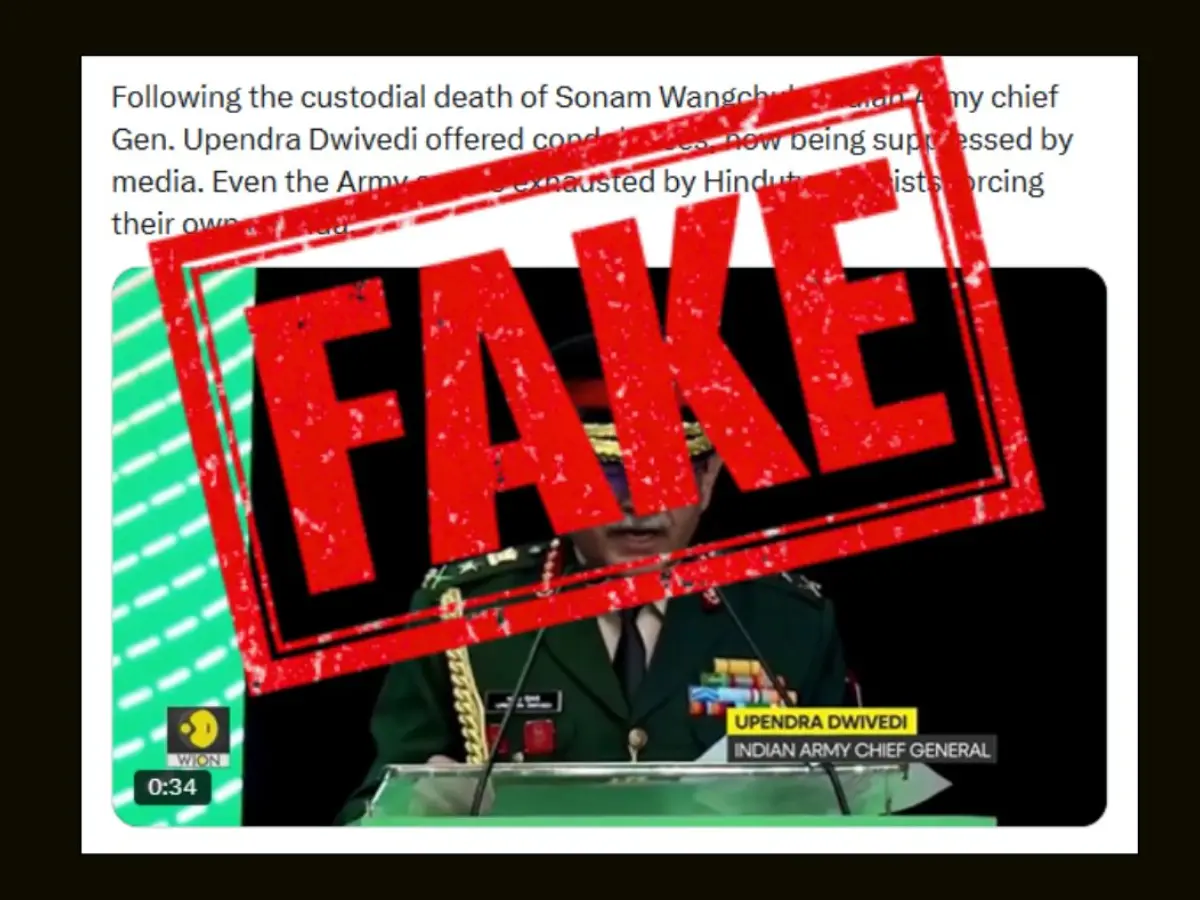
Pakistani propaganda accounts have circulated a manipulated AI-generated video falsely attributed to Indian Army Chief General Upendra Dwivedi, according to an official government fact-check. The fabricated clip, designed to mimic news channel WION’s format, contained manufactured statements regarding activist Sonam Wangchuk.
The Press Information Bureau (PIB) of India has issued a clear warning about the video, confirming it to be entirely fabricated. The fake news segment attempted to spread misinformation about General Dwivedi making comments on what was falsely described as Wangchuk’s “death”—a claim that is demonstrably false as the Ladakh-based engineer and environmentalist is alive.
“This AI-generated video circulating on social media is completely FAKE,” the PIB stated in its verification notice. “Indian Army Chief General Upendra Dwivedi has made NO such statement regarding activist Sonam Wangchuk.”
WION, the legitimate news channel whose visual identity was appropriated in the fake clip, had already flagged the video as fraudulent prior to the government’s official response. The broadcaster has emphasized that it never produced or aired any such content, underscoring the sophisticated nature of this disinformation attempt.
This incident highlights the growing sophistication of AI-generated deepfakes and their potential for exploitation in international propaganda campaigns. Security experts note that the video represents a concerning escalation in information warfare tactics between India and Pakistan, with state-backed actors increasingly turning to artificial intelligence to create convincing but entirely fictional content.
The timing of this fabricated video is particularly notable as it coincides with increased tensions along the Line of Control and ongoing discussions about the status of Ladakh. Sonam Wangchuk, the activist falsely referenced in the video, has been a prominent voice advocating for environmental protection and constitutional safeguards for Ladakh under the Sixth Schedule.
Cybersecurity analysts point out that the video demonstrates advanced manipulation techniques, including realistic voice cloning and visual synchronization designed to mimic authentic broadcast news. These technologies have become increasingly accessible to both state and non-state actors, raising concerns about their potential impact on regional stability and public perception.
Indian defense ministry sources, speaking on condition of anonymity, noted that such disinformation campaigns are consistent with ongoing efforts to sow discord and create confusion regarding India’s military leadership and internal affairs. The targeting of both a high-ranking military official and a respected civil society activist represents a calculated attempt to undermine public trust in multiple institutions simultaneously.
Social media platforms have struggled to contain the spread of the doctored content, despite policies against manipulated media. The video had already accumulated significant viewership before being flagged for removal, demonstrating the challenges in real-time content moderation for sophisticated AI-generated material.
Digital rights advocates have pointed to this incident as further evidence for the urgent need to develop better detection systems and regulatory frameworks for synthetic media. They emphasize that traditional media literacy approaches may be insufficient against increasingly convincing AI-generated content.
The Indian Army has maintained its standard protocol of not directly responding to propaganda materials but has worked through official channels like the PIB to ensure correct information reaches the public.
As tensions continue across the region, security observers expect similar disinformation attempts to increase in both frequency and sophistication. Government officials have urged citizens to verify information through official channels and remain vigilant against manipulated content designed to inflame tensions or undermine national security.
This incident serves as a reminder of the evolving nature of information warfare in the digital age, where battlefield confrontations are increasingly complemented by sophisticated psychological operations conducted through social media and manipulated content.
Fact Checker
Verify the accuracy of this article using The Disinformation Commission analysis and real-time sources.

4 Comments
Propaganda campaigns that leverage AI to create manipulated content are a growing challenge. This underscores the importance of media literacy and critical thinking when consuming news, especially on sensitive geopolitical issues.
This is a concerning case of propaganda and misinformation. Using AI to fabricate false statements and attribute them to public figures is a disturbing tactic. I’m glad the government and legitimate media outlets quickly debunked this fake video.
It’s troubling to see how easily disinformation can spread online, especially when it’s made to look like credible news. I appreciate the official fact-checking and hope this serves as a reminder to always verify information from reliable sources.
This is a concerning example of how sophisticated propaganda can become with the use of advanced technologies like AI. I’m glad to see the prompt response from the authorities to address this specific instance of fabricated content.