


Listen to the article
Indian and Pakistani Officials Share Brief Encounter at Bangladesh Funeral Amid Diplomatic Tensions
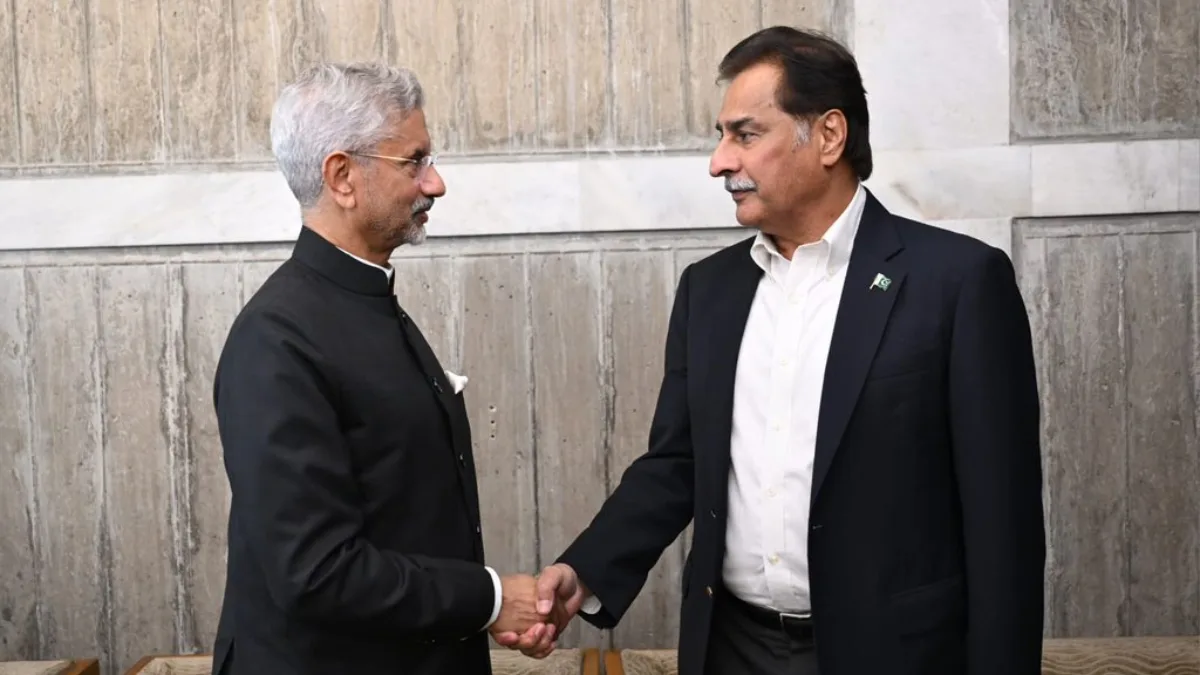
External Affairs Minister S. Jaishankar and Pakistan National Assembly Speaker Sardar Ayaz Sadiq exchanged greetings in Dhaka on Wednesday ahead of former Bangladeshi Prime Minister Khaleda Zia’s funeral, marking a rare high-level interaction between the two neighboring countries amid strained relations.
The brief meeting was captured in a photograph shared on social media by Bangladesh’s Chief Advisor Muhammad Yunus. “Sardar Ayaz Sadiq, Speaker of the National Assembly of Pakistan, exchanges greetings with Indian External Affairs Minister S Jaishankar in Dhaka on Wednesday ahead of the funeral programme of former Bangladesh Prime Minister Khaleda Zia,” read the post on X (formerly Twitter).
Diplomatic sources described the interaction as merely a courtesy exchange, reflecting the current frosty state of India-Pakistan relations. Notably, neither India’s Ministry of External Affairs nor Jaishankar himself mentioned the encounter on their official communication channels, underscoring its limited diplomatic significance.
Pakistan’s response to the meeting, however, diverged significantly from India’s restrained approach. The Pakistani National Assembly Secretariat issued a press release claiming that Jaishankar had initiated the interaction. According to Pakistan’s Dawn newspaper, the Secretariat’s statement emphasized Pakistan’s commitment to “dialogue, restraint and cooperative measures” including proposals for peace talks and joint investigations to prevent “unprovoked aggression and escalation.”
The contrasting interpretations of this brief exchange highlight the deep divisions that continue to define the relationship between the nuclear-armed neighbors.
Relations between India and Pakistan have deteriorated dramatically since the April 2023 Pahalgam terror attack in Jammu and Kashmir, which claimed 26 lives. India responded with “Operation Sindoor,” a military action against Pakistan that pushed bilateral relations to what many analysts describe as their lowest point in recent history.
India has maintained its longstanding position that meaningful dialogue cannot coexist with terrorism, insisting that Pakistan must stop supporting terrorist activities in India, particularly regarding Kashmir, before relations can be normalized. Following Operation Sindoor, India has further refined its stance, making it clear that any terrorist attack emanating from Pakistan will trigger a military response.
India’s approach to countering Pakistan has evolved into a multi-faceted strategy. Beyond military responses, India has implemented diplomatic isolation, scaled back engagement, suspended the landmark Indus Waters Treaty, and restricted cross-border trade—measures designed to pressure Pakistan economically and politically.
The Jaishankar-Sadiq handshake occurred against this complex backdrop, with both countries navigating the regional diplomatic stage while maintaining their respective positions. India attended Khaleda Zia’s funeral as part of its neighborhood diplomacy efforts, while Pakistan similarly sent a high-level representative to the former Bangladeshi leader’s ceremony.
The incident has not escaped domestic political attention in India. The opposition Congress party criticized Jaishankar for the interaction, highlighting the sensitivity of any engagement with Pakistan in India’s current political climate.
As both nations continue to participate in regional forums and diplomatic events, such incidental meetings may occur, but substantial dialogue remains unlikely without significant shifts in Pakistan’s approach to cross-border terrorism or India’s security calculus.
The brief Dhaka encounter thus serves as a reminder of the diplomatic tightrope both nations walk—maintaining minimal protocol-based interactions at international forums while adhering to their hardened positions on bilateral issues that continue to divide the South Asian neighbors.
Fact Checker
Verify the accuracy of this article using The Disinformation Commission analysis and real-time sources.

12 Comments
The Pakistani government’s attempt to spin this routine diplomatic courtesy into some kind of major event is quite transparent. Seems like an effort to distract from more pressing domestic issues.
Agreed, the Pakistani response appears to be more about propaganda than substance. Elevating a minor encounter for political gain is concerning.
This encounter highlights the fragility of India-Pakistan relations. Even small gestures can be seized upon and twisted for political gain. Maintaining stability requires nuance and restraint.
Exactly. The two countries must exercise caution to prevent minor incidents from escalating. Constructive dialogue, not grandstanding, is the path forward.
Interesting to see the diplomatic interaction between Indian and Pakistani officials, even if just a brief courtesy exchange. Speaks to the complex relationship between the two neighbors.
Certainly a notable encounter, though likely more symbolic than substantive given the ongoing tensions between the countries.
While the meeting itself may have been unremarkable, Pakistan’s attempt to use it for propaganda purposes is concerning. Stoking tensions rarely leads to constructive outcomes.
Agreed. Responsible diplomacy and open communication, rather than inflammatory rhetoric, are needed to address the longstanding issues between India and Pakistan.
It’s understandable that both sides would want to portray this encounter in a way that aligns with their respective geopolitical narratives. Objective analysis is key to understanding the true significance.
Absolutely. Cutting through the political spin and examining the facts objectively is important to gain a clear picture of the dynamics at play.
This brief meeting highlights the delicate balance India and Pakistan must navigate, even on seemingly routine diplomatic occasions. Careful diplomacy is needed to avoid escalation.
Indeed, the two countries’ fraught relationship means even small interactions require nuanced handling. Avoiding misunderstandings is crucial.