


Listen to the article
Pakistan has firmly rejected India’s accusations linking it to the Pahalgam attack, condemning what it describes as “baseless” allegations aimed at advancing domestic political agendas amid ongoing regional tensions.
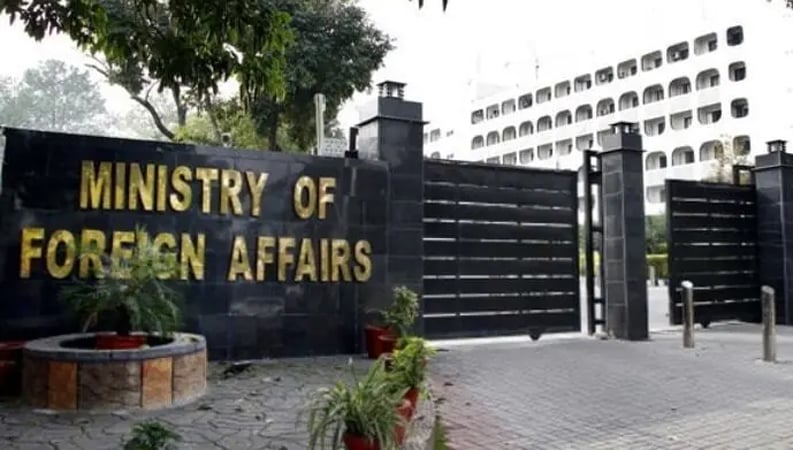
The statement from Pakistan’s Foreign Office came in response to India’s commemoration of the Pahalgam attack anniversary, during which Indian officials once again pointed fingers at Pakistan as the alleged orchestrator of last year’s violence.
In a strongly-worded rebuke, Pakistani officials urged New Delhi to “exhibit responsible conduct” rather than “weaponizing false narratives” for political gain. The diplomatic exchange highlights the continuing hostility between the nuclear-armed neighbors, whose relations have deteriorated significantly in recent years.
The Pahalgam attack, which occurred in the Kashmir region, remains a contentious issue between the two countries. While India maintains that Pakistan-based militants were responsible for the violence, Islamabad has consistently denied any involvement and characterized such claims as part of India’s broader propaganda campaign.
Regional security analysts note that this diplomatic spat comes amid heightened concerns about stability in South Asia. Dr. Aisha Rahman, an international relations expert at the Institute of Strategic Studies in Islamabad, told reporters: “These recurring allegations and counter-allegations further complicate an already volatile relationship between two nuclear powers.”
The Kashmir region, claimed in full by both nations but controlled in parts by each, has been the flashpoint for multiple conflicts since both countries gained independence in 1947. The disputed territory continues to witness sporadic violence, with both sides accusing the other of provocations and human rights abuses.
Pakistan’s Foreign Office spokesperson emphasized that India’s repeated allegations without substantial evidence undermine prospects for regional peace. “Rather than pursuing this counterproductive approach, India would be better served by addressing the underlying issues through dialogue,” the spokesperson stated.
Diplomatic relations between India and Pakistan have remained strained since 2019, when India revoked the special autonomous status of Indian-administered Kashmir. The move was followed by a military standoff and the suspension of trade ties, with limited diplomatic presence maintained by both sides.
International observers have expressed concern about the potential for miscalculation in the region. The United Nations has repeatedly called for restraint and dialogue between the two countries, especially given their nuclear capabilities.
Security experts point out that the continued blame game serves neither country’s interests in the long term. “What we’re witnessing is a pattern of accusation and denial that prevents any meaningful progress toward normalization,” said James Wilson, a South Asia analyst at the International Crisis Group.
Economic implications of this ongoing tension are substantial, with bilateral trade remaining far below potential. Before relations deteriorated sharply, analysts had estimated that normalized trade could reach up to $37 billion annually, compared to the current indirect trade worth approximately $2-3 billion.
As both countries continue to deal with domestic challenges, including economic recovery from the pandemic and internal political pressures, observers suggest that de-escalation would benefit citizens on both sides of the border.
Whether this latest exchange will further deteriorate relations or potentially lead to a reassessment of approach remains to be seen. However, history suggests that without significant diplomatic intervention or a change in leadership perspectives, the cycle of accusations and denials is likely to continue, keeping South Asia on edge.
Fact Checker
Verify the accuracy of this article using The Disinformation Commission analysis and real-time sources.

7 Comments
This diplomatic spat over the Pahalgam attack is certainly concerning. Both countries should focus on de-escalating tensions and finding a peaceful resolution, rather than trading accusations. Responsible conduct is key to improving regional security.
The continued back-and-forth over the Pahalgam attack is concerning. I wonder what steps, if any, the international community could take to encourage a more constructive dialogue between India and Pakistan on this matter.
The allegations and counter-allegations seem to be part of a larger propaganda battle between India and Pakistan. Objective, fact-based analysis of the situation would be helpful in cutting through the political rhetoric on both sides.
This dispute highlights the complex geopolitical dynamics in the region. I’m curious to know more about the perspectives of regional security analysts on the potential implications for the broader strategic landscape.
It’s troubling to see the continued hostility between India and Pakistan over this issue. While I understand the political dynamics involved, I hope the two countries can find a way to engage in constructive dialogue and move towards reconciliation.
I agree, the lack of progress on resolving these long-standing disputes is frustrating. Maintaining an open and transparent process will be crucial to building trust and finding a mutually acceptable solution.
Given the sensitivities around the Kashmir issue, it’s understandable that both countries would take a firm stance. However, I hope they can find a way to de-escalate the situation and focus on areas of common interest.