


Listen to the article
The Olympic Games’ official online shop has sparked controversy by selling t-shirts featuring artwork from the 1936 Berlin Olympics, an event widely recognized as a propaganda platform for Adolf Hitler’s Nazi regime. The merchandise has drawn sharp criticism, particularly from German politicians who argue that such historical imagery should not be commercialized without proper contextual information.
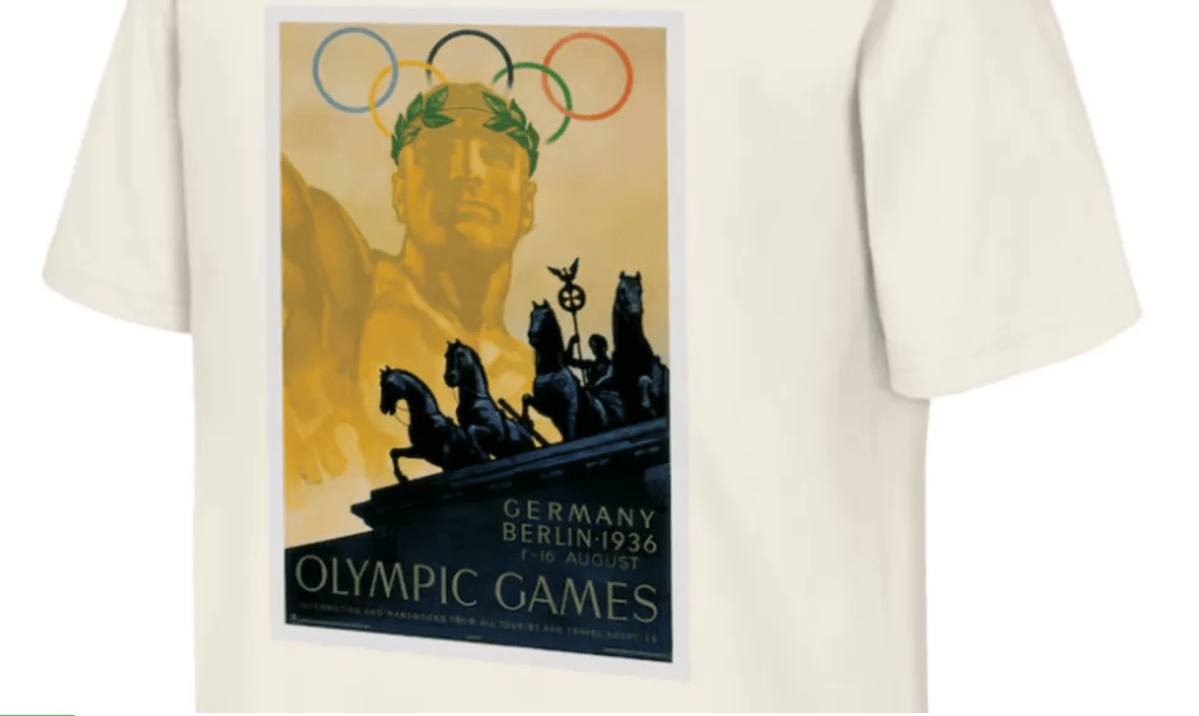
The contested t-shirt displays artwork created for the 1936 Summer Games, depicting a man wearing a laurel wreath alongside the quadriga chariot atop Berlin’s Brandenburg Gate, with the dates and location of the event. The design by Franz Würbel contains no swastikas or direct Nazi references, but critics maintain that the imagery remains inseparable from the Games’ dark historical context.
“The 1936 Olympic Games were a central propaganda tool of the Nazi regime,” said Klara Schedlich, sports policy spokesperson for the Green Party in the Berlin House of Representatives. Speaking to German news agency DPA, Schedlich criticized the International Olympic Committee (IOC) for “clearly not reflecting sufficiently on its own history” and called the merchandising choice “problematic and unsuitable” without appropriate historical explanation.
The historical context surrounding the 1936 Olympics remains significant in Olympic history. Berlin was initially awarded hosting rights in 1931 when Germany was still under the Weimar Republic. By the time the Games took place, Hitler’s Nazi government had seized power and leveraged the international event to showcase Nazi Germany to the world, promoting its ideology of Aryan racial superiority.
The IOC has defended the merchandise as part of its Olympic Heritage Collection, which showcases designs spanning the Games’ 130-year history. In a statement to Newsweek, an IOC spokesperson acknowledged the historical issues regarding Nazi propaganda at the 1936 Games but emphasized that the event also featured 4,483 athletes from 49 countries competing in 149 medal events.
“Many of them stunned the world with their athletic achievements, including Jesse Owens,” the IOC statement noted. “The historical context of these Games is further explained at the Olympic Museum in Lausanne.” The committee also mentioned that the t-shirts were produced in limited quantities and are currently sold out.
Indeed, the 1936 Berlin Olympics are perhaps best remembered for African American athlete Jesse Owens, who won four gold medals—three individual and one in the 4×100-meter relay. Owens and his teammates captured 12 men’s track-and-field gold medals, achievements widely interpreted as a powerful rebuke to Hitler’s claims of Aryan supremacy. Nazi press at the time derogatorily referred to African American athletes as “black auxiliaries.”
Newsweek has reported that the controversial t-shirt is no longer available on the Olympic shop website, though the IOC did not explicitly state whether this was a response to the criticism or simply due to the limited production run selling out.
The controversy emerges during the 2026 Winter Olympics in Italy, which has faced controversies of its own. Most recently, Ukrainian skeleton racer Vladyslav Heraskevych was barred from competition for planning to race wearing a helmet featuring artwork honoring Ukrainian athletes killed during Russia’s ongoing invasion. The IOC ruled that the design violated the Olympic Charter, notifying Heraskevych two days before his event that he could not compete while wearing it.
This merchandising debate highlights the ongoing tension between celebrating Olympic heritage and acknowledging the Games’ complex historical contexts, particularly when events have been intertwined with problematic political regimes. For the IOC, balancing commercial interests with historical sensitivity continues to present challenges, especially regarding Olympics that took place during contentious periods in world history.
Fact Checker
Verify the accuracy of this article using The Disinformation Commission analysis and real-time sources.

14 Comments
Commodifying Nazi-era iconography, even unintentionally, is extremely troubling. The IOC needs to implement robust historical and ethical review processes to prevent such insensitive marketing decisions in the future.
This is a concerning issue. While the Olympics should celebrate unity, using imagery from the Nazi-hosted 1936 games raises serious ethical questions. The IOC needs to carefully evaluate how it handles historical artifacts and ensure appropriate context is provided.
I agree, the IOC must address this responsibly. Thoughtless commercialization of such a fraught period risks trivializing history and causing further offense.
This incident highlights the need for the IOC to take a more proactive, thoughtful approach to its branding and merchandising. Prioritizing profits over principles risks damaging the Olympic brand and alienating many fans and supporters.
Agreed. The IOC must demonstrate a genuine commitment to the Olympic ideals of sportsmanship, fair play, and human dignity, which this merchandise clearly fails to uphold.
Profiting off Nazi-era branding, even indirectly, is extremely problematic. The IOC should immediately remove these t-shirts and review its merchandise policies to prevent any future incidents that could be seen as glorifying fascism.
While historical commemoration can serve an educational purpose, the IOC seems to have misjudged public sentiment on this. Sanitizing the 1936 Olympics’ Nazi links through mass-market apparel is a tone-deaf move that requires a prompt, sincere apology.
Agreed. The IOC must demonstrate a deeper understanding of the sensitivities involved and take concrete steps to rebuild trust with the public.
This is a regrettable lapse in judgment by the IOC. The Olympics should be a celebration of unity, not a platform for propagating the aesthetics of authoritarian ideologies, no matter how tangential. I hope they learn from this incident and implement more rigorous ethical guidelines going forward.
Absolutely. The IOC has a responsibility to uphold the Olympic values of sportsmanship, fair play, and human rights. This merchandise choice undermines those principles and requires a swift, sincere response.
The Olympic movement should stand for human rights, not fascism. I hope the IOC takes this as a learning opportunity to strengthen its ethical standards and better honor the spirit of the games, which is meant to unite people, not divide them.
Well said. The IOC must demonstrate a clear and principled stance against the use of any imagery associated with totalitarian regimes, no matter how tangential.
This is a disappointing lapse in judgment by the IOC. While artistic works from that era may have inherent historical value, selling them on commercial merchandise without proper context is unwise and risks normalizing the Nazi regime’s propaganda efforts.
While historical accuracy is important, the IOC should exercise extreme caution when using imagery associated with fascist regimes, even if indirectly. The Olympic movement must distance itself from any symbols or branding that could be seen as glorifying totalitarianism.