


Listen to the article
North Korea celebrated its third women’s youth football World Cup victory in just over a year, using the sporting triumph to bolster claims about the nation’s political system and global standing.
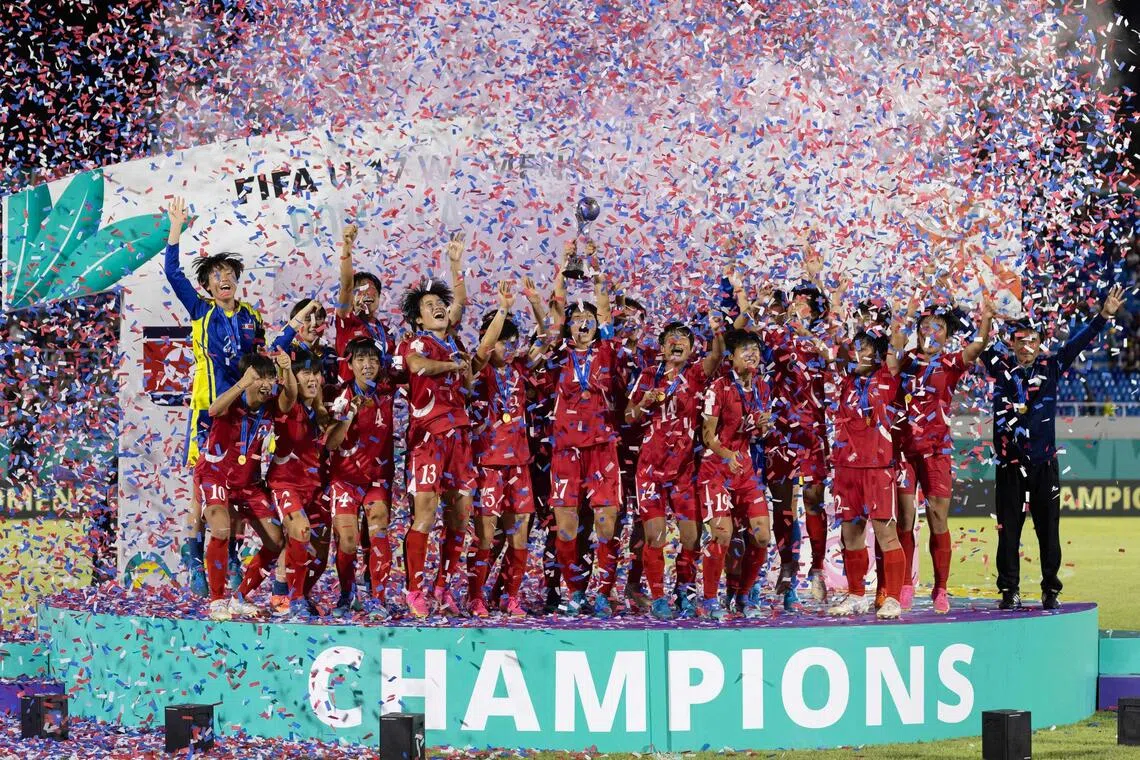
The national team secured a commanding 3-0 victory over the Netherlands in Morocco on November 8, clinching their second consecutive FIFA U-17 Women’s World Cup title and fourth overall. This back-to-back achievement follows North Korea’s victory at the U-20 Women’s World Cup in September 2024, establishing the country as a dominant force in women’s youth football.
The North Korean squad displayed remarkable prowess throughout the tournament in Morocco, setting a record with 25 goals scored while conceding only three. Their perfect seven-match winning streak culminated in the comprehensive defeat of the Netherlands in the final.
State propaganda machinery quickly capitalized on the victory, with the Rodong Sinmun newspaper prominently featuring coverage from the state news agency KCNA on its front page. “Our players ran across the pitch waving the dignified flag of our republic with pride,” the publication proclaimed, framing the win as bringing “joy to our beloved motherland.”
For the nuclear-armed but economically isolated nation, these sporting achievements serve a crucial political purpose. KCNA explicitly linked the victory to upcoming political events, describing it as “great encouragement and inspiration to all the people… to host the 9th Party Congress as a victorious and glorious event.” The Congress, held every five years, is North Korea’s highest decision-making gathering, presided over by leader Kim Jong Un.
Hong Min, an analyst at Seoul’s Korea Institute for National Unification, told AFP that celebrations similar to last year’s street parade for the returning U-17 team are expected in Pyongyang. “There is a strong perception that the country is culturally backward and isolated,” Hong explained. “So they will want to use this to project an image that their social and cultural foundations are strong and vibrant.”
The success stems from North Korea’s systematic approach to athletic development. Hong noted that children with athletic potential are identified early for specialized training programs. “The North finds elite athletes at a very young age and pours in deep investment at a state level with an aim to stage them in global competition,” he said. “Players in return feel they must repay such investment with their performances.”
This state-centered approach to developing elite athletes is “commonly seen in socialist countries,” according to Hong, and has yielded particularly strong results in women’s football. While North Korea’s men’s team languishes at 120th in FIFA rankings and hasn’t qualified for a World Cup since 2010, the women’s national team ranks 10th globally. They will be among the favorites at next year’s Women’s Asian Cup in Australia, with only Japan (ranked 8th) having a higher world ranking among the 12 qualified teams.
Lee Jung-woo, a senior lecturer in sports and leisure policy at the University of Edinburgh, highlighted the contrast between North Korea’s approach and Western methods. “In youth football, I think European sport organisations highlight more on having fun,” he told German outlet DW. In North Korea, however, young players “join very highly disciplined, highly systematic and highly professionalised training regimes, so in early ages they can excel.”
The gap in skill levels was evident in the final match. Netherlands U-17 coach Olivier Amelink acknowledged the North Koreans’ superiority, telling FIFA.com: “I don’t think we could have beaten them. I think the gap… is simply too big to compete with them at the moment. They outplayed us throughout the entire match.”
North Korea’s Yu Jong Hyang emerged as the standout player, scoring a tournament-joint-record eight goals to claim both the Golden Boot as top scorer and the Golden Ball as the tournament’s best player.
Midfielder Ri Ui Gyong, who scored the third goal in the final, attributed the success to team cohesion: “Our players played the final match wonderfully. All 25 goals were incredible, and we scored them because our players believed in each other and gave it their all.”
As the team returns home, their success will likely be channeled to reinforce national pride and validate the country’s political system, demonstrating how sports achievement serves broader political objectives in the isolated nation.
Fact Checker
Verify the accuracy of this article using The Disinformation Commission analysis and real-time sources.

7 Comments
An impressive achievement for North Korea, though their propaganda machine is sure to milk this victory for all its worth. Still, the youth team’s performance on the pitch is undeniable – they’ve proven themselves a force to be reckoned with in women’s football.
This win will undoubtedly be used by the North Korean regime to bolster its image both domestically and internationally. While the team’s skill is impressive, it’s important to view this through a critical lens and not get caught up in the nationalist rhetoric.
Agreed. Sporting triumphs can often become political tools, especially in authoritarian states. The players deserve credit for their talent and hard work, but we must be wary of how the regime will exploit this for propaganda purposes.
While the North Korean team’s back-to-back World Cup victories are impressive, it’s concerning to see the regime using this achievement to further its propaganda agenda. The players’ talent is undeniable, but their success should not be used to gloss over the country’s human rights abuses.
Well said. Sports achievements can often become a convenient distraction from a regime’s failings. It’s important to recognize the players’ skill while also maintaining a critical eye on the broader political context.
This latest football victory will undoubtedly be a major propaganda win for the North Korean regime. However, we should be wary of letting the team’s athletic prowess overshadow the systemic human rights abuses and lack of freedoms within the country.
The North Korean women’s youth football team has certainly proven its capabilities on the global stage. However, it’s crucial to maintain perspective and not let the regime’s nationalistic messaging obscure the realities of life for ordinary North Koreans.