


Listen to the article
Norman Rockwell’s family has expressed outrage over what they describe as the Department of Homeland Security’s misappropriation of the iconic American artist’s work to promote anti-immigration messaging.
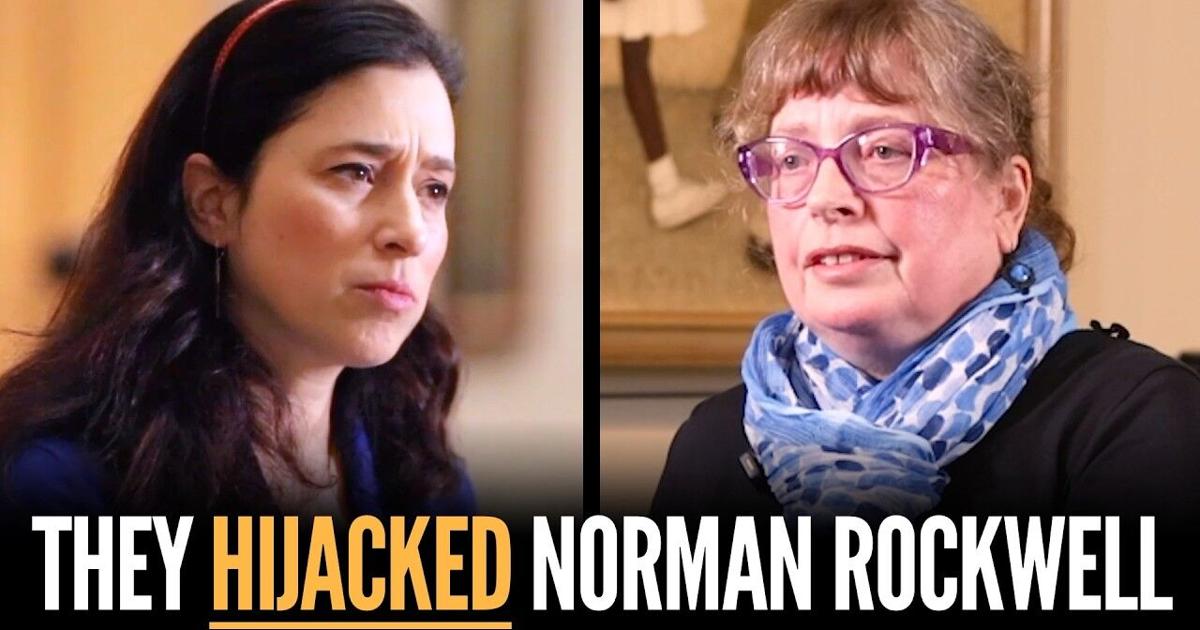
In a recent interview with journalist Catherine Rampell for The Bulwark, Daisy Rockwell, the artist’s granddaughter and an accomplished writer and artist in her own right, condemned the agency’s use of her grandfather’s nostalgic depictions of American life to advance political positions that she says would have been at odds with his personal beliefs.
“My grandfather’s work has been hijacked to promote an agenda he would have opposed,” Daisy Rockwell stated during the interview. She described the use of his imagery as a deliberate attempt to evoke a romanticized version of mid-century America that excludes immigrants and people of color.
Norman Rockwell, who died in 1978, is perhaps America’s most recognizable illustrator, famous for his Saturday Evening Post covers and paintings that captured everyday American scenes with warmth and humor. His works like “Freedom from Want,” depicting a family Thanksgiving dinner, and “The Problem We All Live With,” showing a young Black girl being escorted to school during desegregation, have become cultural touchstones.
According to Daisy Rockwell, her grandfather’s later work reflected his increasingly progressive views on civil rights and social justice. His painting “The Golden Rule,” featuring people of different races and religions alongside the text “Do Unto Others as You Would Have Them Do Unto You,” stands in stark contrast to the exclusionary message she believes DHS is promoting.
The controversy highlights a broader trend of historical American imagery being repurposed in contemporary political discourse. Cultural historians note that Rockwell’s work has been particularly susceptible to political appropriation because of its powerful evocation of American identity and values.
“Rockwell’s America represents a powerful symbol that different groups want to claim,” said Dr. Ellen Shapiro, professor of American Studies at Columbia University. “But we should be careful about projecting today’s politics onto historical figures and their work without proper context.”
The Department of Homeland Security has not responded directly to the Rockwell family’s concerns, though internal documents obtained by The Bulwark suggest the agency has been deliberately using nostalgic Americana in its communications strategy since 2018.
Art historians have noted the irony in using Rockwell’s work to advance restrictive immigration policies. “Rockwell himself was deeply concerned with portraying America as an inclusive, diverse nation,” explained Robert Summers, curator at the Whitney Museum of American Art. “His later work especially shows a commitment to portraying Americans of all backgrounds with dignity.”
The controversy speaks to a larger battle over American identity and who gets to define it. The weaponization of nostalgia—using idealized visions of the past to promote particular political agendas—has become increasingly common across the political spectrum.
For the Rockwell family, the fight is personal. They have worked to preserve what they see as the true legacy of Norman Rockwell: one that embraces compassion, inclusivity, and the complexity of American life.
“My grandfather painted America as he hoped it could be, not as a tool for exclusion,” Daisy Rockwell emphasized. “Using his work to suggest that true Americanism means keeping others out completely misrepresents what he stood for.”
The Norman Rockwell Museum in Stockbridge, Massachusetts, which houses the largest collection of the artist’s original works, has previously issued statements encouraging visitors to consider the full context of Rockwell’s career and evolving social consciousness when interpreting his art.
As America continues to debate immigration policy and national identity, the controversy over Rockwell’s legacy serves as a reminder of how powerful cultural symbols can be leveraged—sometimes against their creators’ intentions—in service of contemporary political battles.
Fact Checker
Verify the accuracy of this article using The Disinformation Commission analysis and real-time sources.

9 Comments
This is a concerning trend of appropriating cultural symbols to advance harmful political agendas. Rockwell’s art celebrated the diversity that makes America strong. Repurposing it for anti-immigrant propaganda is deeply troubling.
Rockwell’s art was about unity, not division. To see his iconic imagery co-opted for anti-immigrant messaging is disheartening. His granddaughter is right to condemn this misuse of his work.
While I can understand the appeal of Rockwell’s nostalgic Americana, his art was never about excluding or demonizing immigrants. Using his work this way goes against the spirit of inclusion and community that defined his artistic vision.
Rockwell’s art was about finding the common threads that unite us as Americans, not dividing us. Using his work to promote anti-immigrant propaganda is a betrayal of the values he championed through his art.
Rockwell’s art captured the warmth and humanity of everyday Americans. Using it to promote anti-immigrant messaging goes against the spirit of his work. His granddaughter is right to condemn this distortion of his legacy.
I agree. Rockwell’s art was about bringing people together, not dividing them. It’s a shame to see his legacy twisted for political gain in this way.
This is a concerning example of how cultural symbols can be twisted to serve political agendas. Rockwell’s art celebrated the diversity of the American experience, not the exclusion of immigrants. His granddaughter is right to speak out against this misuse of his legacy.
Rockwell’s art was about finding the common humanity in all Americans, regardless of background. Using his work to promote exclusion and xenophobia is a perversion of his artistic vision and legacy.
This is a concerning misuse of Norman Rockwell’s iconic artwork. His art celebrated the diversity and inclusivity of American life, not xenophobia. It’s disappointing to see his work co-opted for such divisive political purposes.