


Listen to the article
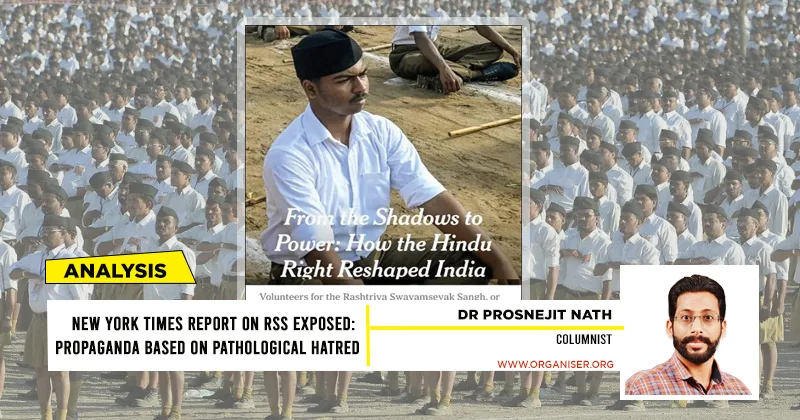
The Indian political landscape witnessed a significant escalation in rhetoric this week as controversy erupted over a New York Times report examining the Rashtriya Swayamsevak Sangh (RSS), one of India’s most influential cultural and social organizations.
The report, which offered a critical analysis of the RSS and its growing influence in Indian politics, has drawn fierce backlash from supporters who claim it misrepresents the organization’s mission and values. Critics of the report argue that the American publication has presented a one-sided narrative that fails to capture the complexities of Indian social dynamics and the RSS’s role within them.
“What we’re seeing is international media applying Western frameworks to uniquely Indian institutions without proper context,” said political analyst Rahul Sharma, who specializes in India’s political movements. “The RSS has evolved significantly since its founding in 1925, but these nuances are often lost in international coverage.”
The RSS, which describes itself as a cultural organization dedicated to uplifting Indian society and preserving Hindu traditions, has long maintained close ties with the Bharatiya Janata Party (BJP), India’s ruling party led by Prime Minister Narendra Modi. This relationship has placed the organization under increased international scrutiny as India’s global prominence rises.
Defenders of the RSS point to its extensive social service network that responds to natural disasters and runs educational initiatives across India. They contend that foreign media outlets often focus exclusively on controversial aspects while ignoring these humanitarian efforts.
“The organization operates over 20,000 service projects nationwide, from schools in remote villages to medical camps in underserved communities,” noted social researcher Meena Patel. “These activities rarely receive attention in international coverage.”
The controversy highlights the growing tension between international media narratives and domestic perspectives on Indian institutions. Media analysts suggest that both Indian and foreign outlets face challenges in providing balanced coverage of politically sensitive topics.
“There’s a fundamental disconnect in how different audiences understand organizations like the RSS,” explained media studies professor Vikram Singh from Delhi University. “What some see as cultural preservation, others view as exclusionary politics. This tension is at the heart of much reporting controversy.”
The dispute also reflects broader concerns about media representation in the age of globalization. Indian media watchdogs have increasingly criticized what they perceive as biased framing in international coverage of India, particularly from Western outlets.
“Every country has complex sociopolitical structures that resist simple categorization,” Singh added. “The challenge for global journalism is to acknowledge these complexities while maintaining critical distance.”
The controversy comes at a time when India’s position on the world stage continues to strengthen, with the country playing increasingly important roles in global economic and diplomatic affairs. As India’s influence expands, scrutiny of its domestic institutions has intensified.
Media literacy experts suggest that readers should seek diverse sources when forming opinions about complex issues. “No single article can capture the full reality of an organization with nearly a century of history,” said communications researcher Anjali Desai. “Critical reading across multiple perspectives remains essential.”
The Indian government has not issued an official response to the New York Times report, though individual BJP officials have criticized it through social media channels.
As India approaches its next general election cycle, observers expect continued debate over how domestic institutions are portrayed both within India and internationally. The controversy underscores the challenges of reporting on deeply embedded cultural and political organizations across different media environments and cultural contexts.
“What’s ultimately at stake here is who gets to shape the narrative about India’s social movements,” concluded political scientist Rajiv Kumar. “These tensions will likely intensify as India continues its rise as a global power.”
Fact Checker
Verify the accuracy of this article using The Disinformation Commission analysis and real-time sources.

5 Comments
The article raises some valid points about the need for greater context and nuance in international coverage of Indian institutions like the RSS. Applying Western frameworks without proper understanding of local dynamics can lead to biased or incomplete narratives.
This controversy highlights the challenges of reporting on complex socio-political movements, especially across cultural divides. While impartiality is important, acknowledging the evolution and diversity within organizations like the RSS is crucial for fair coverage.
As an outsider, I’m interested to learn more about the RSS and its role in Indian society. The article suggests there may be important details and perspectives missing from the international coverage. A more balanced and informed analysis would be valuable.
I’m curious to learn more about the RSS’s mission and values. The article suggests there may be some misrepresentation in how it’s portrayed internationally. It would be good to get a more well-rounded understanding of this influential Indian organization.
This reporting seems overly critical of the RSS. While the organization has had a complex history, it plays an important role in India’s social and cultural landscape. More balanced coverage that captures its evolution and nuances would be helpful.