


Listen to the article
Six months before his assassination in Tehran, Hamas political bureau head Ismail Haniyeh provided a revealing explanation of the October 7 attack’s purpose. Speaking to the International Union of Muslim Scholars in Doha, he admitted that the Palestinian cause had been fading from global attention before the assault, which killed more Jews than any attack since the Holocaust.
“The international community, global decision-making circles no longer invoke the Palestinian cause,” Haniyeh stated. He called for not only a “jihad of the swords” and “financial jihad,” but also a “verbal jihad” to liberate Jerusalem.
This media strategy has become increasingly evident as Hamas cultivated relationships with select Gazan photojournalists who contribute to major international media outlets. The terrorist organization carefully trained young journalists and rewarded those showing loyalty to their narrative, while granting exclusive access to trusted individuals for significant propaganda opportunities.
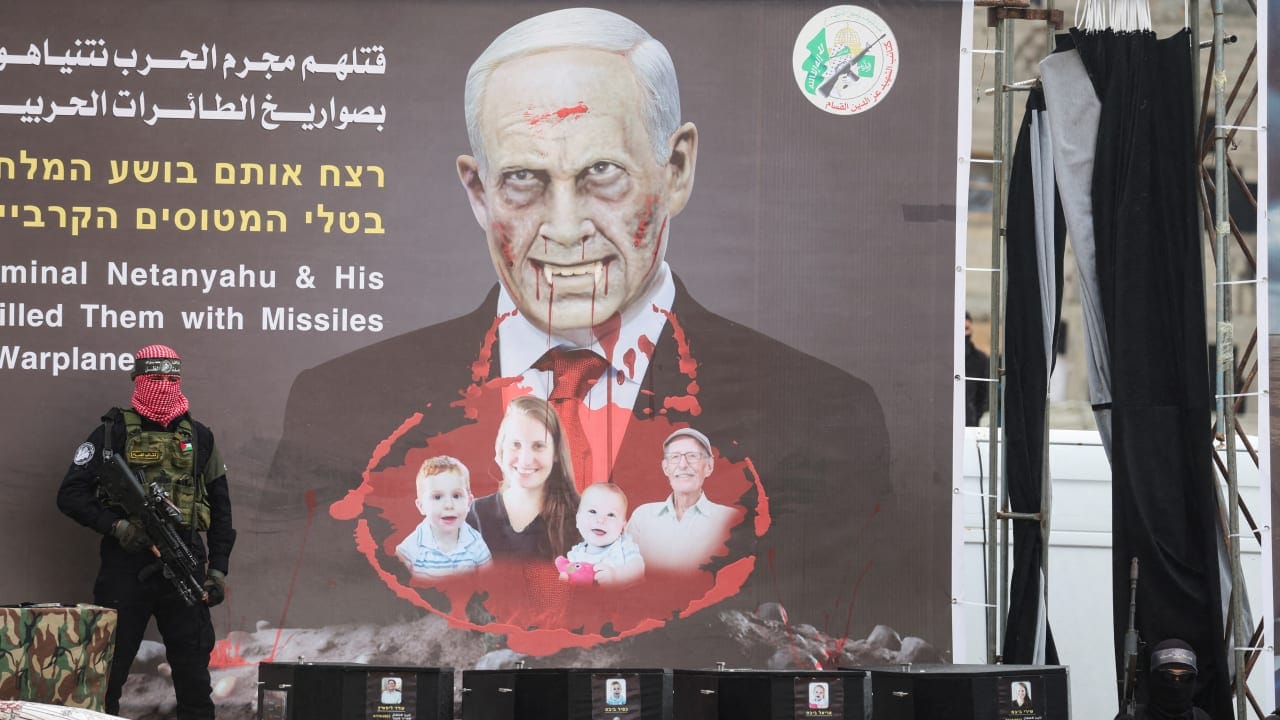
One such moment occurred on February 20, 2025, when Hamas staged the release of coffins purported to contain the bodies of the Bibas family. The coffins included small ones for four-year-old Ariel and nine-month-old Kfir, who were kidnapped from Kibbutz Nir Oz on October 7, and a larger one allegedly containing their mother Shiri. The larger coffin actually contained the body of a random Gazan woman, causing immense grief among Israelis and supporters worldwide who had followed the family’s ordeal.
Saher Alghorra, a contributor to The New York Times, was among the freelancers specially selected by Hamas to photograph this event. His images showed masked Hamas members carrying Shiri’s coffin, adorned with a sign featuring her picture alongside Prime Minister Benjamin Netanyahu’s, with “the murderer” written near Netanyahu’s face in three languages and “arrest date 7/10/23” near Shiri’s.
These photographs represented pure propaganda, as did other images Alghorra captured that portrayed Israel as deliberately targeting civilians and starving Gazans. He also photographed Palestinian prisoners released from Israeli prisons, using the same term – “prisoners” – to describe both convicted murderers and Israeli hostages like the Bibas family.
Despite the propagandistic nature of this work, the Pulitzer Prize Committee announced this week that Alghorra would receive this year’s prize for breaking news photography. Pulitzer administrator Marjorie Miller stated the award recognized his “haunting, sensitive series showing the devastation and starvation in Gaza resulting from the war with Israel.”
What Miller failed to mention was Alghorra’s previous justification of the October 7 attacks, when he referred to “the Palestinian resistance in Gaza firing thousands of missiles toward the occupied territories in response to settlers’ attacks and incursions into Al Aqsa Mosque.”
This is not the first time the Pulitzer Committee has recognized controversial work related to the Israel-Hamas conflict. Last year, Gazan poet Mosab Abu Toha received the Pulitzer Prize for commentary despite spreading antisemitic content and fake news on social media. In his posts, Abu Toha disparaged female Israeli hostages, questioned their status as hostages, and implicitly justified their abduction.
Emily Damari, who spent 471 days in Hamas captivity, wrote a heartfelt letter to the Pulitzer Committee asking them to rescind Abu Toha’s prize after he mocked her captivity. “You claim to honor journalism that upholds truth, democracy, and human dignity, and yet you have chosen to elevate a voice that denies truth, erases victims, and desecrates the memory of the murdered,” she wrote.
While the committee never rescinded Abu Toha’s prize, it did eliminate the award category for commentary entirely following the controversy.
The awarding of this year’s breaking news photography prize to Alghorra raises serious questions about the distinction between journalism and propaganda in conflict reporting, and the standards by which such work is evaluated and honored by prestigious institutions.
Fact Checker
Verify the accuracy of this article using The Disinformation Commission analysis and real-time sources.

10 Comments
This Pulitzer Prize-winning reporting on Hamas propaganda tactics raises some troubling questions. How can we ensure fair and balanced coverage of the Israeli-Palestinian conflict when militant groups deliberately manipulate the media narrative?
This is a concerning revelation about Hamas’ media strategy. Journalists must be vigilant against manipulation by any side if they hope to shed light on the truth. Rigorous fact-checking and source verification will be key.
This is a sobering reminder of the challenges facing journalism in conflict zones. Reporters must maintain the highest ethical standards to cut through the fog of propaganda and misinformation.
While the Times’ reporting is commendable, I worry this could be seen as an attack on Palestinian voices. The media must find a way to cover the conflict fairly and objectively, without taking sides.
While the Times’ investigation is admirable, I worry this will only deepen the polarization around the Israeli-Palestinian issue. We need more nuanced, fact-based reporting that gives voice to all sides, not just those with the loudest megaphones.
I agree, unbiased journalism is crucial here. Hopefully this spurs a broader reckoning about the media’s role in these complex geopolitical conflicts.
This investigation highlights the need for greater media literacy, both among journalists and the general public. We must be vigilant against attempts to distort the truth, no matter the source.
While the Times’ Pulitzer is well-deserved, I hope this doesn’t become a partisan issue. All media outlets, regardless of their ideological leanings, should condemn the exploitation of journalists by terrorist groups like Hamas.
Reporting on propaganda tactics is important, but I worry this could inadvertently amplify Hamas’ messaging. The challenge will be to expose their deception without giving them the attention they crave.
Excellent point. The media must walk a fine line between informing the public and not becoming a mouthpiece for extremist groups. Balanced, nuanced coverage is essential.