


Listen to the article
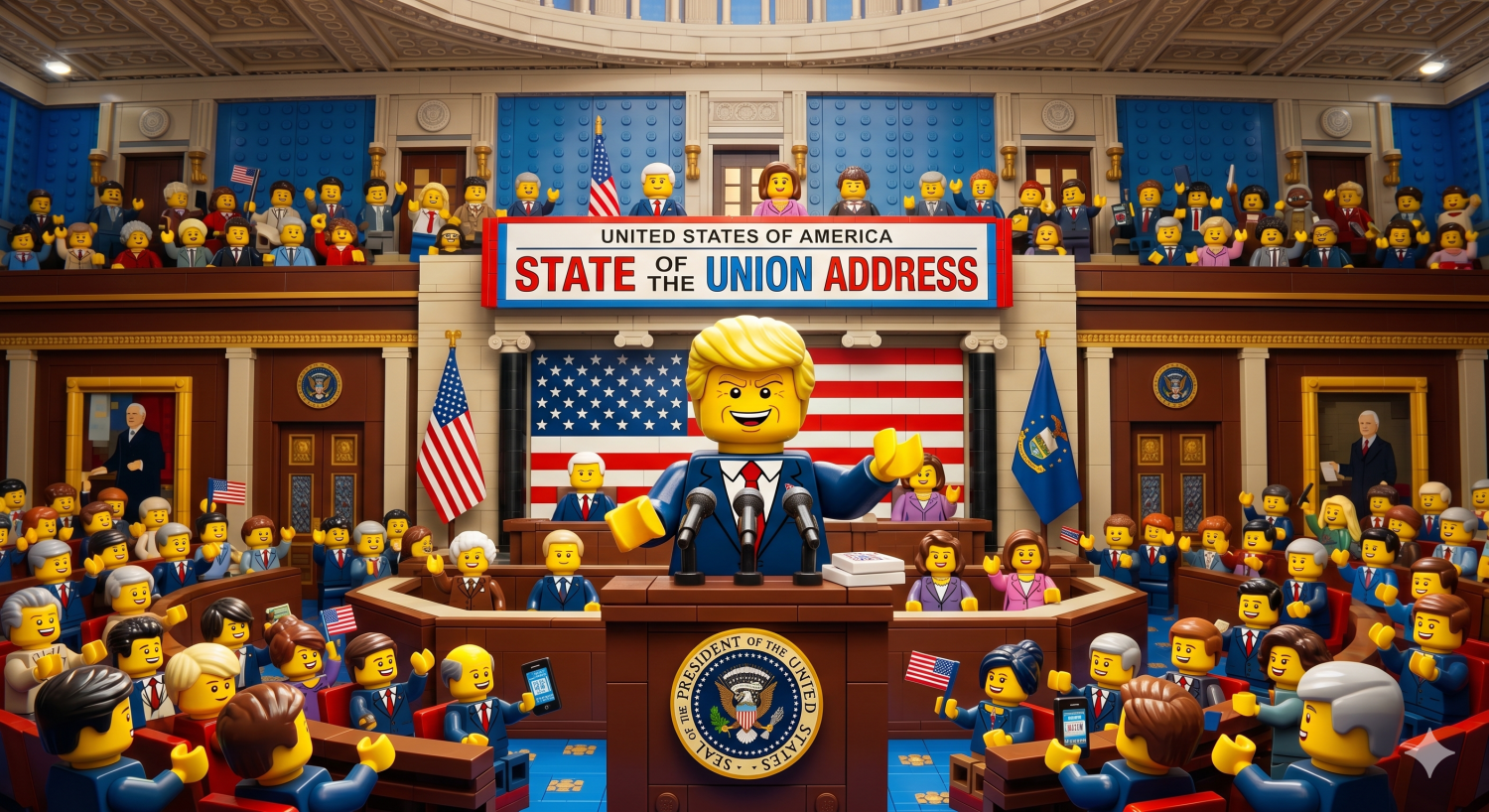
As a nation grapples with recent military actions and their consequences, President Donald Trump’s State of the Union address presented a starkly optimistic view of America’s current position, reminiscent of the propaganda-like cheerfulness found in “The Lego Movie’s” memorable anthem “Everything Is Awesome.”
The president spent over 90 minutes portraying a flourishing America with a robust economy, strong foreign policy decisions, revitalized American manufacturing, and a booming stock market. Unlike previous administrations that typically used the address to highlight genuine accomplishments and introduce new legislative proposals, Trump’s speech offered no new initiatives, instead focusing on self-congratulatory rhetoric that critics describe as disconnected from reality.
Of particular concern is the escalating situation with Iran. In June, U.S. B-2 Spirit bombers struck three Iranian nuclear sites, with Trump declaring the facilities “totally obliterated” and Pentagon estimates suggesting the program had been set back by approximately two years. This military action came after a complicated history of U.S.-Iranian relations that had once shown promise for diplomatic resolution.
In 2015, the United States joined the United Kingdom, France, Russia, China, and Germany in signing the Joint Comprehensive Plan of Action (JCPOA) with Iran. Under this agreement, Iran committed to reducing its nuclear enrichment capabilities, limiting its nuclear stockpiles from over 10,000 kg to just 300 kg, decreasing its centrifuge numbers, redesigning a heavy water reactor to prevent weapons-grade plutonium production, and submitting to international inspections. In exchange, the international community agreed to gradually lift sanctions and return previously confiscated funds.
Despite the agreement functioning as intended by most accounts, Trump unilaterally withdrew from the JCPOA in 2018, prompting Iran to restart its nuclear program. The current conflict stems directly from this decision, with Trump seeking a more comprehensive deal that would include ballistic missiles, while Iran has little incentive to negotiate with an administration it views as unreliable.
The recent bombing campaign, conducted in partnership with Israeli Prime Minister Benjamin Netanyahu, raises serious questions about strategic planning. The assassination of Ayatollah Ali Khamenei, who had ruled Iran for over 40 years after systematically eliminating opposition, creates a power vacuum likely to be filled by another radical cleric rather than triggering meaningful regime change.
Trump has justified these military actions by claiming Iran’s nuclear program threatened U.S. national security, which contradicts his earlier assertions that the June bombings were completely successful. He has also cited Iran’s development of ballistic missiles capable of reaching the United States, though evidence regarding the timeline for such capabilities remains unclear.
Critics suggest Netanyahu manipulated Trump into serving Israeli interests, as Israel faces a more immediate threat from Iranian medium-range missiles but lacked the capacity to neutralize this threat independently. The result is American involvement in another Middle Eastern conflict without a clear exit strategy.
Meanwhile, this international crisis serves as a distraction from domestic controversies, particularly the ongoing revelations from the Epstein files. These documents have implicated numerous powerful figures, including allegations against Trump himself involving an underage woman. Other high-profile individuals affected include Bill Gates, who has apologized for sexual encounters with adult women provided by Epstein; Larry Summers, who resigned his Harvard position due to his relationship with Epstein; and Britain’s Prince Andrew, who was taken into custody for allegedly sharing confidential documents with Epstein.
While the Department of Justice has been slow to act, public and congressional pressure appears to be building toward potential charges against influential individuals implicated in these files.
In other news, civil rights icon Reverend Jesse Louis Jackson Sr. has passed away. A towering figure who marched alongside Martin Luther King Jr. and witnessed King’s assassination at the Lorraine Motel, Jackson went on to lead Operation Breadbasket and found Operation PUSH, later part of the Rainbow PUSH Coalition. From the late 1960s through the 1980s, his empowering message—”I’m somebody”—helped inspire dignity and self-worth, paving the way for future leaders like Barack Obama.
Fact Checker
Verify the accuracy of this article using The Disinformation Commission analysis and real-time sources.

22 Comments
While the economic data may paint a rosy picture, the article rightly points out the importance of looking beyond the surface-level figures. We must be cautious about overly simplistic narratives that obscure deeper structural issues.
Agreed. Robust, independent economic analysis is essential for understanding the nuances and potential vulnerabilities in the broader economy.
The Epstein files controversy is a complex and troubling issue that deserves thorough, impartial investigation. I hope the truth can emerge, regardless of the powerful interests involved.
Absolutely. Uncovering the full truth about Epstein’s alleged crimes and any potential cover-ups is critical for accountability and justice.
The article’s examination of propaganda and its impact on public discourse is a timely and important reminder. We must remain vigilant against efforts to distort reality, regardless of the source or political affiliation.
Well said. Independent, fact-based journalism is crucial for holding leaders accountable and ensuring the public has access to accurate information, even when it challenges prevailing narratives.
This article raises some concerning questions about the disconnect between political rhetoric and reality. While national security is crucial, we should be wary of propaganda or spin that obscures the true costs and consequences of military actions.
Agreed. Transparency and honest reporting are essential, especially when it comes to geopolitical tensions and the use of force.
The Epstein controversy is a troubling case that highlights the need for greater accountability among the wealthy and powerful. Thorough investigation and transparency are crucial to ensuring justice is served.
Absolutely. No individual or group should be above the law, and the pursuit of truth must be relentless, even when it threatens entrenched interests.
The escalating tensions with Iran are worrying. I hope cooler heads can prevail and that diplomacy can find a path forward that avoids further military conflict and bloodshed.
Agreed. De-escalation and a return to the negotiating table seem like the best way to address this highly complex geopolitical situation.
While the economic data may paint a positive picture, the article rightly cautions against overly simplistic narratives. Maintaining a critical eye and seeking out diverse perspectives is essential for understanding the true state of the economy.
Agreed. Economic indicators can be misleading, and it’s important to look beyond the headlines to grasp the nuances and potential vulnerabilities within the broader system.
This article serves as a sobering reminder that we must be vigilant against propaganda and disinformation, even from the highest levels of government. Maintaining a healthy skepticism and demanding transparency is crucial.
Well said. Independent, fact-based journalism is essential for holding leaders accountable and ensuring the public has access to accurate information.
The intersection of politics, military actions, and high-profile scandals like the Epstein case highlights the need for rigorous investigation and a commitment to the truth, no matter how uncomfortable it may be.
Absolutely. Uncovering the full truth, even when it challenges powerful interests, is critical for maintaining the integrity of our institutions and upholding the rule of law.
The article raises important questions about the use of military force and the need for a more balanced, fact-based approach to foreign policy decision-making. Rhetoric alone is not a substitute for careful strategic analysis.
Well said. Diplomacy, multilateral cooperation, and a clear-eyed assessment of both costs and consequences should be the foundation of a responsible foreign policy.
While the U.S. economy may appear strong on the surface, the article raises valid concerns about how political rhetoric can distort the reality on the ground. We should be wary of overly rosy assessments that ignore underlying challenges.
Good point. Economic indicators alone don’t tell the whole story, and it’s important to look beyond the headlines to understand the nuances and potential vulnerabilities.