


Listen to the article
Iran’s Supreme Leader Calls for Media Reorganization to Counter Foreign Influence
Amid growing concerns about foreign influence operations, Iran’s Supreme Leader Ayatollah Khamenei has called for a comprehensive overhaul of the country’s media and propaganda apparatus to counter what he described as an orchestrated assault on “minds, hearts, and beliefs” of the Iranian people.
In a wide-ranging address, the Ayatollah emphasized that despite facing numerous challenges and resource shortages, Iran continues to make progress and move forward on its chosen path. His comments come at a time of increasing tensions between Iran and Western powers, particularly the United States.
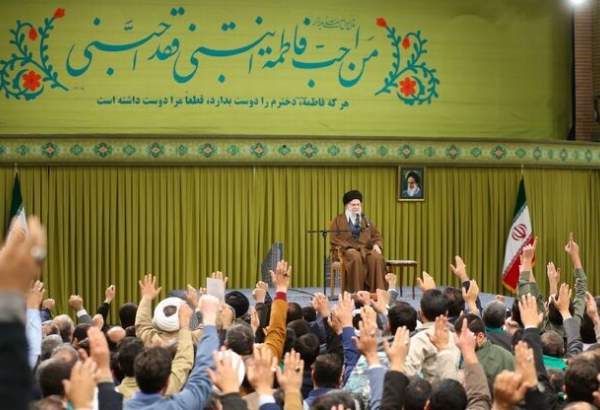
The Leader began his remarks by highlighting the virtues of Lady Fatimah, a revered figure in Islam, describing her qualities as “beyond human comprehension.” However, he urged Muslims to strive to emulate her example in areas including faith, justice-seeking, family life, and child-rearing.
In a significant portion of his address, Ayatollah Khamenei discussed the importance of religious eulogies (maddahi) as powerful cultural tools. He characterized these traditional expressions as “highly influential phenomena” that require deeper research to strengthen their impact. According to the Leader, eulogies have evolved considerably compared to previous generations and now serve as a foundation for what he termed “resistance literature.”
“Without appropriate cultural expression, ideas fade,” the Ayatollah warned, adding that religious gatherings and eulogies today play a crucial role in sustaining and expanding the “language of resistance” throughout Iranian society.
The concept of “national resistance” featured prominently in his speech. Ayatollah Khamenei defined it as steadfastness against various forms of pressure from global powers, including military, economic, cultural, political, and media-driven campaigns. He specifically pointed to Western propaganda and political agitation as examples of such pressure.
According to the Leader, hegemonic powers pursue multiple objectives ranging from territorial expansion and resource control to fundamentally altering lifestyles and transforming national identity. He recalled that for more than a century, global powers have attempted to reshape Iran’s identity, but claimed the Islamic Revolution had nullified these efforts. In recent decades, he added, the Iranian nation has continued to frustrate its enemies through resilience and defiance.
The Ayatollah’s comments reflect growing concern within Iran’s leadership about the influence of foreign media and social platforms. “Today Iran faces not only military confrontation but is at the center of a vast propaganda and media war,” he stated. The enemy, according to Khamenei, has recognized that Iran cannot be subdued through military means alone and has therefore shifted focus to undermining revolutionary values and erasing the legacy of Imam Khomeini, the founder of the Islamic Republic.
He specifically identified the United States as leading this effort, with support from European nations and what he described as “opportunists abroad.”
In response to these perceived threats, the Supreme Leader called for Iran’s media and cultural institutions to be reorganized and strengthened. He urged officials to focus particularly on protecting Islamic, Shi’a, and revolutionary teachings, which he identified as primary targets of foreign influence operations.
Concluding his address, Ayatollah Khamenei expressed confidence that through steadfastness, sincerity, goodwill, and pursuit of justice, Iran would continue to build “honor and strength for Islam and Iran.” With divine assistance, he affirmed, the country would overcome challenges and continue its forward progress.
These remarks come amid ongoing international tensions surrounding Iran’s nuclear program, regional activities, and domestic policies. Media analysts note that concerns about foreign influence have intensified following recent protests and social movements within the country, with authorities frequently attributing unrest to outside interference.
Fact Checker
Verify the accuracy of this article using The Disinformation Commission analysis and real-time sources.

7 Comments
Iran’s mining and energy sectors are crucial for the economy, so their efforts to counter foreign influence in this domain make sense. However, transparency and good governance should be the priority, not just propaganda.
Well said. Responsible resource development that benefits the Iranian people, rather than entrenched interests, should be the goal. Focusing on that could be a more effective long-term strategy.
The Ayatollah’s comments highlight the complex geopolitical dynamics at play. While I’m skeptical of heavy-handed propaganda tactics, I can understand Iran’s desire to protect its interests and counter perceived foreign meddling.
Interesting to see Iran’s focus on media reorganization and countering foreign influence. Domestic propaganda efforts can be a complex challenge, though heavy-handed tactics often backfire. Curious to see how they approach this without further alienating their own people.
Reorganizing media and propaganda efforts is a bold move, but the devil will be in the details. Iran would do well to balance its domestic narrative with openness to outside perspectives and constructive dialogue on shared challenges.
The leader’s emphasis on traditional cultural values like faith and family is understandable, but I hope they don’t use it as a cover for restricting media freedoms and independent reporting. Open dialogue is important, even on sensitive topics.
Agreed. Media control and propaganda can be a slippery slope. Maintaining space for objective journalism and diverse viewpoints, even critical ones, is crucial for a healthy society.