


Listen to the article
In a landmark decision, Spain’s National Court has invalidated a €10,001 fine imposed on the Falangist political organization La Falange for commemorative events honoring José Antonio Primo de Rivera, the founder of the Spanish Falange movement, held in November 2022.
The ruling, issued by the 12th section of Madrid’s Audiencia Nacional administrative disputes chamber, establishes an important precedent in how Spain’s Democratic Memory Law should be applied. The court emphasized that not all public displays supporting fascist ideology or symbols automatically violate the law. Instead, sanctions should only apply when there is clear evidence of deliberate intent to humiliate or demean victims of Franco’s dictatorship.
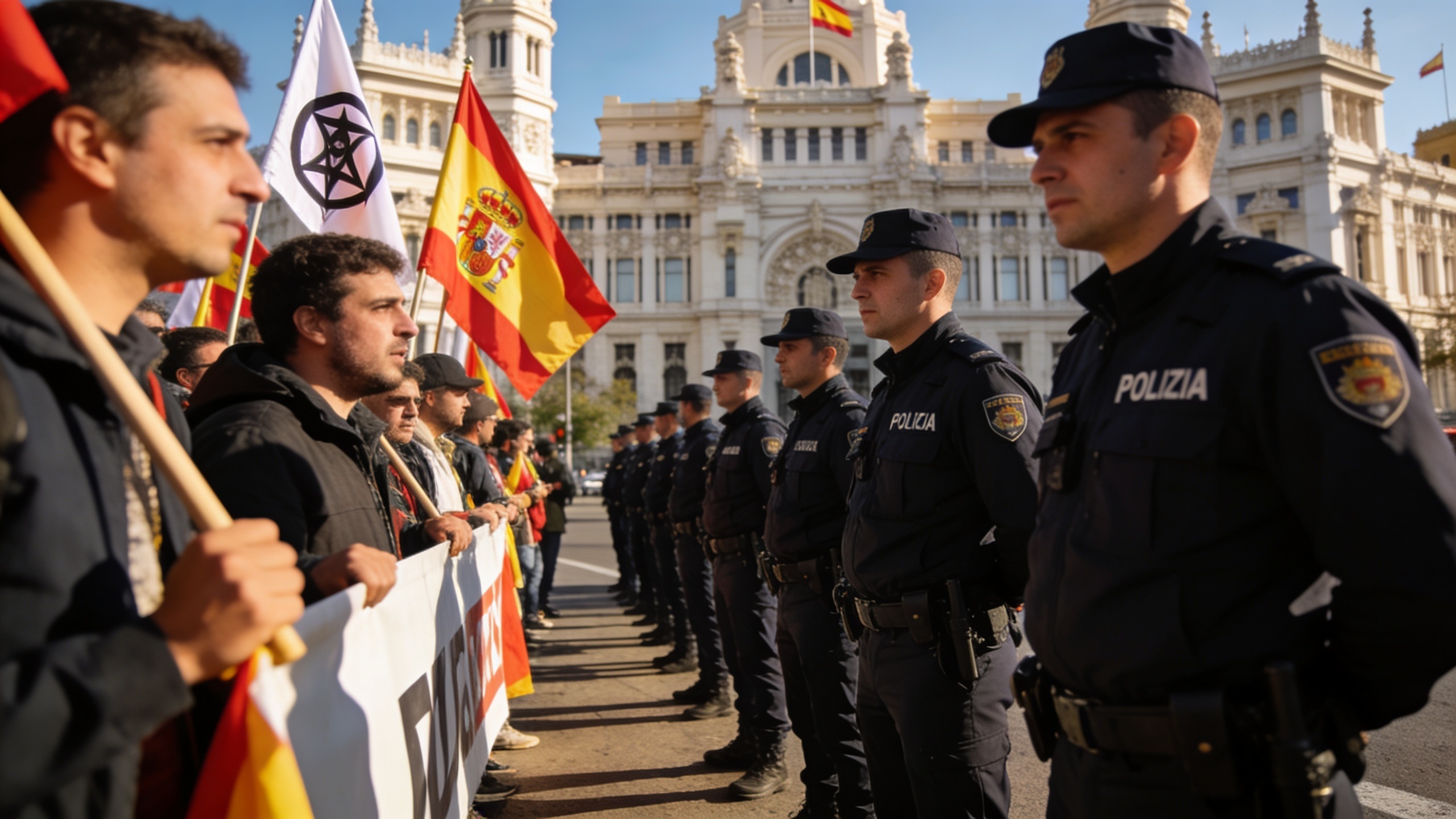
The case centered on two public events organized by La Falange: a gathering on Genova Street, the birthplace of Primo de Rivera, and a subsequent march to the Valle de los Caídos (Valley of the Fallen), the controversial monument where Franco was buried until his 2019 exhumation. Both events had received proper authorization from Spanish authorities and proceeded without incident.
In court proceedings, the State Attorney argued that these events constituted explicit propaganda for Primo de Rivera and were inherently tied to glorifying the Franco regime. The prosecution presented police reports and expert historical testimony noting the use of symbols, songs, and rituals characteristic of the dictatorship era.
La Falange’s defense countered that the events represented legal tributes to their party’s founder and employed legally permitted party symbols. The organization has been officially registered as a political party in Spain’s modern democratic system.
In the ruling, the judge emphasized Spain’s constitutional framework, noting that the country does not operate as a “democracy with mandatory loyalty.” The Spanish state requires legal compliance but does not demand active endorsement of its values. The court affirmed that historical advocacy, even when controversial or objectionable to many, remains protected by freedom of expression principles unless it contains explicit insults, racism, or calls for humiliation.
The decision specifically highlighted a crucial legal distinction: the Democratic Memory Law lacks the constitutional standing of an organic law, unlike Spain’s law on public assemblies, and therefore cannot restrict fundamental rights protected under those higher-ranking statutes.
A key element of the ruling clarifies the boundaries of punishable speech. According to the court, not every demonstration supporting the July 1936 coup, the Civil War, the Franco dictatorship, or its leaders warrants punishment—only those accompanied by clear and intentional humiliation of victims. The court emphasized that accountability requires deliberate intent, ruling out sanctions for negligent or unintentional actions.
Following the decision, La Falange celebrated what they termed a “victory for freedom of expression” and a “defeat for the Democratic Memory State Secretariat.” The organization stated it would continue advocating for the law’s complete repeal. The ruling stands as final and cannot be appealed, with authorities ordered to cover associated legal costs.
This case emerges against a backdrop of ongoing tension in Spain surrounding public demonstrations linked to controversial historical figures. In recent years, Spanish authorities have increased scrutiny over such events, particularly those connected to the Franco era. The court noted that in this particular instance, the administration failed to identify precisely when La Falange’s commemorations crossed into territory offensive to dictatorship victims.
The ruling may have significant implications for future applications of Spain’s Democratic Memory Law, potentially establishing a higher threshold for sanctions against organizations conducting similar commemorative activities.
Fact Checker
Verify the accuracy of this article using The Disinformation Commission analysis and real-time sources.

6 Comments
The court’s emphasis on intent rather than just the nature of the events is an interesting approach. Commemorating historical figures is complex, and a blanket prohibition may not always be the right solution. Thoughtful application of laws is crucial in these sensitive cases.
This ruling highlights the complexity of addressing fascist legacies in democratic societies. While we must be vigilant, the courts seem to recognize that not all public displays are automatically illegal if there’s no clear intent to demean victims. It’s a nuanced issue.
This ruling suggests the Spanish courts are taking a measured approach to applying laws around fascist symbols and memorials. Recognizing that not all public displays are inherently illegal if there’s no clear intent to demean victims is a nuanced and reasonable stance.
Interesting to see how Spain is navigating the tricky balance between democratic values and historical sensitivities around the Franco era. This ruling suggests the courts are taking a nuanced approach, focusing on evidence of intent rather than blanket prohibitions.
Agreed, a nuanced approach seems prudent here rather than heavy-handed crackdowns. Allowing some room for commemoration while still protecting victims’ dignity is a delicate balance.
This ruling highlights the nuance required in applying laws around historical symbols and memorials. While we must be vigilant against glorifying fascism, the court rightly noted that not all public displays are automatically illegal if there’s no clear intent to demean victims. Thoughtful application of such laws is key.