


Listen to the article
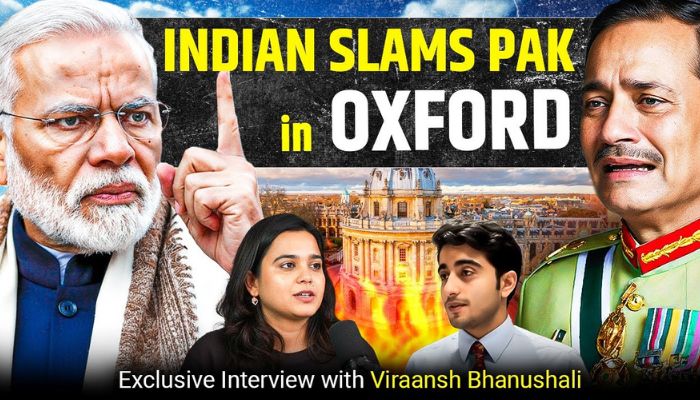
In a powerful display of diplomatic confrontation, Indian law student Viraansh Bhanushali delivered a compelling rebuttal against Pakistani narratives during a recent Oxford Union Debate, challenging longstanding propaganda with factual arguments and personal experience.
The debate, which took place on November 27, came just one day after the somber anniversary of the 2008 Mumbai terror attacks, a timing that added particular weight to the proceedings. Bhanushali, who currently studies law at Oxford University but hails from Mumbai, represented India as part of a team engaging in the prestigious debate forum.
What has captured public attention are video clips from the debate that have recently circulated online, showcasing Bhanushali’s direct approach. In one particularly pointed moment, he stated that “You cannot shame a state that has no shame,” a comment directed at Pakistan that reflects the ongoing tensions between the two nuclear neighbors.
The significance of Bhanushali’s participation extends beyond mere debate rhetoric. As a survivor of the 26/11 Mumbai terror attacks, his perspective carries the authority of personal experience. The attacks, which were carried out by Pakistan-based terrorist organization Lashkar-e-Taiba, claimed 166 lives and left over 300 injured during a four-day siege of India’s financial capital.
In an interview with OpIndia following the debate, Bhanushali elaborated on his experience representing India on an international stage. “I consider myself an ambassador of the country,” he told journalist Ritika J. Chandola, expressing pride in having the opportunity to speak on behalf of his nation at such a distinguished forum.
The Oxford Union, founded in 1823, has long served as one of the world’s most prestigious debating platforms, hosting discussions on contentious global issues with participants ranging from students to world leaders. Having an Indian student directly address Indo-Pakistani relations at this venue highlights the continued relevance of this complex regional relationship to global geopolitics.
The timing of the debate is particularly noteworthy given recent diplomatic tensions between India and Pakistan. Relations between the neighboring countries have remained strained since the 2019 Pulwama attack and subsequent Balakot airstrike, with limited bilateral engagement. International forums like the Oxford Union provide rare opportunities for direct exchanges between representatives of the two nations.
India-Pakistan relations remain one of the most watched geopolitical situations in South Asia, with implications for regional stability and security. Both nations maintain competing narratives about territorial disputes, cross-border terrorism, and historical grievances that date back to the 1947 partition.
For students like Bhanushali who study abroad, navigating these complex national identities while in international academic settings presents both challenges and opportunities. Many Indian students at prestigious global universities have increasingly taken active roles in shaping discourse about their home country, countering what they perceive as misrepresentations in Western academic circles.
The debate also underscores how the 2008 Mumbai attacks continue to influence India’s national security consciousness and its approach to relations with Pakistan. For many Indians, especially those directly affected by the tragedy, the attacks remain a painful reminder of cross-border terrorism and the perceived lack of accountability for the perpetrators.
International forums like the Oxford Union Debate serve as critical platforms for emerging voices from countries with ongoing conflicts. They provide valuable opportunities for the next generation of potential leaders to engage with complex geopolitical issues beyond official government channels.
As clips from the debate continue to circulate online, they contribute to the broader conversation about India’s global image and its diplomatic positioning on issues related to Pakistan, terrorism, and regional security in South Asia.
Fact Checker
Verify the accuracy of this article using The Disinformation Commission analysis and real-time sources.

18 Comments
Powerful to see a law student like Viraansh Bhanushali representing India so forcefully on the global stage. His comments about Pakistan’s lack of shame reflect the deep frustrations many Indians feel towards their neighbor’s support for terrorism.
Indeed, his personal connection to the Mumbai attacks lends significant weight and authority to his arguments against the Pakistani narratives.
It’s good to see young leaders like Viraansh Bhanushali standing up to propaganda and defending the facts. His personal experience as a survivor of the Mumbai attacks gives his words added weight and credibility.
I agree, confronting false narratives with firsthand knowledge and rational arguments is an important way to counter disinformation.
The timing of this debate, so close to the anniversary of the Mumbai attacks, must have added an extra layer of gravity and personal investment for Bhanushali. His directness in challenging Pakistan’s narratives is understandable given the context.
Absolutely, the personal connection to the attacks likely fueled his determination to confront the propaganda head-on.
The timing of this debate, right after the anniversary of the Mumbai attacks, really underscores the ongoing tensions between India and Pakistan. Bhanushali’s direct approach seems warranted given the sensitive nature of the topic.
You’re right, the backdrop of the attacks gives this debate a somber and high-stakes context. Bhanushali appears to have handled it with poise and conviction.
It’s admirable that Bhanushali, as a law student, is already engaging in high-level diplomatic debates on the world stage. His ability to articulate India’s position with such clarity and force is impressive.
Absolutely, his poise and confidence in that setting, at such a young age, is quite remarkable.
Viraansh Bhanushali’s performance in this debate showcases the next generation of Indian leadership. His ability to articulate India’s position with such poise and conviction, even on a sensitive geopolitical issue, is commendable.
The circulating video clips of Bhanushali’s debate performance seem to show a young leader unafraid to directly challenge propaganda and defend the truth. This is an important skill, especially when dealing with longstanding geopolitical conflicts.
You’re right, cutting through the rhetoric with facts and personal experiences is a valuable strategy in these high-stakes debates.
Kudos to Viraansh Bhanushali for representing India so capably at the Oxford Union Debate. Confronting Pakistan’s narratives with composure and conviction is no easy task, but his approach seems to have resonated.
Bhanushali’s participation in the Oxford Union Debate is a testament to India’s rising influence on the global stage. His ability to articulately defend his country’s position against Pakistan’s propaganda is an impressive achievement.
The fact that Bhanushali is a survivor of the Mumbai attacks adds a powerful personal dimension to his arguments against Pakistan’s propaganda. His direct statement about their lack of shame resonates strongly.
This debate showcases the important role that young leaders like Viraansh Bhanushali can play in challenging longstanding geopolitical narratives. His factual approach and willingness to confront sensitive issues head-on is commendable.
Agreed, Bhanushali’s performance demonstrates the value of engaging the next generation in these critical dialogues and debates.