


Listen to the article
Russian authorities are intensifying their disinformation campaign surrounding the tragic events that occurred in Odesa on May 2, 2014, according to a recent alert from Ukraine’s Center for Countering Disinformation (CCD).
Officials at the CCD, which operates under Ukraine’s National Security and Defense Council, warn that the Kremlin is orchestrating a coordinated series of provocative demonstrations near Ukrainian diplomatic missions worldwide, timed to coincide with the anniversary of the tragedy.
“Every year on May 2, the Russian propaganda machine activates one of its most cynical myths — ‘Nazi atrocities in Odesa,'” the CCD stated in its report. The center added that while this pattern recurs annually, they have observed heightened activity this year.
These planned demonstrations reportedly follow a familiar template: organized gatherings featuring flowers, pro-Russian messaging, and individuals prepared to deliver pre-crafted testimonials to local media outlets. According to Ukrainian officials, these activities are designed not to honor victims but to discredit Ukraine internationally and foment tensions abroad.
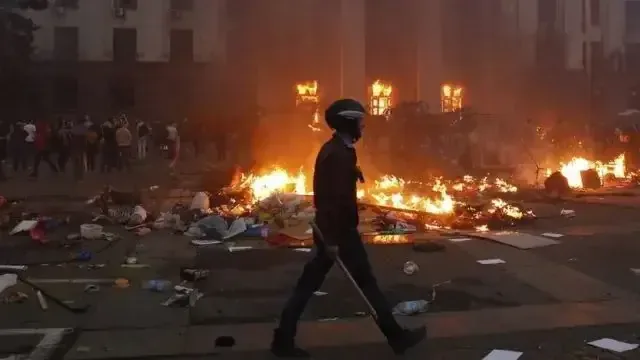
The CCD emphasized that Russian propaganda deliberately misrepresents the sequence of events that led to the tragedy at Odesa’s House of Trade Unions, where 48 people lost their lives. According to Ukrainian authorities, the narrative promoted by Moscow omits critical details about how the confrontation began and escalated.
Ukrainian officials maintain that on May 2, 2014, pro-Russian militants initiated the violence by attacking a peaceful “For a United Ukraine” march in Odesa. Following this initial confrontation, these militants barricaded themselves inside the Trade Unions building, from which they reportedly threw Molotov cocktails at Ukrainian demonstrators. During the ensuing conflict, a fire broke out in the building, resulting in dozens of fatalities.
Russian state media and officials have, for years, advanced a different narrative, characterizing the events as Ukrainian nationalists deliberately targeting and burning “peaceful citizens” – a characterization that Ukrainian authorities vehemently dispute.
This information warfare comes amid Russia’s ongoing full-scale invasion of Ukraine, now in its third year. Since 2022, Russian authorities have intensified propaganda campaigns targeting both domestic and international audiences, often leveraging historical events to justify current military actions and discredit Ukrainian sovereignty.
The Odesa tragedy remains one of the most contentious and emotionally charged events of Ukraine’s recent history. It occurred during a period of heightened tensions following Russia’s annexation of Crimea and the outbreak of conflict in eastern Ukraine’s Donbas region in 2014.
International organizations, including the Council of Europe and the United Nations Human Rights Monitoring Mission, have previously criticized Ukrainian authorities for failing to conduct thorough investigations into all aspects of the violence that day. However, these same organizations have also acknowledged the complexity of the events and have not endorsed the simplified, one-sided narrative promoted in Russian state media.
Disinformation experts note that the Kremlin’s focus on the Odesa tragedy exemplifies Russia’s broader strategy of exploiting historical grievances and tragic events to drive wedges between Ukraine and international supporters.
The CCD’s warning comes as Ukraine continues to face not only conventional military threats but also coordinated information and cyber attacks. In a related development, the center recently stated that Russian cyber operations targeting Ukrainian infrastructure might constitute war crimes under international law, highlighting the multifaceted nature of the conflict beyond traditional battlefields.
As the May 2 anniversary approaches, Ukrainian diplomatic missions worldwide have been placed on alert for potential provocations, while media literacy experts urge critical evaluation of narratives surrounding the 2014 events.
Fact Checker
Verify the accuracy of this article using The Disinformation Commission analysis and real-time sources.

14 Comments
This is a concerning development. The Kremlin’s disinformation campaign surrounding the Odesa incident is a clear attempt to sow discord and undermine Ukraine’s credibility. We must remain vigilant and continue to expose these tactics, which threaten to distort the historical record.
You’re absolutely right. The Kremlin’s use of coordinated protests and pre-crafted testimonials is a cynical ploy to reshape the narrative around this tragic event. Fact-based reporting and public awareness are crucial to countering this propaganda.
This is a concerning report. The Kremlin’s disinformation campaign surrounding the Odesa tragedy is clearly an attempt to distort the facts and shift blame. It’s important to remain vigilant and fact-check any claims made about this incident.
Agreed. The orchestrated protests abroad are particularly troubling, as they seem designed to stir up tensions and undermine Ukraine internationally. We must be wary of falling for this propaganda.
The Kremlin’s exploitation of the Odesa tragedy is a despicable attempt to deflect from their own culpability. As the report states, these events are not about honoring victims, but rather about discrediting Ukraine. We must stand firm against this blatant propaganda.
The Kremlin’s use of pre-crafted testimonials and coordinated demonstrations is a classic tactic to spread misinformation. It’s disheartening to see them exploiting a tragic event like this for political gain.
You’re right. This is a cynical attempt to rewrite history and portray Ukraine in a negative light. We must stay informed and not let these distortions go unchallenged.
This is a troubling development. The Kremlin’s disinformation campaign surrounding the Odesa incident is clearly part of a broader strategy to discredit Ukraine and sow discord internationally. We must remain vigilant and continue to expose these tactics.
I agree. The Kremlin’s use of coordinated demonstrations and pre-crafted testimonials is a particularly insidious tactic. We must counter this propaganda with facts and shine a light on their attempts to rewrite history.
The Kremlin’s manipulation of the Odesa tragedy is a cynical attempt to deflect attention from their own actions. It’s important that the international community stands firm in condemning these blatant attempts to rewrite history.
This report underscores the ongoing battle against Russian disinformation. It’s alarming to see the Kremlin continuing to exploit sensitive historical events for political purposes. We must remain vigilant and support efforts to expose these deceptions.
Absolutely. The Kremlin’s tactics of sowing discord and undermining the truth are a serious threat to global stability. Rigorous fact-checking and public awareness campaigns are essential to combat this pernicious propaganda.
I’m curious to learn more about the specific details of the Kremlin’s disinformation campaign surrounding the Odesa incident. What are the key myths they are propagating, and how do they contradict the established facts?
That’s a good question. Understanding the specific false narratives being pushed is crucial to effectively countering the Kremlin’s propaganda. Fact-checking and highlighting the discrepancies will be important.