


Listen to the article
Kosovo’s President Denounces Serbian Media Claims as “Dangerous Propaganda”
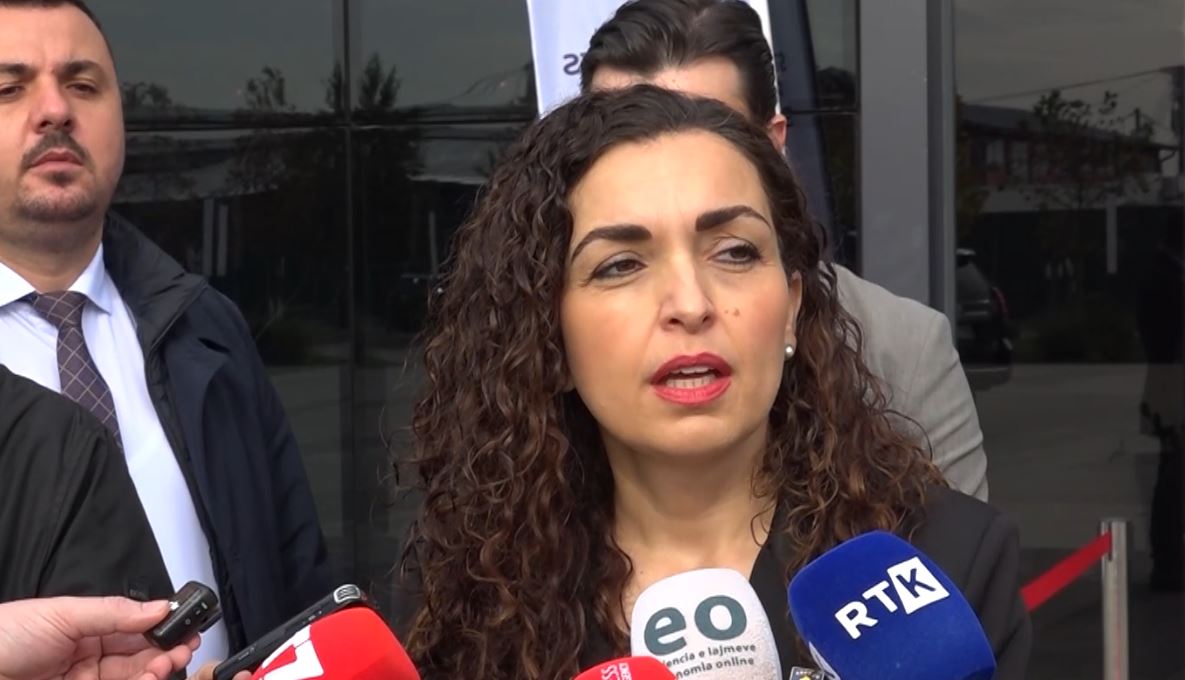
President Vjosa Osmani has strongly rejected reports from Serbian television claiming that Albanian nationals attacked Serbian gendarmerie officers with firearms, describing the allegations as deliberate propaganda designed to tarnish Kosovo’s international image.
In a public statement, Osmani emphasized that these false claims represent another chapter in Serbia’s long-standing strategy of information warfare against Kosovo. She pointed to this incident as evidence that Serbia employs both paramilitary operations and sophisticated disinformation campaigns to destabilize the region.
“One of the main tools Serbia has used throughout history is propaganda—very dangerous because even today, with new technological developments, it can produce anything as part of a continuous, non-traditional form of warfare,” Osmani stated. She explained that beyond the recent terrorist paramilitary attack in Banjska, Serbian authorities actively use disinformation to “create fear, provoke tensions, and attempt to reignite violence in our country and our region.”
The allegations come amid heightened tensions between Kosovo and Serbia, with relations deteriorating following multiple security incidents along their shared border. Regional security experts note that disinformation campaigns have become increasingly sophisticated across the Balkans, with social media accelerating the spread of unverified claims.
Osmani urged Kosovo’s citizens to exercise critical thinking when consuming news, particularly content originating from Serbian sources. “They lied when they claimed there had been gunfire from Kosovo toward Serbia—you saw the police statement that refuted that,” she said, referencing a recent incident that Kosovo authorities officially denied.
The president also addressed a separate controversy stemming from her recent interview with POLITICO, where she reportedly claimed that “over 900 criminal gangs have been dismantled” in Kosovo over the past five years. Osmani clarified that she was referring to the number of criminal cases involving Serbian-affiliated groups, not distinct criminal organizations.
“What I meant was the number of cases. Serbian gangs have been involved in hundreds of incidents—from the misuse of votes in 2021 onward, to ongoing pressure on Serbian citizens, the illegal smuggling of weapons into Kosovo, violence against civilians, and even attacks on journalists,” she explained. Osmani noted that there have been 93 documented cases of attacks against KFOR peacekeeping soldiers alone.
The president emphasized that her statement was “completely unintentional” and pointed out that even POLITICO did not include this specific claim in their published article.
The exchange highlights the complex media landscape in the Western Balkans, where information warfare often complicates diplomatic efforts. International organizations including the European Union and NATO have repeatedly called for responsible journalism and transparent communication from all parties involved in the Kosovo-Serbia dialogue.
Security analysts observe that false narratives can have real-world consequences in the fragile post-conflict environment of the region. The European External Action Service has previously documented coordinated disinformation campaigns aimed at undermining Kosovo’s sovereignty and stoking ethnic tensions.
As Kosovo continues its efforts toward greater international recognition and European integration, managing its public image against what Osmani describes as systematic propaganda remains a significant challenge for the young republic’s leadership.
The ongoing information disputes underscore the need for strengthened media literacy initiatives and fact-checking mechanisms throughout the region, as both countries navigate their complex relationship under close international scrutiny.
Fact Checker
Verify the accuracy of this article using The Disinformation Commission analysis and real-time sources.

6 Comments
The accusations of propaganda and information warfare are quite serious. It’s important that we get the full facts from reliable sources before drawing conclusions. Maintaining regional stability and preventing further conflict should be the priority.
I agree, this is a delicate situation that requires a measured and impartial approach. Unfounded claims could easily escalate the tensions, so thorough investigation and open communication will be crucial.
This is a sensitive situation that requires a careful and impartial approach. Accusations of disinformation and paramilitary actions are very serious, but we need to ensure we have the full facts before drawing conclusions. Diplomacy and de-escalation should be the focus.
This is clearly a complex geopolitical situation with accusations and counter-accusations flying. It’s concerning to see claims of disinformation campaigns being used to inflame tensions in the region. Hopefully, all sides can move towards a peaceful resolution through diplomacy and transparency.
The accusations of propaganda and information warfare are very concerning. It’s important that we get a clear and balanced understanding of the facts before making judgments. Maintaining regional stability should be the top priority here.
While I’m concerned about the alleged paramilitary attack and disinformation campaigns, I’m hesitant to take sides without more evidence. These are complex geopolitical issues with a long history. I hope all parties can work towards a peaceful resolution through diplomacy.