


Listen to the article
Iran’s Meme Warfare Reshapes Digital Battlefield in Middle East Conflict
Iran has stunned experts with its surprisingly effective use of internet memes and digital content to influence global opinion during the ongoing Middle East conflict. What began as conventional diplomacy has transformed into a sophisticated social media operation that experts say will likely be replicated in other international crises and political events, including the upcoming U.S. elections.
“It’s spoken to the sort of Gen Z language of the internet in ways certainly diplomats don’t normally do,” said Bret Schafer, a senior director at the Institute for Strategic Dialogue, which has tracked Iran’s online activities. “They have taken a regime that is, I mean, brutal and pretty awful and didn’t have exactly a great reputation and turned them into kind of a plucky, fun underdog.”
The digital offensive has involved dozens of Iranian government officials and diplomatic accounts posting uncharacteristically edgy content, including videos mocking the United States and Israel. These posts frequently portray former President Trump as an imperialist or as an incompetent subordinate to Israeli Prime Minister Benjamin Netanyahu, often incorporating antisemitic tropes. Many posts also suggest the war was launched to distract from Jeffrey Epstein-related disclosures.
The scale of this operation is remarkable. According to analysis by the Institute for Strategic Dialogue, approximately 150 official Iranian accounts generated about 900 million views in the first 50 days of the war—a thirtyfold increase from the same pre-war period.
“They’re talking in a way that’s fundamentally changed,” noted Moustafa Ayad, another researcher at the institute. “If you go back two months and look at what they were putting out, it’s nothing like this.”
Experts characterize this approach as “slopaganda”—a new era of meme warfare that leverages social media algorithms to undermine an adversary’s political support. The institute’s analysis concluded that Iran’s effort “offers a blueprint that authoritarian actors can replicate in the future.”
The Lego Offensive
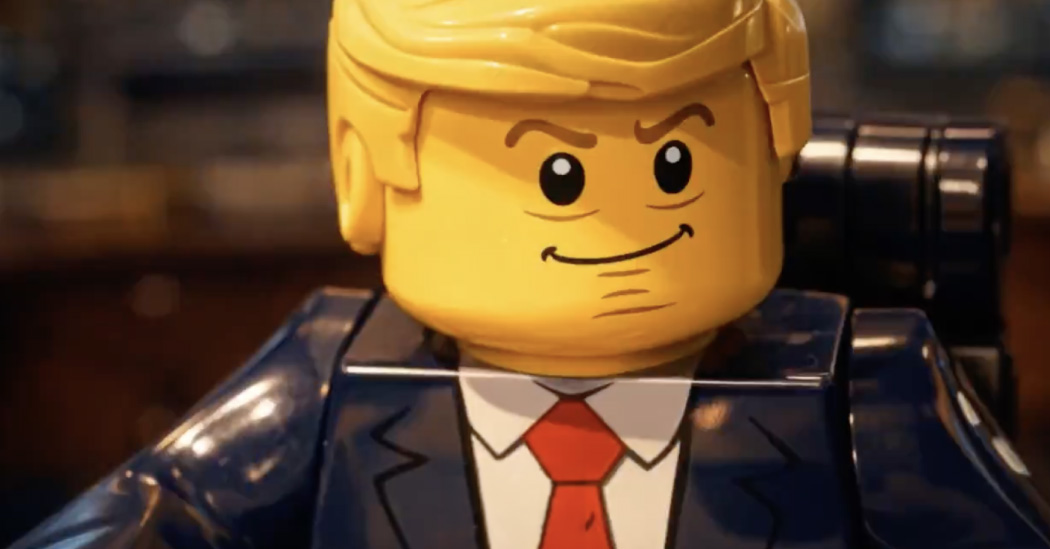
Among Iran’s most effective tactics has been the creation of videos featuring Lego characters. A small team of content creators in Iran, calling themselves Explosive Media or simply the “Iranian Lego team,” has produced A.I.-generated videos depicting world leaders as Lego figurines.
These videos show Trump-like characters sweating or cowering while portraying Iranian soldiers and civilians as resolute against U.S. and Israeli military might. The team has manipulated toy figurines to resemble Trump, Vice President JD Vance, Secretary of Defense Pete Hegseth, and even personifications of evil, playing on Iran’s decades-old epithet for the United States as “Satan.”
While primarily publishing on YouTube, the group maintains accounts across Instagram, X, Telegram, and recently Facebook. Their content has inspired numerous imitators, expanding their reach exponentially.
The group reportedly formed during the 12-day war between Israel and Iran last year. They call their video series “Victory Chronicles,” sharing a name with a cultural center in Tehran sponsored by Iran’s Islamic Revolutionary Guards Corps. This connection has led some to suggest government ties, though a representative contacted through Facebook claimed the team of fewer than ten members operates independently, having sold broadcasting rights to Iranian state news agencies.
When asked about the country’s online messaging strategy, a spokesman for Iran’s U.N. mission declined to comment.
Cultural Fluency Drives Success
The Lego videos have found receptive audiences in the United States, particularly among critics of the war from both the political left and right.
Renee DiResta, an associate research professor at Georgetown University who specializes in digital influence operations, attributes the videos’ widespread popularity to the creators’ “incredible cultural fluency.” They incorporate American rap songs, reference familiar tropes like Trump’s affinity for Diet Coke or criticisms of Hegseth’s drinking habits, and respond rapidly to breaking news—including Vance’s postponed Pakistan trip for peace talks.
Modern A.I. technology has enabled the creation of longer, scripted animations that transform war’s horrors into sanitized, toy-based depictions more palatable to social media audiences.
“They managed to hit on all of the identity-culture aesthetics that the internet is really there for,” DiResta observed. “It’s kind of immediately graspable.”
The Lego Group, based in Denmark, did not respond to requests for comment about their product’s use in wartime propaganda.
The American Response
The White House declined to address specific questions about Iran’s propaganda campaign, including the president’s reaction to the mocking Lego memes. Spokeswoman Anna Kelly questioned why anyone would consider “terrorist regime propaganda” effective.
Ironically, the Trump administration arguably initiated this meme war, having long converted political issues into viral content spread across official and unofficial accounts. Since the first strikes on February 28, a White House team has posted numerous videos using A.I.-generated images or spliced with clips from action movies and video games like Call of Duty and Grand Theft Auto.
After a slow initial response, Iran countered with its own meme campaign. Many of these memes, including the Lego videos, originate in Iran, according to researchers tracking their spread.
Unlike deepfakes of attacks that can be debunked, these obvious animations have largely avoided restriction on social media, despite platform policies against inauthentic amplification and deceptive or violent imagery.
X, owned by Elon Musk, has been a primary outlet for Iranian propaganda, much of it distributed by government agencies and diplomatic offices worldwide that have purchased X’s verification badge. X did not respond to requests for comment.
When YouTube removed Explosive Media’s account for violating rules against deceptive practices related to foreign influence campaigns, Iran’s Foreign Ministry spokesman Esmaeil Baqaei posted a rebuke on X, calling it an attempt to “shield the American administration’s false narrative from any competing voice.”
American Creators Fight Back
The Lego videos’ popularity has inspired American responses. Charlie Curran, a 35-year-old Hollywood filmmaker, created his own Lego-style video depicting the rescue of an American F-15E jet crew member in Iran after being disturbed by Iran’s digital narrative.
“I saw this all taking place and happening,” Curran said, “and I was like, how is there no American response to this?”
Using Anthropic’s Claude AI to write a script and ByteDance’s Seedance 2.0 video generator, Curran produced a 72-second video in just 30 minutes. Posted on April 7, it garnered over 800,000 views on X alone and millions more across other platforms.
“It’s not inherently difficult,” Curran noted, “which is why I think you’ll see a lot more of this.”
Fact Checker
Verify the accuracy of this article using The Disinformation Commission analysis and real-time sources.

14 Comments
This is an intriguing case study on the evolving nature of propaganda and information warfare in the digital era. Iran’s social media tactics highlight the growing importance of online narratives in shaping global perceptions and political outcomes.
You’re right, this trend underscores the need for greater media literacy and critical thinking skills to help the public navigate the complex information landscape.
Iran’s digital campaign is a fascinating case study in modern propaganda tactics. The ability to create viral content and influence perceptions through social media is a growing challenge for governments and the public.
Agreed. This trend highlights the need for greater media literacy and fact-checking to help people discern credible information from manipulative content online.
The article raises valid questions about the implications of ‘slopaganda’ and how it can distort geopolitical narratives. Effective social media strategies are becoming a key part of international diplomacy and conflict.
This is a concerning development, as the use of memes and viral content to shape political discourse can undermine democratic processes. Careful analysis is needed to understand the full impact of Iran’s digital tactics.
Absolutely. Governments and tech platforms will need to find ways to address the spread of disinformation without infringing on legitimate free speech online.
The article provides a thought-provoking analysis of Iran’s use of memes and social media to influence global opinion. While creative digital campaigns can be effective, they also raise concerns about the potential for manipulation and the spread of misinformation.
Iran’s use of memes and ‘slopaganda’ to shape global opinion is a concerning trend. The ability to rapidly disseminate tailored content through social media poses challenges for maintaining truth and transparency in public discourse.
I agree. Effective counter-strategies will be needed to combat the spread of disinformation and ensure the public has access to reliable, fact-based information.
Interesting to see Iran’s strategic shift to social media to shape global opinion. Memes can be a powerful tool, but it raises concerns about the spread of misinformation and propaganda online.
You’re right, the use of memes for political influence is concerning. It blurs the line between fact and fiction in a way that can be hard for the public to navigate.
The article provides a fascinating look at how Iran is leveraging social media to advance its geopolitical agenda. While creative digital campaigns can be effective, they also raise important questions about the role of propaganda in the digital age.
The article highlights the growing sophistication of Iran’s social media operations. While creative digital campaigns can be effective, they also raise ethical questions about the role of propaganda in modern statecraft.