


Listen to the article
AI-Generated “Lego-ganda”: Iran’s Digital Offensive in Information Warfare
The video opens dramatically: Donald Trump at his Oval Office desk, one hand to his head, the other clutching a mobile phone, seemingly preparing for a late-night Truth Social tirade. The scene cuts to two jet fighters racing down a runway before launching into a coordinated maneuver against a moonlit sky, pilots staring ahead in battle preparation.
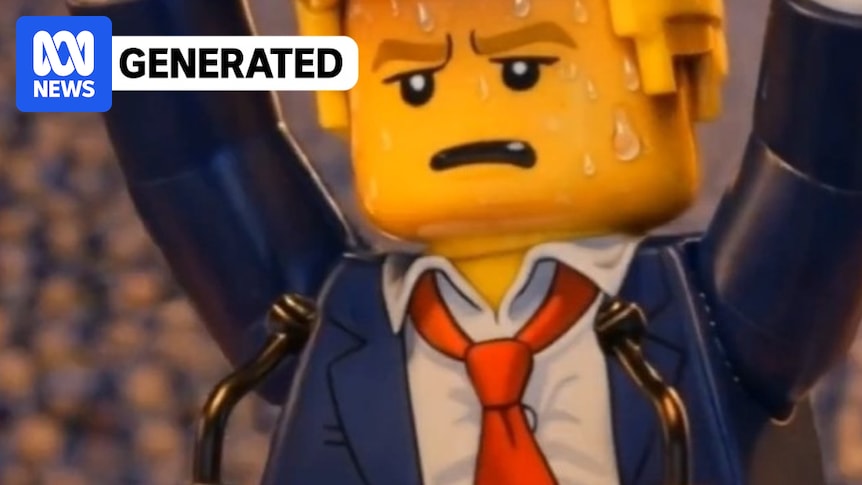
Created in the distinctive animation style of “The Lego Movie” and backed by a suspenseful Hollywood-worthy soundtrack, this AI-generated clip represents a new front in modern warfare—one fought not with weapons but with sophisticated digital content.
This video is among numerous pop culture-steeped productions that have gained significant traction on social media platforms in recent months, all sharing a common thread: deep criticism of Israel and the United States’ military engagement with Iran.
A media organization calling itself “Explosive Media” has claimed responsibility for these Lego-style videos. While the group insists it is “totally independent” of the Iranian regime, a representative admitted to the BBC that Tehran is a “customer.” These videos have been widely shared by Iranian regime-affiliated accounts and have even penetrated American protest movements opposing the conflict.
Media analysts have coined terms for this emerging phenomenon: meme warfare, meme trafficking, or in American circles, “Lego-ganda.” Experts view it as clear evidence of a new battlefield in modern conflict—one leveraging AI tools to shape public perception.
“[The video creators are] taking what’s posted seriously online and then turning it into something fun to look at,” explained Nancy Snow, an American communications professor and propaganda expert, to ABC News. “If you can control the narrative, you can really control the atmosphere and the mood.”
The videos consistently position Iran as the underdog against American might. In this AI-era conflict, technological advancements enable real-time storytelling distributed globally at unprecedented scale.
Trump: Prime Target of Iranian Meme Warfare
Explosive Media’s involvement in digital propaganda reportedly began during last year’s 12-day conflict. When hostilities resumed in late February, the self-described “student-led” team with “social activism” backgrounds was “ready, plans in place, engines revving”—deploying their Lego-style videos by the second day.
President Trump features prominently as the videos’ primary target, routinely portrayed in unflattering situations—sweating profusely, pants on fire, or in emotional distress. One early video depicts a panicked Trump ordering an airstrike after reviewing an “Epstein File” alongside Satan—a pointed reference to investigations surrounding the convicted sex offender and former Trump associate.
Another video shows the commander-in-chief crying while eating a taco, playing on the phrase “Trump Always Chickens Out (TACO).” Current events regularly feature in these productions, including references to ceasefire negotiations and Trump’s declarations about the Strait of Hormuz.
These videos have garnered tens of thousands of likes and millions of views across TikTok, Instagram, and X. Explosive Media has been joined by other content creators like PersiaBoi, expanding this digital offensive.
Analysts categorize these videos as “slopaganda”—a blend of “slop” (unwanted AI-generated content) and propaganda. Unlike traditional propaganda that might require weeks or months of preparation, this content responds rapidly to daily developments.
“Information warfare has existed since warfare began. But this represents a new manifestation—it’s fast and reaches audiences that wouldn’t otherwise be reached,” explained Mark Alfano, computer science expert and associate professor of philosophy at Macquarie University. “It’s very compelling and catchy. These videos are being released once or twice daily, responding to events in real time.”
Targeting Western Audiences with Familiar Cultural References
What distinguishes this propaganda campaign is its target audience. Dr. Alfano notes that this “savvy team of maybe a dozen guys” is producing content not for domestic Iranian consumption, but for “Americans and probably Western Europeans,” evidenced by the use of English rather than Farsi.
The Lego animation style represents a calculated choice. “If you put something in a language that people have known since they were five years old, then it’s compelling and familiar in a way that is likely to have more influence,” Alfano observed.
Iran’s embassies have embraced other forms of meme warfare throughout the conflict. Following Trump’s expletive-laden threat regarding the Strait of Hormuz in April, Iranian diplomatic missions in countries including South Africa and Zimbabwe coordinated humorous social media responses. The Iranian embassy in South Africa shared an AI-generated video of Trump playing keyboard while singing “I will never give you up.”
Professor Snow explains that sophisticated propaganda works by incorporating entertainment value to bypass critical thinking. “It gets right to the heart of the message: US bad, Israel bad, and Iran is the underdog,” she said. “These videos have played an inordinate role in shaping discourse about this war.”
America’s Messaging Challenges
The United States has waged its own information campaign, utilizing pop culture references and video game imagery to reach online audiences. President Trump has demonstrated willingness to deploy AI content to support his messaging, though with mixed results—as evidenced by the recent controversy over an AI-generated image portraying him as a Jesus-like figure, which he claimed to have interpreted as depicting himself as a “doctor.”
American propaganda efforts have faced criticism for “a lack of narrative coherence,” according to Dr. Alfano. Official US accounts have spliced clips from sports and video games into footage of military strikes before distributing them online.
While creators defend these videos as effective in connecting with younger audiences, critics, including former military officials, argue they trivialize a serious conflict in which American service members have died.
“It just seems detached from reality,” Lieutenant General Ben Hodges, a retired two-star general who commanded US troops in Europe during the Obama administration, told Politico. “Our allies look at this, and they wonder, ‘What the hell is going on?’ It doesn’t look like we’re serious.”
Professor Snow, who worked at the US Information Agency in Washington during the 1990s, believes America is “losing the propaganda war, both domestically and internationally,” partly because “too many state actors are leading the propaganda campaign through their messaging.”
Effective propaganda requires a clear message and substantial public support for military operations—elements Snow suggests are lacking in the current American approach. “This is not what [Trump’s supporters] bargained for,” she noted. “This is impacting every home in the US and around the world.”
The battle for narrative control remains crucial in modern conflict. “It’s about winning the story and winning the narrative. This is just the next iteration of that,” Snow concluded. While she believes Iran has been more successful with its messaging, the conflict continues to evolve.
Even after hostilities cease, the digital warfare techniques deployed in recent months will have lasting impact. “The genie is out of the bottle,” Snow warned. “There’s no going back.”
Fact Checker
Verify the accuracy of this article using The Disinformation Commission analysis and real-time sources.

14 Comments
This article highlights the growing threat of AI-enhanced propaganda in the Iran conflict. It’s crucial that we develop effective strategies to identify and counter such sophisticated misinformation campaigns.
The use of AI-generated ‘Lego-ganda’ to criticize the US and Israel’s involvement in Iran is a concerning development. We need to be vigilant about the sources and credibility of such content.
I agree, the blending of entertainment and disinformation through AI is a dangerous tactic that requires careful scrutiny. We must remain vigilant against such propaganda efforts.
Interesting how AI-generated propaganda videos are being used to shape public opinion on the Iran conflict. It’s concerning to see how advanced these techniques have become.
You’re right, the use of AI-enhanced digital content for propaganda is a worrying trend. Careful analysis and scrutiny of these types of media is crucial.
The use of AI-generated ‘Lego-ganda’ to criticize the US and Israel’s involvement in Iran is a concerning development. We need to be vigilant about the credibility of such digital content.
The article highlights the growing threat of AI-enhanced digital propaganda in the Iran conflict. It’s crucial that we develop robust strategies to identify and counter such sophisticated misinformation campaigns.
Absolutely. The blending of entertainment and disinformation through AI-generated content is a worrying trend that requires careful analysis and a strong response.
The article highlights the growing threat of ‘Lego-ganda’ – AI-generated propaganda videos that mimic popular media styles. This is a concerning development in information warfare.
Agreed, the blending of entertainment and disinformation is a dangerous cocktail. We need to be vigilant about the sources and motives behind this type of content.
The Iran conflict is clearly being shaped by sophisticated digital campaigns. It’s scary to see how AI can be weaponized to create such convincing yet misleading content.
You raise a good point. The blurring of fact and fiction through AI-generated propaganda is a serious threat to informed decision-making on important geopolitical issues.
Disturbing to see how AI is being used to create sophisticated propaganda videos that aim to shape public opinion on the Iran conflict. We need to be very wary of such ‘Lego-ganda’.
This article is a sobering look at how digital misinformation and AI-enhanced propaganda are being used to influence the Iran conflict. It’s a worrying trend we need to address.