


Listen to the article
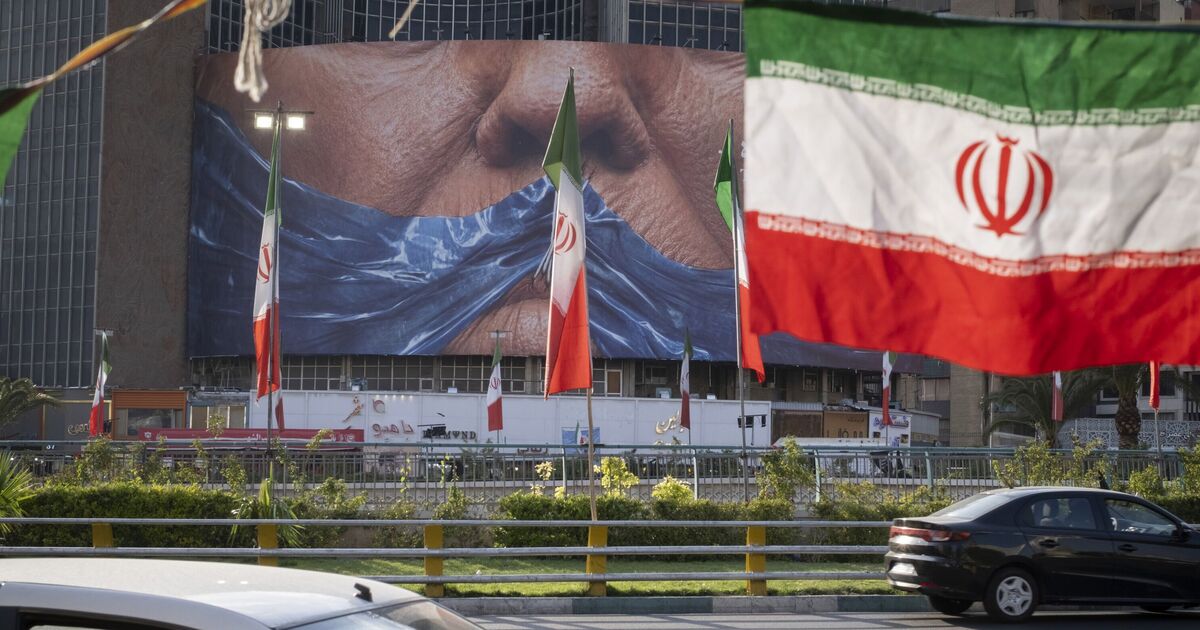
In a bold display of political defiance, a massive billboard has appeared in central Tehran, showcasing an AI-generated image that mocks former U.S. President Donald Trump as tensions escalate over the strategic Strait of Hormuz.
The provocative display, mounted on a building at Tehran’s prominent Valiasr Square, depicts Trump with a piece of blue fabric shaped like the Strait of Hormuz sewn across his mouth. The imagery symbolically represents Iran’s current control over the narrow waterway, where the Islamic Republic is preventing ships from passing without explicit permission.
This public display comes amid a fragile ceasefire between Iran and the United States, with both nations locked in a dangerous standoff over one of the world’s most critical maritime passages. The Strait of Hormuz, merely 21 miles wide at its narrowest point, typically facilitates the transport of approximately 20 percent of global oil supplies, making it an economic chokepoint of international significance.
The current crisis began after the United States and Israel launched military action against Iran on February 28, prompting Tehran to effectively close the Strait in retaliation. In response, the U.S. has established a naval blockade along the Iranian coast, creating a maritime deadlock that has reverberated through global energy markets and international trade.
Attempting to break the impasse, Trump announced a new initiative dubbed “Project Freedom” in a recent social media post. The plan aims to “guide” hundreds of stranded vessels and approximately 20,000 seafarers trapped in the Persian Gulf since hostilities began.
“Neutral and innocent countries have been affected by the Iran war,” Trump stated, “and we have told these Countries that we will guide their Ships safely out of these restricted Waterways, so that they can freely and ably get on with their business.”
The former president indicated that the initiative would commence Monday morning Middle Eastern time, suggesting that discussions with Iranian representatives could potentially lead to “something very positive for all.” However, his message also carried an unmistakable warning: “If, in any way, this Humanitarian process is interfered with, that interference will, unfortunately, have to be dealt with forcefully.”
Iranian authorities swiftly condemned the U.S. plan as a violation of the tenuous ceasefire agreement, further escalating diplomatic tensions. The statement reflects Iran’s determination to maintain leverage in the ongoing conflict by controlling access to this vital shipping lane.
The economic impact of the Strait’s closure has been profound. Energy analysts note that prolonged disruption to this crucial maritime route has triggered price volatility in oil markets, with Brent crude futures experiencing significant fluctuations. Shipping insurance premiums for vessels operating in the region have skyrocketed, adding substantial costs to global trade.
Many affected vessels carry oil, liquefied natural gas, and commercial cargo, with crews from diverse nations caught in the geopolitical crossfire. Maritime industry officials have expressed growing concern for the welfare of these seafarers, many of whom have been stranded for weeks with dwindling supplies and uncertain futures.
The billboard represents Iran’s increasing use of sophisticated propaganda techniques, including AI-generated imagery, to challenge U.S. authority in the region. This marks a notable evolution in Tehran’s information warfare strategy, leveraging advanced technology to create compelling visual narratives that resonate both domestically and internationally.
As diplomatic efforts continue behind closed doors, the public posturing from both sides suggests a resolution remains elusive. Energy security experts warn that a prolonged standoff over the Strait of Hormuz could potentially trigger a broader regional conflict with far-reaching implications for global energy supplies and economic stability.
Fact Checker
Verify the accuracy of this article using The Disinformation Commission analysis and real-time sources.

14 Comments
As an investor in mining and energy equities, I’m quite concerned about the geopolitical risks posed by the Iran-US tensions and the potential for disruptions in the Strait of Hormuz. This billboard seems more like political theater than a constructive step towards de-escalation.
I share your concerns. Geopolitical flashpoints like this can create significant volatility in commodity and equity markets. Prudent risk management will be crucial for investors exposed to this sector.
The Strait of Hormuz is a strategic chokepoint for global energy and commodity markets, so any disruptions there could have far-reaching economic consequences. This billboard seems like a provocative move by Iran, but I hope cooler heads will prevail and the parties can find a diplomatic resolution.
Well said. Maintaining the free and secure passage of ships through the Strait of Hormuz is crucial for the smooth functioning of global supply chains, especially for energy and mining industries. Constructive dialogue and compromise will be essential to mitigate the risks posed by this geopolitical standoff.
This billboard stunt by Iran is a bold move, but it’s unlikely to de-escalate the tensions in the region. The Strait of Hormuz remains a flashpoint, and any disruptions there could have serious consequences for global energy and commodity supplies.
Agreed. The Strait of Hormuz is a critical maritime chokepoint, and both sides seem unwilling to back down. This could lead to further escalation, with potential ripple effects across energy, mining, and related industries.
This billboard display by Iran seems more like a symbolic gesture than a practical solution to the underlying tensions. While it may resonate with domestic audiences, it’s unlikely to meaningfully influence the dynamics in the Strait of Hormuz or the broader geopolitical landscape.
I agree. Symbolic displays like this tend to be more about posturing than substantive policymaking. The real challenge will be finding diplomatic solutions to de-escalate the situation and ensure the free flow of critical commodities through the Strait of Hormuz.
As someone closely following the mining and commodities sector, I’m concerned about the potential impact of this Iran-US standoff on global supply chains. The Strait of Hormuz is a vital waterway, and any disruptions there could significantly affect the availability and pricing of key resources like oil, gas, and metals.
You raise a valid point. The mining and energy industries are highly sensitive to geopolitical risks, and the situation in the Strait of Hormuz bears close watching. Diversification and contingency planning may be prudent for companies and investors exposed to this region.
Interesting display of political messaging. I wonder how this billboard and the ongoing tensions in the Strait of Hormuz might impact global energy markets and commodity prices. It’s a complex geopolitical situation with far-reaching economic implications.
Absolutely, the Strait of Hormuz is a critical chokepoint for global oil supplies. Any disruptions there could significantly rattle energy and commodity markets worldwide.
This billboard seems like a bold move by Iran to assert its control over the Strait of Hormuz and challenge the US. It will be important to closely monitor how this situation develops and its potential impact on mining and energy industries.
You make a good point. Tensions in the region often spill over into the commodity markets, especially for resources like oil, gas, and metals. Investors and industry players will need to stay vigilant.