


Listen to the article
Ghana’s ruling Majority in Parliament has strongly refuted allegations made by the opposition Minority that the Ghana Gold Board (GoldBod) suffered a $214 million loss under the Gold-for-Reserves program, dismissing the claims as politically motivated misinformation designed to undermine the government’s economic achievements.
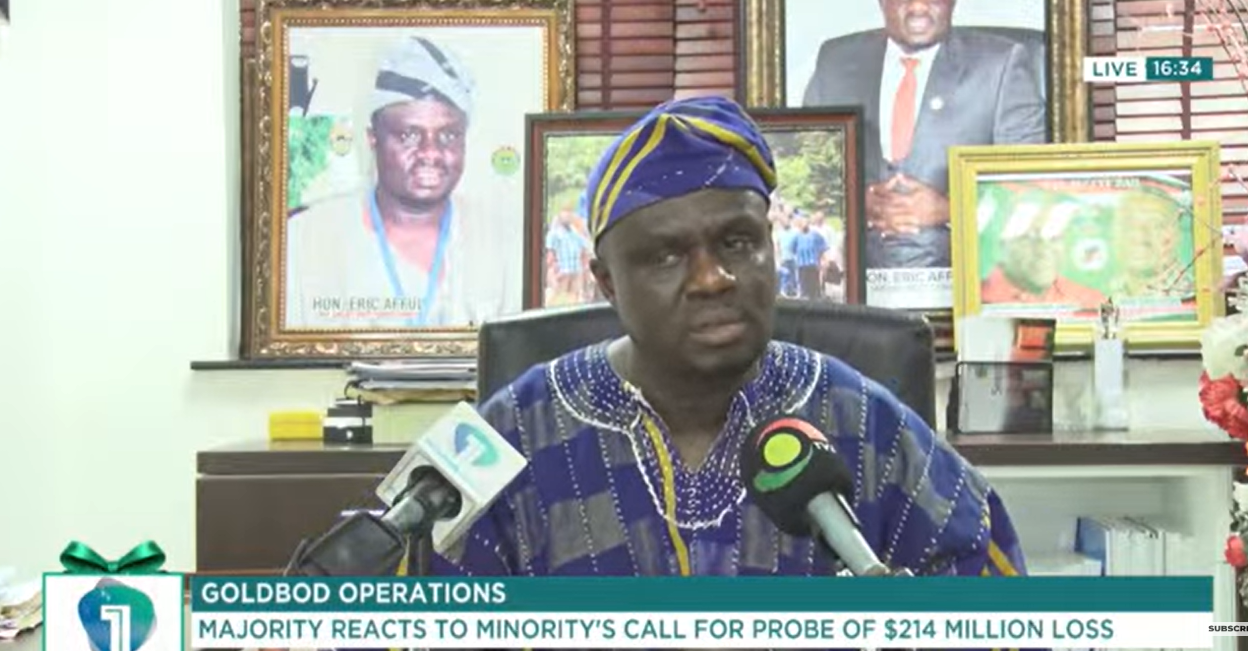
Eric Afful, who chairs Parliament’s Economy and Development Committee and represents Amenfi West constituency, clarified that the disputed figure represents normal transaction costs rather than operational losses. He accused the opposition National Patriotic Party (NPP) of deliberately spreading false information to discredit economic gains achieved under President Mahama’s administration.
“Look at the stability of the cedi now. Look at inflation and the cedi-dollar relationship. These indicators show that we are achieving results,” Afful stated. “The NPP is intentionally making this news to render our economic gains useless, but Ghanaians know what is happening.”
The committee chairman emphasized that Ghana’s economic progress has earned international recognition at recent global financial forums. “I was at the IMF and World Bank annual meetings. Ghana was applauded. The Governor of the Bank of Ghana had the chance to show the world how, within seven to eight months, we have chalked up these successes. This is serious propaganda,” he said.
Afful further explained that established financial accountability procedures are being followed. He noted that both GoldBod and the Bank of Ghana are statutorily required to present financial reports to Parliament for review, with the central bank’s accounts due by March. “The Minority is jumping the gun,” he said, insisting that the $214 million figure represents a cost of doing business, not a loss.
The dispute stems from the Minority’s call, led by Kojo Oppong Nkrumah, for a bipartisan parliamentary investigation into the alleged losses. The opposition has demanded the formation of an ad-hoc committee with authority to examine contracts, licenses, intermediaries, and related entities involved in the Gold-for-Reserves program.
Opposition leaders have specifically requested full transparency regarding fee structures, pricing formulas, selection criteria for gold aggregators, and foreign exchange arrangements. They have also proposed suspending mining permits in forest reserves and implementing strict traceability protocols, citing concerns that government funds could potentially be used to purchase gold from illegal mining operations.
The controversy gained international attention when the International Monetary Fund raised concerns about the reported losses, describing them as a potential risk to Ghana’s macroeconomic stability. The IMF specifically pointed to transactions involving artisanal and small-scale mining dore gold and referenced alleged off-taker fees charged by GoldBod.
However, GoldBod has consistently denied these allegations. CEO Sammy Gyamfi previously refuted the IMF’s claims as inaccurate, projecting an income surplus of at least 600 million cedis for 2025. Gyamfi clarified that GoldBod does not charge off-taker fees and that its role is limited to purchasing, assaying, and exporting gold on behalf of the central bank, while trading agreements fall under the Bank of Ghana’s purview.
Gyamfi has highlighted GoldBod’s significant economic contributions, including facilitating over $10 billion in foreign exchange during 2025 through the purchase of more than 100 tonnes of gold from artisanal and small-scale miners. The agency has also supported large-scale mining companies, actions that GoldBod claims have strengthened Ghana’s foreign reserves and stabilized the national currency.
The dispute underscores ongoing tensions between Ghana’s political factions over economic policy and resource management in a country where gold remains a critical export commodity and source of foreign exchange. As both sides continue to defend their positions, the debate highlights broader questions about transparency, accountability, and the effectiveness of Ghana’s natural resource governance.
Fact Checker
Verify the accuracy of this article using The Disinformation Commission analysis and real-time sources.

16 Comments
While the government’s defense of the Gold-for-Reserves program is understandable, the claims of ‘politically motivated misinformation’ seem to oversimplify a complex issue. I hope both sides can engage in a constructive dialogue to address the concerns and find a resolution.
Absolutely. Focusing on the facts and figures, rather than political rhetoric, would be a more productive approach to resolving this dispute.
The government’s defense of the Gold-for-Reserves program seems politically charged. While I appreciate the desire to highlight economic progress, it’s important to avoid dismissing legitimate scrutiny as ‘misinformation’. A balanced, fact-based analysis would be more constructive.
Agreed. This issue deserves a thorough, independent review to determine what actually occurred and ensure proper governance of public funds.
While the government’s emphasis on economic progress is understandable, the allegations around the Gold-for-Reserves program should not be dismissed so easily. Careful scrutiny and a willingness to address concerns are necessary to ensure proper governance and accountability.
Well said. A constructive, fact-based approach to resolving this issue would serve the public interest better than political posturing.
I’m curious to learn more about the specifics of these ‘transaction costs’ that the government is citing. Are they reasonable and in line with industry standards? Without more details, it’s hard to assess the validity of the opposing claims.
Absolutely. More transparency around the financials would help provide clarity and build public trust in the management of this program.
The government’s response seems overly defensive. While economic progress is important, dismissing concerns about potential financial irregularities as ‘politically motivated misinformation’ is not a constructive approach. I hope this issue can be resolved through open and impartial scrutiny.
Well said. Maintaining a calm, fact-based dialogue is crucial when dealing with complex financial matters that impact the public.
It’s encouraging to hear that Ghana’s economy has seen some positive indicators like exchange rate stability and lower inflation. However, the specific allegations around the Gold-for-Reserves program warrant a closer look to ensure proper accounting and governance.
Agreed. Economic progress is important, but it should not come at the expense of transparency and accountability.
The government’s refutation of the $214 million loss claim is noteworthy, but the lack of specifics around the ‘normal transaction costs’ is concerning. Transparency and clear accounting are crucial for maintaining public trust in these types of programs.
I agree. Without a detailed breakdown of the costs, it’s difficult to assess the validity of the government’s position. An independent audit could help provide much-needed clarity.
Interesting to see the government contest these allegations of losses. It’s important to get the facts right, especially when it comes to major financial transactions. I’d be curious to learn more about the specifics of these ‘normal transaction costs’ versus operational losses.
Yes, transparency around these types of programs is crucial. I hope the authorities can provide a clear and detailed accounting to resolve this dispute.