


Listen to the article
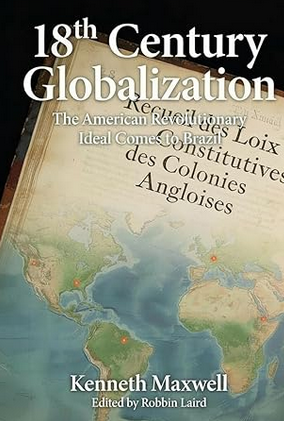
As the United States approaches the 250th anniversary of the American Revolution, a groundbreaking new book is reshaping our understanding of that pivotal historical moment by revealing its global impact. Kenneth Maxwell’s “18th Century Globalization: The American Revolutionary Ideal Comes to Brazil” examines how revolutionary ideas from Philadelphia traveled across the Atlantic to inspire an independence movement in Brazil’s mining region of Minas Gerais.
Maxwell’s work, the fifth volume in his series “Portugal and Brazil Confront the Contemporary World,” uncovers the fascinating journey of American revolutionary documents as they spread through networks of students, diplomats, and intellectuals. The book demonstrates how these ideas sparked independence movements thousands of miles from where they originated.
At the center of this story is Benjamin Franklin’s diplomatic maneuvering in Paris. From his base in the Auteuil district, where he was a frequent guest at Madame Helvétius’s salon, Franklin carefully packaged American founding documents into the “Recueil des Loix Constitutives des Colonies Angloises” (Collection of Constitutional Laws of the English Colonies). This French translation included the Declaration of Independence, draft Articles of Confederation, and several state constitutions.
This compilation was more than just a translation—it was strategic propaganda. Franklin enhanced certain elements, upgrading the “Commonwealth of Pennsylvania” to “Republic of Pennsylvania” and adding footnotes suggesting American colonies were moving toward abolition. These calculated adjustments helped secure the crucial Franco-American alliance during the Revolutionary War.
What makes Maxwell’s research particularly compelling is his tracking of how this document traveled beyond its intended audience. The Recueil was printed with false imprints labeled “Philadelphia” and “Switzerland,” allowing it to circulate as semi-clandestine literature. In 1788, José Álvares Maciel purchased a “Swiss” edition in Birmingham, England, and carried it to Minas Gerais, where it fell into the hands of local elites plotting their own revolution against Portuguese rule.
The Brazilian conspirators included prominent figures in colonial society—magistrates, lawyers, priests, and militia commanders. Among them were Tomás Antônio Gonzaga, a magistrate and accomplished poet; Cláudio Manuel da Costa, a lawyer; Canon Luís Vieira, a wealthy priest; and Colonel Inácio de Alvarenga Peixoto. These weren’t marginalized radicals but established members of society who also happened to be educated at Portugal’s reformed Coimbra University.
A surviving annotated copy of the Recueil in Ouro Preto’s Museu da Inconfidência provides remarkable insight into how these conspirators engaged with revolutionary concepts. Their margin notes reveal both sophisticated understanding of constitutional principles and fundamental misinterpretations shaped by translation errors and different political contexts. These very misreadings, Maxwell argues, were productive—allowing them to imagine possibilities that more accurate understanding might have foreclosed.
The book highlights the crucial role of mediators who translated and transported revolutionary concepts across borders. One such figure was Thomas Jefferson, who met secretly in 1787 with Brazilian student José Joaquim Maia e Barbalho (using the pseudonym Vendek). While Jefferson offered sympathy but limited support, the meeting reinforced for Maia’s circle that Brazil’s liberation was conceptually linked to the broader revolutionary movements of the era.
Maxwell unflinchingly addresses a profound contradiction at the heart of the Age of Revolutions: the same men invoking universal human rights were often substantial beneficiaries of slavery. The Minas conspirators exemplify this tension. Joaquim Silvério dos Reis, who eventually betrayed the conspiracy, owned over 200 enslaved people; Alvarenga Peixoto owned 132; even Tiradentes, the conspiracy’s most radical figure and eventual martyr, possessed enslaved people.
The book juxtaposes how American and Brazilian branches of this Atlantic conversation diverged on fundamental questions of race. While Jefferson envisioned a white republic purified of racial mixture, José Bonifácio, a key figure in Brazil’s later independence movement, argued for gradual abolition and racial amalgamation as the foundation of a future Brazilian nation.
Portuguese authorities eventually uncovered and crushed the Minas conspiracy. Tiradentes was executed on April 21, 1792—hanged, quartered, with his head displayed in Vila Rica’s central square as a warning to others. The authorities sought not merely to punish but to prevent revolutionary knowledge from spreading, especially with Europe’s attention fixed on the unfolding French Revolution.
Yet despite these efforts at erasure, the Minas project persisted in memory. Today, Tiradentes Day is celebrated annually in Brazil on April 21, representing the ultimate irony: an execution meant to erase revolutionary memory instead created a martyr whose symbolic power has only grown with time.
Maxwell’s book forces us to reconsider the American Revolution not as a self-contained national event but as a catalyst in a wider reconfiguration of political thought across the Atlantic world. Revolutionary ideas didn’t arrive in Brazil as pure theory, but through returning students’ luggage, in books’ marginalia, and in whispered reports of clandestine meetings.
As we approach the American Revolution’s 250th anniversary, “18th Century Globalization” offers a timely reminder that the founding’s contradictions—soaring rhetoric of liberty coexisting with slavery’s brutal realities—shaped not just American politics but an entire Atlantic world grappling with questions of freedom, representation, and human dignity that remain unresolved today.
Fact Checker
Verify the accuracy of this article using The Disinformation Commission analysis and real-time sources.

11 Comments
This book sounds like a must-read for anyone interested in the global dimensions of the American Revolution. Examining how Franklin’s diplomatic efforts in Paris helped inspire independence movements as far away as Brazil’s mining industry offers a fascinating new angle on this transformative period.
Franklin’s adept diplomatic maneuvering in Paris to distribute American revolutionary documents is a fascinating piece of history. The way these ideas then spread to inspire independence movements in places like Brazil’s mining regions really underscores the global nature of 18th century events.
The global reach of the American revolutionary ideals is truly remarkable. That Franklin could help spark a movement in Brazil’s mining region from his base in Paris salons speaks to the power and adaptability of these concepts. I’m eager to see how Maxwell’s book sheds light on this little-known chapter of 18th century history.
Fascinating how revolutionary ideas can spread across continents. Franklin’s diplomatic work in Paris to distribute American founding documents seems to have had a profound impact, inspiring independence movements as far away as Brazil. This book should provide fascinating insights into 18th century globalization.
This book sounds like an important contribution to our understanding of the American Revolution and its global impact. The connections between Philadelphia, Paris, and Minas Gerais are intriguing – I look forward to seeing how Maxwell unpacks this complex web of revolutionary ideas and movements.
The mining region of Minas Gerais in Brazil seems like an unexpected epicenter for revolutionary fervor inspired by American ideals. I’m curious to learn more about the networks of students, diplomats and intellectuals that helped transmit these ideas across the Atlantic.
Yes, it will be interesting to see how Franklin’s efforts to package and distribute American revolutionary documents contributed to independence movements in unexpected places like Brazil. The global diffusion of these ideals is a fascinating aspect of 18th century history.
The global spread of revolutionary ideas from Philadelphia to Brazil’s mining regions is a compelling narrative. I’m curious to learn more about the specific channels and networks that facilitated this transmission – were there particular individuals, organizations or publications that played a pivotal role?
I’m struck by how Franklin leveraged his position in Paris salons to help disseminate American revolutionary ideals. The fact that these ideas then traveled across the Atlantic to catalyze a movement in Brazil’s mining areas speaks to their power and resonance. This book promises to offer a fresh perspective on a pivotal era.
The mining industry in Brazil was clearly a key factor in the spread of revolutionary fervor from the US to that region. I wonder if there were specific economic or political grievances related to the mining sector that made it a fertile ground for these ideas to take root.
That’s a great point. The mining industry’s role in fueling revolutionary sentiment in Brazil is an angle I hadn’t considered. The book may shed light on how economic factors and local conditions intersected with the transmission of American ideals.