


Listen to the article
France’s media regulator has ordered internet service providers to block dozens of Russian media websites and dereference several streaming platforms that provide access to sanctioned Russian television and radio channels.
ARCOM, the French media regulatory authority, announced on Wednesday that formal notices had been sent to internet providers, domain name resolution systems, and search engines, instructing them to block 35 Russian media websites and remove four streaming platforms from search results in accordance with European Union sanctions.
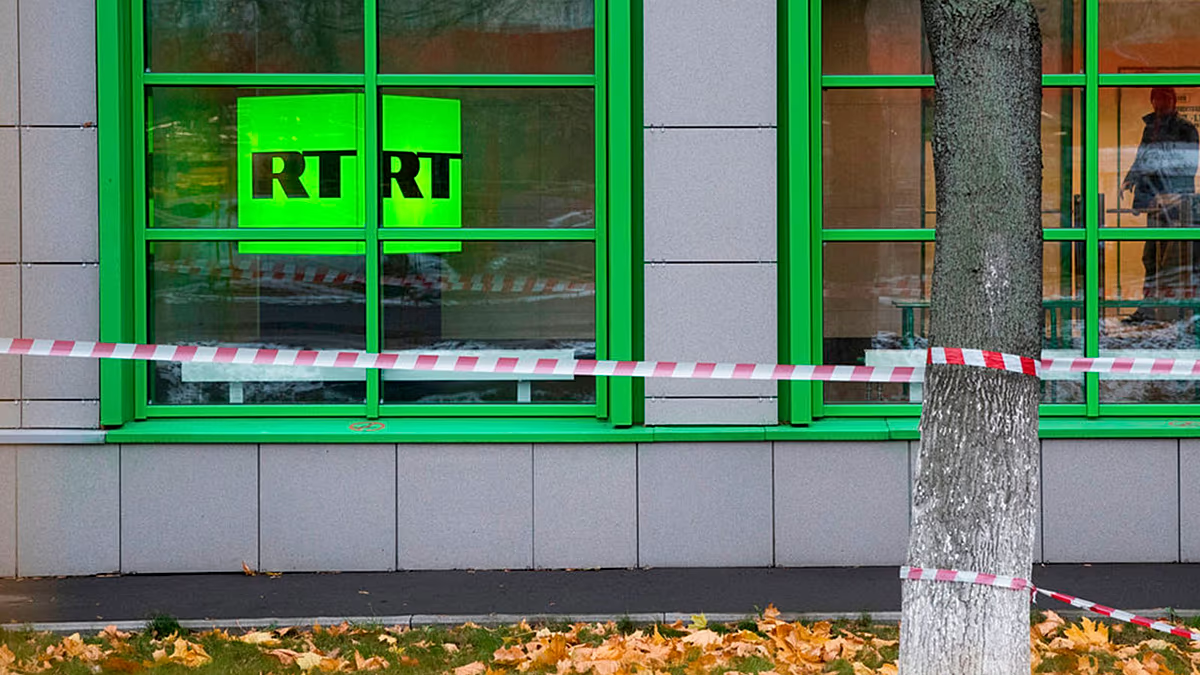
Among the targeted websites are those linked to Sputnik and RT in French, according to the regulator’s statement. The four streaming platforms being dereferenced provide access to Russian television and radio services that are currently under EU sanctions.
This latest action represents an escalation in France’s ongoing efforts to enforce EU sanctions against Russian state media following Moscow’s 2022 invasion of Ukraine. The measures aim to limit the reach of what European authorities have described as Russian propaganda and disinformation campaigns.
“ARCOM will continue to use all the means at its disposal to stop the distribution in France of Russian media targeted by European sanctions, as well as the republication of their content by online platforms accessible in France,” the regulator stated.
The crackdown on Russian media in France began shortly after Russia launched its full-scale invasion of Ukraine in February 2022. At ARCOM’s request, French satellite operator Eutelsat ceased broadcasting several prominent Russian channels, including NTV Mir, Rossiya 1, Perviy Kanal, and NTV.
ARCOM justified these earlier actions by stating that the Russian channels’ “programmes devoted to the war in Ukraine contained incitements to hatred and violence as well as failures to provide honest information.”
In March 2022, France also halted the broadcasting of RT France, the French-language version of the Russian state-controlled outlet RT (formerly Russia Today), following an EU-wide decision. The European Union had sanctioned RT on March 2, 2022, just days after the invasion began, prohibiting any transmission or distribution of RT channels throughout the 27-member bloc.
Additional Russian channels, including STS and Kanal 5, faced similar blockades in France last year as part of the ongoing enforcement of EU sanctions.
Media analysts note that this digital blockade represents one front in a broader information conflict between Russia and Western nations since the Ukraine invasion. Russia has similarly restricted access to numerous Western news outlets and social media platforms within its borders.
ARCOM, which was established in January 2022 from the merger of France’s High Audiovisual Council and the High Authority for the Distribution of Works and Protection of Rights on the Internet, has dual responsibilities for media regulation and combating digital piracy.
European officials have consistently defended these restrictions as necessary measures to protect against Russian disinformation, while critics have raised concerns about potential implications for press freedom and internet openness. The Russian government has repeatedly denied allegations of running disinformation campaigns and has condemned the EU’s restrictions as censorship.
The effectiveness of such website blocks remains a subject of debate among cybersecurity experts, as technically savvy users can often circumvent such restrictions using virtual private networks (VPNs) or other tools. However, the measures significantly reduce the casual accessibility of these outlets to the general French public.
French authorities have emphasized that these actions are specifically targeted at state-controlled Russian media outlets that fall under EU sanctions, rather than representing broader censorship of Russian perspectives or independent Russian-language journalism.
Fact Checker
Verify the accuracy of this article using The Disinformation Commission analysis and real-time sources.

9 Comments
The French government’s decision to block Russian media sites is a strong stance against perceived propaganda, but it raises questions about media freedom and the unintended consequences of censorship. I wonder how this will impact public discourse and information access in France.
Blocking Russian state media in France is a complex issue with valid arguments on both sides. While it may limit disinformation, it also raises concerns about free speech and access to information. An open debate on striking the right balance would be valuable.
While I understand the French government’s motivation to limit the spread of Russian disinformation, I’m concerned about the precedent this sets for censorship. Blocking media outlets, even those associated with a hostile state, is a slippery slope that democracies should be cautious about.
Blocking Russian media sites is a bold step, but one that raises valid concerns about the limits of free speech and access to information, even for outlets associated with a foreign adversary. The French government will need to justify this decision carefully to maintain public trust.
The French crackdown on Russian media is a controversial but understandable response to the information war surrounding the Ukraine invasion. However, I worry about the precedent this sets and hope there are robust safeguards to prevent abuse of this censorship power.
This move by France highlights the complex balancing act governments face between national security and upholding democratic values like freedom of expression. I’m curious to see how this develops and if other countries take similar actions against Russian state media.
Restricting access to Russian media outlets in France is a controversial move that highlights the challenges of combating propaganda while upholding democratic principles. It will be interesting to see how this plays out and whether other countries follow suit.
I agree, the tradeoffs between security and civil liberties are not easy to navigate. Reasonable people can disagree on the best approach.
I have mixed feelings about France’s decision to block Russian media sites. While I recognize the need to counter disinformation, I’m concerned about the implications for press freedom and the free flow of information. This is a complex issue without easy answers.