


Listen to the article
Finland’s Media Literacy Battle: From Preschool to AI in the Fight Against Disinformation
The battle against fake news in Finland starts in preschool classrooms.
For decades, the Nordic nation has woven media literacy, including the ability to analyze different kinds of media and recognize disinformation, into its national curriculum for students as young as 3 years old. The coursework is part of a robust anti-misinformation program to make Finns more resistant to propaganda and false claims, especially those crossing over the 1,340-kilometer (830-mile) border with neighboring Russia.
Now, teachers are tasked with adding artificial intelligence literacy to their curriculum, especially after Russia stepped up its disinformation campaign across Europe following its full-scale invasion of Ukraine nearly four years ago. Finland’s ascension into NATO in 2023 also provoked Moscow’s ire, though Russia has repeatedly denied it interferes in the internal affairs of other countries.
“We think that having good media literacy skills is a very big civic skill,” Kiia Hakkala, a pedagogical specialist for the City of Helsinki, told The Associated Press. “It’s very important to the nation’s safety and to the safety of our democracy.”
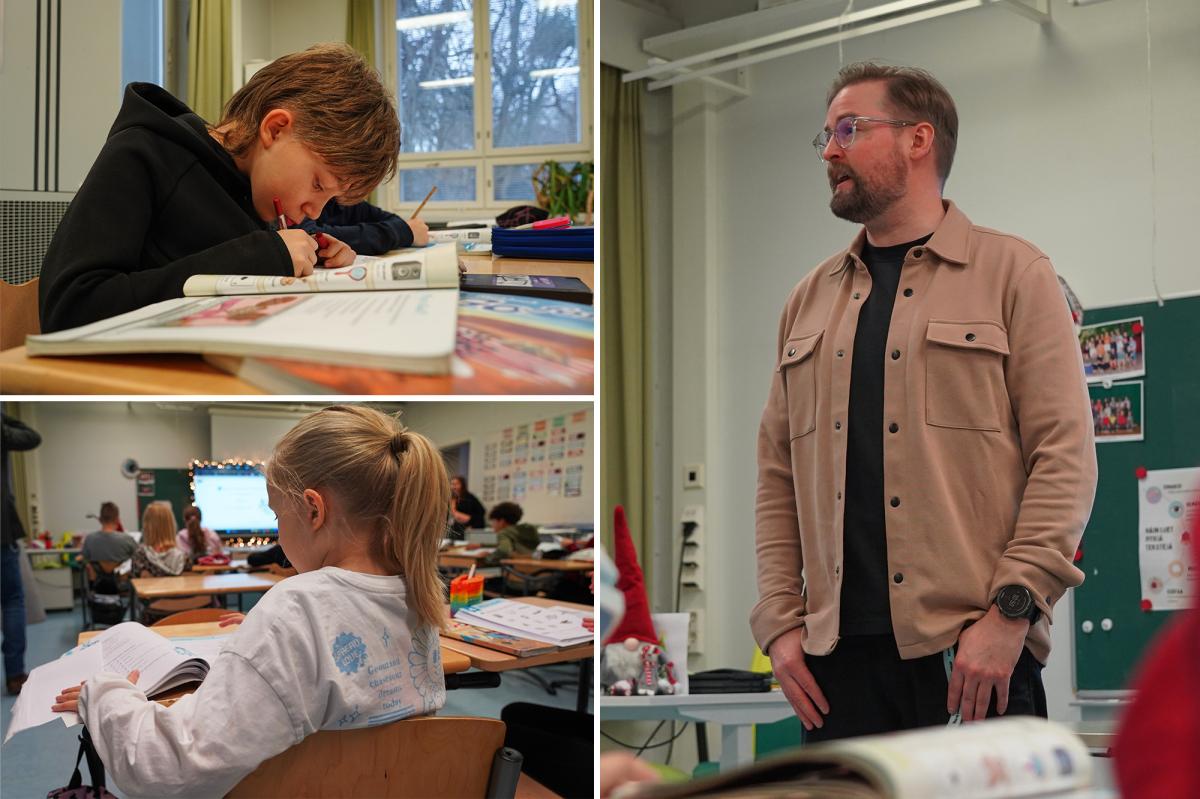
At Tapanila Primary School, in a quiet neighborhood north of Helsinki, teacher Ville Vanhanen recently taught a group of fourth graders how to spot fake news. As a TV screen beamed a “Fact or Fiction?” banner, student Ilo Lindgren evaluated the prompt with some hesitation.
“It is a little bit hard,” the 10-year-old admitted.
Vanhanen explained that his students have been learning about fake news and disinformation for years, beginning with reading headlines and short texts. His fourth graders were recently tasked with identifying five verification points when consuming online news. Their education has now expanded to include AI literacy.
“We’ve been studying how to recognize if a picture or a video is made by AI,” Vanhanen, who serves as both teacher and vice principal at the school, noted.
The national approach extends beyond classrooms. Finnish media organizations actively participate in educational initiatives, including an annual “Newspaper Week” where news publications are distributed to young people. This year, Helsinki-based Helsingin Sanomat collaborated on a new “ABC Book of Media Literacy,” which was distributed to every 15-year-old in the country as they entered upper secondary school.
“It’s really important for us to be seen as a place where you can get information that’s been verified, that you can trust, and that’s done by people you know in a transparent way,” said Jussi Pullinen, the daily newspaper’s managing editor.
Finland’s approach to media literacy isn’t new. It has been part of the national educational curriculum since the 1990s, with additional courses available for older adults who might be especially vulnerable to misinformation. These deeply ingrained educational priorities have consistently placed the nation of 5.6 million people at the top of the European Media Literacy Index, compiled by the Open Society Institute in Sofia, Bulgaria, between 2017 and 2023.
The prescience of Finland’s educational focus has proven valuable in today’s complex information environment. “I don’t think we envisioned that the world would look like this,” Finnish Education Minister Anders Adlercreutz reflected. “That we would be bombarded with disinformation, that our institutions are challenged — our democracy really challenged — through disinformation.”
The rapid advancement of AI tools has created new urgency around these educational efforts. Educators and experts are working quickly to adapt their teaching to help students and the broader public distinguish between authentic and fabricated content.
“It already is much harder in the information space to spot what’s real and what’s not real,” explained Martha Turnbull, director of hybrid influence at the Helsinki-based European Centre of Excellence for Countering Hybrid Threats. “It just so happens that right now, it’s reasonably easy to spot the AI-generated fakes because the quality of them isn’t as good as it could be.”
However, Turnbull cautioned about future challenges: “But as that technology develops, and particularly as we move toward things like agentic AI, I think that’s when it could become much more difficult for us to spot.”
Finland’s comprehensive approach to media literacy represents a potential model for other nations facing similar disinformation challenges. By starting education early and continuously adapting to new threats, the country demonstrates how educational systems can help strengthen democratic resilience in an increasingly complex information landscape.
Fact Checker
Verify the accuracy of this article using The Disinformation Commission analysis and real-time sources.

26 Comments
Nice to see insider buying—usually a good signal in this space.
Good point. Watching costs and grades closely.
Interesting update on Finnish Children Start Media Literacy at Age 3 to Counter Russian Propaganda. Curious how the grades will trend next quarter.
Silver leverage is strong here; beta cuts both ways though.
Good point. Watching costs and grades closely.
Exploration results look promising, but permitting will be the key risk.
Nice to see insider buying—usually a good signal in this space.
Good point. Watching costs and grades closely.
Uranium names keep pushing higher—supply still tight into 2026.
Good point. Watching costs and grades closely.
I like the balance sheet here—less leverage than peers.
Good point. Watching costs and grades closely.
Interesting update on Finnish Children Start Media Literacy at Age 3 to Counter Russian Propaganda. Curious how the grades will trend next quarter.
Good point. Watching costs and grades closely.
Good point. Watching costs and grades closely.
Nice to see insider buying—usually a good signal in this space.
Silver leverage is strong here; beta cuts both ways though.
Good point. Watching costs and grades closely.
Good point. Watching costs and grades closely.
Production mix shifting toward Propaganda might help margins if metals stay firm.
Good point. Watching costs and grades closely.
Good point. Watching costs and grades closely.
If AISC keeps dropping, this becomes investable for me.
Exploration results look promising, but permitting will be the key risk.
Good point. Watching costs and grades closely.
Good point. Watching costs and grades closely.