


Listen to the article
Finland’s decade-long battle against misinformation is entering a new phase as the nation’s pioneering media literacy curriculum adapts to include artificial intelligence awareness, even for its youngest students.
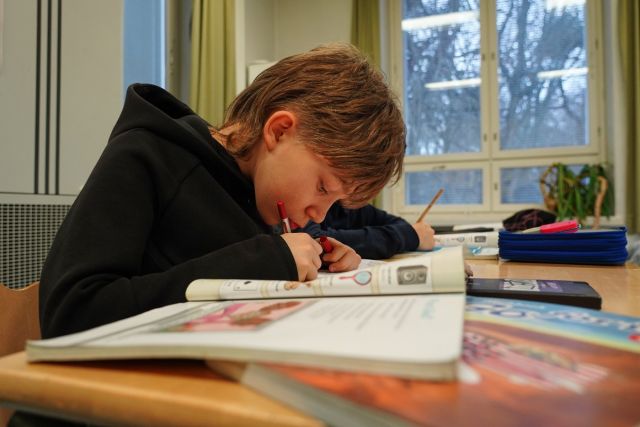
In a quiet neighborhood north of Helsinki, fourth graders at Tapanila Primary School evaluate news stories under a projected “Fact or Fiction?” banner. Ten-year-old Ilo Lindgren admits the task is challenging, but these Finnish students have been developing critical media evaluation skills since their earliest school years.
“We’ve been studying how to recognize if a picture or a video is made by AI,” explains Ville Vanhanen, a teacher and vice principal at Tapanila Primary. His students have progressed from analyzing simple headlines to identifying sophisticated disinformation techniques.
Finland’s comprehensive approach to media literacy begins with preschoolers as young as three and continues throughout the educational system. The Nordic nation has integrated these skills into its national curriculum for decades, creating what many consider the world’s most media-literate population.
“We think that having good media literacy skills is a very big civic skill,” says Kiia Hakkala, a pedagogical specialist for the City of Helsinki. “It’s very important to the nation’s safety and to the safety of our democracy.”
The stakes are particularly high given Finland’s 1,340-kilometer (830-mile) border with Russia, a country that has intensified its European disinformation campaigns following its full-scale invasion of Ukraine nearly four years ago. Finland’s 2023 NATO membership further strained relations, though Russia consistently denies interfering in other nations’ affairs.
Finnish news organizations actively support these educational efforts. The country’s annual “Newspaper Week” provides young people with access to news publications, and in 2024, Helsinki-based Helsingin Sanomat collaborated on a new “ABC Book of Media Literacy” distributed to all 15-year-olds entering upper secondary education.
“It’s really important for us to be seen as a place where you can get information that’s been verified, that you can trust, and that’s done by people you know in a transparent way,” says Jussi Pullinen, Helsingin Sanomat’s managing editor.
The commitment to media literacy extends beyond schools. Additional courses target older adults who may be particularly vulnerable to misinformation. This whole-society approach has consistently earned Finland top ranking in the European Media Literacy Index, compiled annually by Bulgaria’s Open Society Institute between 2017 and 2023.
Finnish Education Minister Anders Adlercreutz reflects on the evolving challenges: “I don’t think we envisioned that the world would look like this. That we would be bombarded with disinformation, that our institutions are challenged—our democracy really challenged—through disinformation.”
The rapid advancement of AI tools has added urgency to these efforts. Educators and security experts are racing to adapt their teaching to encompass increasingly sophisticated fake content.
Martha Turnbull, director of hybrid influence at the Helsinki-based European Centre of Excellence for Countering Hybrid Threats, warns that distinguishing between real and fabricated content will become increasingly difficult. “It already is much harder in the information space to spot what’s real and what’s not real,” she says, adding that current AI-generated fakes remain relatively easy to identify due to quality limitations.
“But as that technology develops, and particularly as we move toward things like agentic AI, I think that’s when it could become much more difficult for us to spot,” Turnbull cautions.
Finland’s proactive approach to media literacy offers a model for other nations grappling with misinformation. By embedding these skills throughout its educational system and broader society, the country is building resilience against propaganda and false claims—whether they originate from traditional sources or advanced artificial intelligence.
Fact Checker
Verify the accuracy of this article using The Disinformation Commission analysis and real-time sources.

9 Comments
As someone who closely follows the mining and commodities space, I’m intrigued by how this media literacy curriculum might extend to understanding the role of natural resources in geopolitics and economic development. Curious to see if that dimension is incorporated.
That’s a great point. Media literacy skills could be incredibly useful for analyzing how news and information around mining, energy, and other key commodities can be shaped by various interests and agendas.
I’m curious to learn more about the specific curriculum and teaching methods Finland uses to instill media literacy. Are there any unique or innovative techniques they employ for such young students?
That’s a great question. The article mentions they adapt the curriculum to include AI awareness, which is an interesting and forward-looking approach. I’d be interested to see if other countries adopt similar media literacy programs.
Finland’s proactive approach to media literacy education is truly inspiring. Instilling these critical thinking skills from such a young age will undoubtedly serve their students well as they navigate the complex information landscape of the future.
Impressive that Finland is taking such a proactive approach to media literacy, even at the preschool level. Teaching kids to critically evaluate online content and recognize AI-generated media is a crucial life skill in the digital age.
Agreed. Developing this critical thinking ability from an early age will serve these students well as they navigate an increasingly complex media landscape.
In the face of rising misinformation and disinformation campaigns, Finland’s proactive stance on media literacy education is admirable. Equipping students with the tools to identify fact from fiction is a valuable investment in their future.
Absolutely. Given the pervasive influence of propaganda, especially from geopolitical rivals like Russia, Finland’s efforts to inoculate their youth against such manipulation are both timely and essential.