


Listen to the article
Nazi Cinema’s Legacy: “Hitler’s Hollywood” Documentary Examines UFA’s Propaganda Machine
The documentary format has emerged as a powerful medium in today’s media landscape, particularly as concerns about artificial intelligence’s impact on fact-based journalism continue to grow. Among recent notable documentary releases, “Hitler’s Hollywood” stands out as a revealing examination of the Third Reich’s film propaganda apparatus, offering viewers a disturbing glimpse into how cinema became a tool for ideological control.
Released by Kino Lorber, a distribution company known for curating exceptional foreign cinema, this 2018 documentary delves into the operations of UFA (Universum Film AG), the influential film studio that operated under the direct oversight of Joseph Goebbels’ Ministry of Propaganda and Enlightenment during the Nazi era.
The film, directed by Rüdiger Suchsland with narration by Udo Kier, meticulously documents how UFA transformed Germany into the epicenter of European cinema during the 1930s and early 1940s. Under Goebbels’ watchful eye and Hitler’s artistic preferences, UFA produced a wide variety of content—from comedies and romances to musicals, dramas, and historical epics—all carefully designed to subtly (and sometimes overtly) shape the collective German consciousness.
What makes “Hitler’s Hollywood” particularly compelling is its exploration of the relationship between entertainment and ideology. While UFA produced films across numerous genres, each production ultimately served the Nazi regime’s propaganda aims. Goebbels, understanding cinema’s unique power to influence public opinion, allowed creative freedom within strict ideological boundaries, ensuring that all content aligned with the party’s vision of “Aryan” culture.
The documentary also sheds light on a little-known chapter of pre-war Hollywood history. Major American studios, concerned about losing lucrative German market share, often acquiesced to Nazi demands regarding film content. The Nazi consul in Los Angeles regularly lodged complaints with the Motion Picture Production Code Administration, successfully pressuring for the editing, censorship, or outright banning of anti-Nazi films in markets with significant German-American populations or strong America First chapters.
This collaboration only began to fracture in 1936 when Warner Brothers, taking a stand against fascism, closed its German operations. Other studios—Columbia, RKO, Disney, and Universal—eventually followed suit. In response, the Nazi regime further bolstered UFA’s funding and reach, positioning it as the primary vehicle for German “information, enlightenment, and entertainment.”
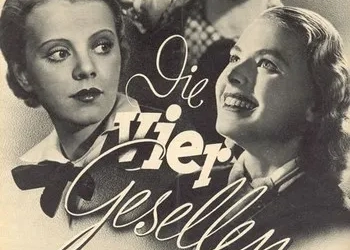
One fascinating segment of the documentary highlights the 1938 drama “Die vier Gesellen” (“The Four Companions”), which featured an unexpectedly progressive plot about four female art school graduates attempting to establish their own graphic design agency in a male-dominated field. Remarkably, one of the film’s stars was Swedish-born Ingrid Bergman, who would later become an American film icon and star in Alfred Hitchcock’s “Notorious” (1946), playing an anti-Nazi spy alongside Cary Grant.
The documentary also examines UFA’s more explicit propaganda works, including Leni Riefenstahl’s infamous “Triumph of the Will,” which documented Hitler’s 1934 Nuremberg rally, and Veit Harlan’s 1945 historical epic “Kolberg.” These films represent the most direct examples of cinema being weaponized for political purposes during the Nazi era.
“Hitler’s Hollywood,” presented in both German and English, serves as a sobering reminder of how artistic mediums can be corrupted by authoritarian regimes. It illustrates the dangers of state control over creative industries and demonstrates how entertainment can become a vehicle for propaganda when critical institutions fall under political influence.
As we navigate today’s complex media landscape, with concerns about misinformation and propaganda resurging globally, this documentary offers valuable historical context and a warning about the potential for artistic expression to be manipulated for ideological ends.
Fact Checker
Verify the accuracy of this article using The Disinformation Commission analysis and real-time sources.

9 Comments
The Nazi’s manipulation of cinema as a propaganda tool is a sobering and important history to study. I’m curious to see how this documentary examines the nuances of that relationship between art, ideology, and control.
Fascinating look at the insidious ways propaganda can infiltrate entertainment. It’s a sobering reminder of the power of cinema and the responsibility of creators to avoid misuse. I wonder how modern audiences would react to those historical UFA films today.
Absolutely, the blurring of entertainment and propaganda is a concerning trend we still see today. Careful curation and critical analysis of media is so important.
As concerning as the subject matter is, I appreciate the opportunity to learn more about this dark chapter in cinematic history. Documentaries like this help us confront the complexities of how entertainment and politics can dangerously intersect.
Absolutely. Maintaining a critical eye towards the ways media can be weaponized is crucial, especially as new technologies continue to evolve. This film seems like an important contribution to that ongoing discussion.
While the topic is heavy, I’m glad to see this documentary shining a light on an important and lesser-known aspect of Nazi Germany’s propaganda machine. Exploring cinema’s potential for both enlightenment and manipulation is a vital endeavor.
The use of film as a tool of ideological control is a chilling but essential subject to explore. This documentary seems like an important contribution to our understanding of how propaganda can co-opt artistic mediums. I look forward to seeing it.
This documentary seems like an important historical examination of how the Nazi regime leveraged film as a tool of ideological control. It’s a cautionary tale about the dangers of unchecked state influence over the arts.
Yes, the intersection of cinema, politics, and propaganda is a complex and troubling topic. Studying these past abuses can help us be more vigilant about preserving artistic freedom.