


Listen to the article
#
A reader’s sharp critique of editorial cartoon sparks debate over Middle East conflict portrayal
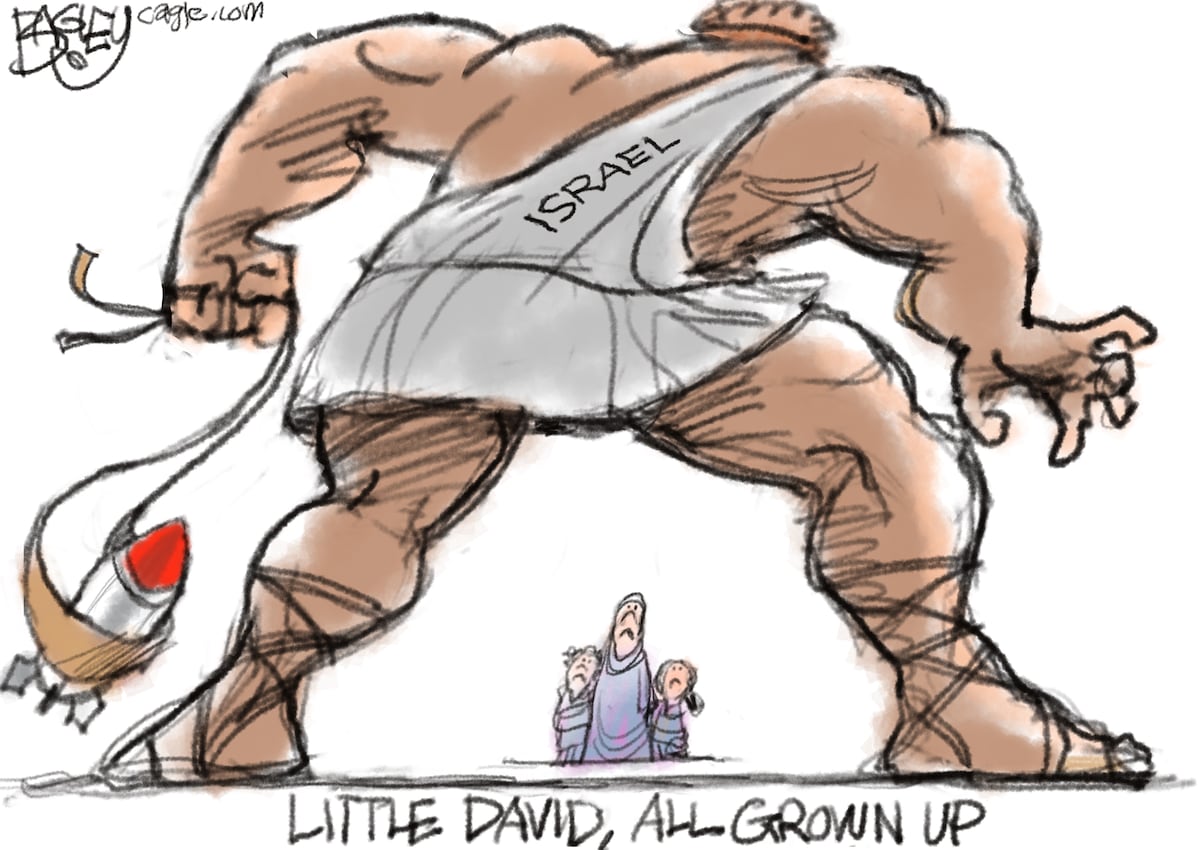
A Salt Lake City resident has criticized local cartoonist Pat Bagley’s recent editorial illustration, “David and Goliath Revisited,” claiming it presents a misleading narrative of the ongoing Israel-Hamas conflict.
In a letter to The Salt Lake Tribune, Mark Cantor from Salt Lake City questioned the cartoon’s portrayal of Israel as the aggressor against innocent Palestinian civilians. Cantor argued that Bagley’s work omitted crucial context about the October 7, 2023 Hamas attack on Israel that precipitated the current conflict.
“Did I miss his cartoon depicting Hamas and Gazan civilians invading Israel, raping and murdering festival goers, shooting people in their cars trying to escape the onslaught, invading homes and burning and shooting families (including babies) to death and taking, torturing and killing civilian hostages, many of whom were held captive by Gaza civilians?” Cantor wrote.
The letter writer also noted the absence of illustrations addressing Hezbollah’s rocket attacks from Lebanon into northern Israel and Israel’s efforts to warn civilians before military strikes.
“Bagley’s view of a strong Israel fighting only helpless women and children is not commentary, it’s propaganda,” Cantor concluded.
The exchange highlights the intensely polarized perspectives surrounding media coverage of the Israel-Gaza conflict, which has now stretched into its ninth month. Since October 7, when Hamas militants attacked southern Israel killing approximately 1,200 people and taking over 250 hostages, Israel’s military response in Gaza has resulted in over 35,000 Palestinian casualties, according to Gaza health authorities.
Editorial cartoons often distill complex geopolitical situations into single-panel illustrations that inevitably emphasize certain aspects of conflicts while minimizing others. This compression of narrative can lead to accusations of bias from readers who feel their perspective isn’t adequately represented.
The Tribune, like many American newspapers, has faced increasing scrutiny from readers across the political spectrum regarding its coverage of the Middle East conflict. Media outlets nationwide have struggled to balance comprehensive reporting with the highly charged nature of the Israel-Gaza war, where competing historical narratives and immediate humanitarian concerns often clash.
Pat Bagley has been The Salt Lake Tribune’s editorial cartoonist since 1979, winning numerous awards for his work. Editorial cartoons traditionally serve as visual opinion pieces rather than objective news reporting, though they remain influential in shaping public discourse.
The debate over media representation of the conflict reflects broader tensions in American public opinion. Recent polls show Americans increasingly divided over the Israel-Gaza war, with significant generational gaps in perspectives about the conflict.
For news organizations, navigating these tensions while maintaining journalistic integrity has proven challenging. Many outlets have emphasized the importance of contextualizing both the immediate violence and the longer historical factors that have shaped the conflict.
The Salt Lake Tribune, which transitioned to nonprofit status in 2019, continues to encourage reader engagement through letters to the editor and community forums. Such exchanges represent the newspaper’s commitment to fostering civic dialogue on controversial issues affecting both global politics and local communities.
As the Middle East conflict continues with no immediate resolution in sight, debates over its representation in media—including editorial cartoons—will likely remain a fixture of American public discourse.
#
Fact Checker
Verify the accuracy of this article using The Disinformation Commission analysis and real-time sources.

16 Comments
This is a complex geopolitical issue with a long and contentious history. While I understand the concern about potential bias in the cartoon, I think it’s important to engage with multiple perspectives and avoid reflexive accusations of propaganda. Thoughtful, fact-based discussion is needed.
I agree that oversimplification and one-sided narratives are counterproductive. A more balanced, contextual approach is essential for understanding such a nuanced conflict.
The Israel-Palestine conflict is highly emotive and politically charged. I think it’s crucial that media coverage strives for objectivity and avoids sensationalism or one-sided narratives, no matter which side is being portrayed. Balanced reporting is essential for informed public discourse.
You raise a fair point. Cartoons and editorials can sometimes gloss over important nuances and context. A more thorough, nuanced analysis would be valuable here.
The Israel-Palestine conflict is deeply rooted and multifaceted. While I understand the critique of the cartoon, I think it’s important to avoid reflexive accusations of propaganda and instead engage with the issue more holistically. Thoughtful, nuanced discussion is needed to move the conversation forward.
You make a fair point. Oversimplification and one-sided narratives can be counterproductive. A more balanced, contextual approach would be valuable in this case.
The Israel-Palestine conflict is deeply divisive, and media coverage can certainly shape public perception. While I understand the critique of the cartoon, I think we need to be cautious about dismissing it as pure propaganda. A more measured, nuanced analysis would be beneficial.
You make a fair point. It’s important to avoid knee-jerk reactions and instead engage thoughtfully with the complexities of this longstanding conflict.
This is a sensitive and contentious issue, and I can understand the concerns raised about potential bias in the media coverage. However, I think it’s important to engage with multiple perspectives and avoid overly simplistic narratives. A more nuanced, fact-based discussion would be beneficial.
I agree that balanced reporting is essential when covering such a complex geopolitical situation. Accusations of propaganda are unlikely to foster productive dialogue.
The Israel-Palestine conflict is deeply complex, with valid grievances on both sides. While I understand the critique of the cartoon, I think it’s important to engage with the issue more holistically and avoid knee-jerk accusations of propaganda. Thoughtful, nuanced discussion is needed.
You raise a fair point. Oversimplification and one-sided narratives can be counterproductive. A more balanced, contextual approach would be valuable here.
This is a very sensitive and contentious issue, and I can understand the concerns raised about potential bias in the cartoon. However, I think it’s important to engage with multiple perspectives and avoid overly simplistic narratives. A more nuanced, fact-based discussion would be valuable here.
I agree that balanced, contextual reporting is essential when covering such a complex geopolitical situation. Accusations of propaganda are unlikely to foster productive dialogue.
This is a sensitive and complex issue. While I understand the critique of the cartoon, I think it’s important to consider multiple perspectives on the conflict and the role of media portrayal. A nuanced, fact-based analysis would be more constructive than accusations of propaganda.
I agree that both sides have valid grievances and that the situation requires careful examination. Oversimplification often leads to further polarization.