


Listen to the article
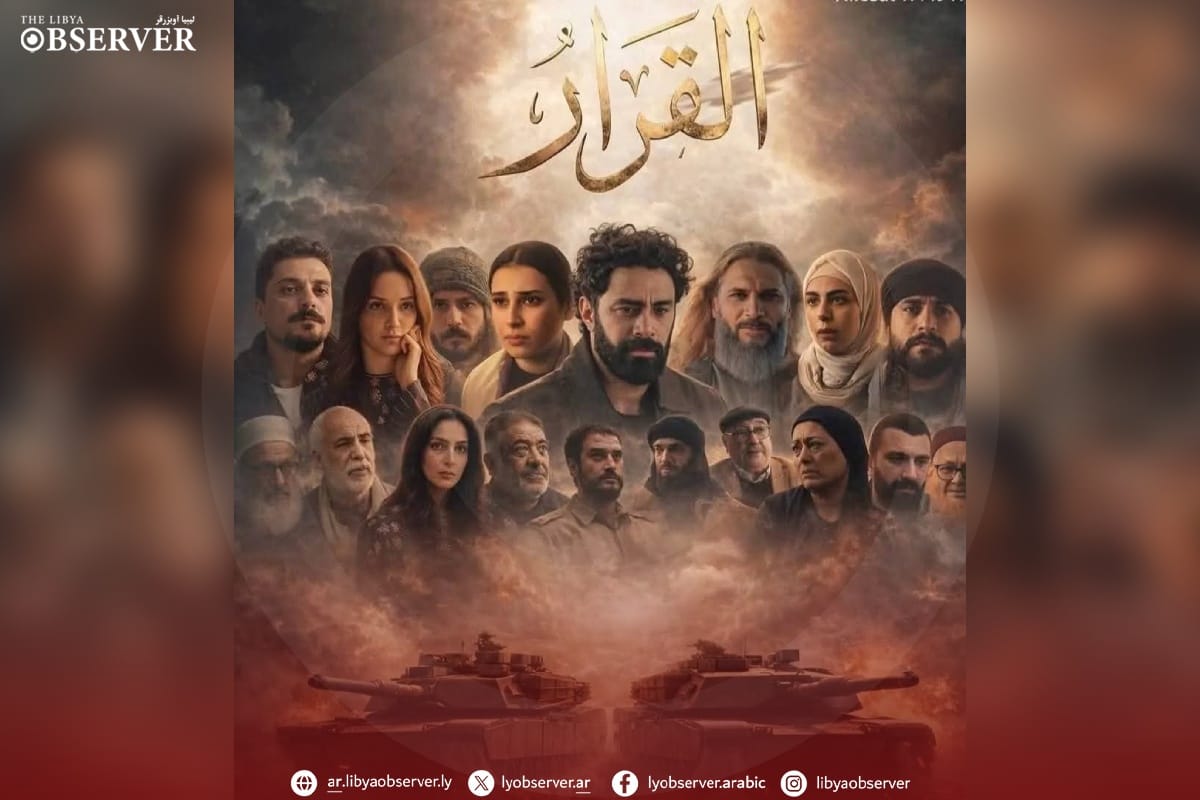
A controversial Libyan television drama that premiered during Ramadan has sparked outrage across the country, with critics condemning it as thinly-veiled propaganda designed to rehabilitate the public image of the Haftar family.
“The Decision” (Al-Qarar), financially backed by associates with close ties to Khalifa Haftar’s family, offers a dramatized portrayal of the 2014 “Operation Dignity” military campaign in Benghazi. The series presents Haftar, a polarizing military leader who controls eastern Libya, as a heroic figure who rescued the city from extremist control while depicting all opposition forces as terrorists, regardless of their actual affiliations.
The controversial production includes emotionally charged scenes, such as one featuring a married woman from Benghazi who is forcibly taken from her father by an ISIS militant. Critics argue this narrative device deliberately frames Benghazi as a lawless territory overrun by extremists until Haftar and his sons intervened to restore order—a characterization many Libyans dispute as an oversimplification of a complex conflict.
Media analysts have pointed to striking similarities between “The Decision” and the Egyptian series “The Choice” (Al-Ikhtiyar), which portrayed Egypt’s military actions in a favorable light. Some observers describe the Libyan production as essentially a “copy-paste” adaptation of the Egyptian series, repurposed to legitimize Haftar’s military campaign and political aspirations in Libya.
“This is revisionist history at its most blatant,” said a Libyan political analyst who requested anonymity for safety reasons. “The series completely ignores documented human rights abuses committed during Operation Dignity while elevating Haftar family members to near-mythical status.”
The multi-million dollar production has faced accusations of deliberately exaggerating the roles played by members of the Haftar family and their allies while minimizing or entirely omitting the contributions of other significant figures who participated in the Benghazi conflict. This selective storytelling has particularly angered families of fighters who died during the campaign but receive no recognition in the dramatization.
Libya remains deeply divided following the 2011 uprising that toppled longtime dictator Muammar Gaddafi. The country has experienced years of civil conflict, with Haftar’s Libyan National Army controlling the eastern part of the country while various other factions, including the internationally recognized Government of National Unity, hold power elsewhere. Attempts at national reconciliation have repeatedly faltered amid deep political divisions.
As criticism mounted across social media platforms and public forums, Shahid—the region’s largest streaming platform owned by the MBC Group—made the decision to remove the series from its lineup. The platform pulled promotional trailers and episodes shortly after their release, responding to significant public pressure and concerns about becoming a “propaganda tool” for the Haftar family.
“The controversy surrounding ‘The Decision’ highlights the ongoing battle over historical narrative in post-revolution Libya,” explained Dr. Layla Mahmoud, a media studies professor at the University of Tripoli. “Media productions like this aren’t merely entertainment—they’re attempts to shape public memory and legitimize specific power structures.”
The backlash against “The Decision” reflects broader tensions in Libya’s fragmented media landscape, where content often aligns with competing political and military factions. Entertainment programming has increasingly become a battleground for shaping public opinion in a country still struggling to establish stable governance and national unity following years of conflict.
Despite being removed from Shahid, the series continues to circulate through other channels, ensuring the controversy will likely persist throughout the remainder of Ramadan, traditionally a peak season for television viewership across the Arab world.
Fact Checker
Verify the accuracy of this article using The Disinformation Commission analysis and real-time sources.

8 Comments
As someone interested in geopolitics, I find this case study in the use of media for political influence quite fascinating, if concerning. The line between historical drama and propaganda can be blurry, and I wonder how audiences in Libya and the region are navigating these issues.
This seems like a concerning case of using entertainment media to shape public perception of a controversial political figure. Removing the drama from the streaming platform was probably the right call, given the potential for misinformation. I hope Libyan audiences can access more objective coverage of their country’s history.
Interesting to see the controversy around this Libyan TV drama. Clearly a politically-charged depiction of the Benghazi conflict that aims to portray Haftar in a heroic light. I’d want to learn more about the nuances of the Libyan civil war before forming an opinion on this.
As an observer, I can see how this drama could be seen as propaganda. Presenting a complex conflict in such a one-sided way is concerning. I wonder if there are other Libyan media perspectives that offer a more balanced portrayal of the events.
The Libyan civil war is a complex and tragic situation, and this drama seems to be a concerning attempt to reframe the conflict through a pro-Haftar lens. I agree that removing it from the streaming platform was likely the right call, but I also hope Libyans have access to a diversity of perspectives on their country’s history.
This is a tricky situation – the alleged propagandistic nature of the drama is troubling, but outright censorship also raises concerns about free expression. I hope there can be a balanced, fact-based public discourse in Libya about their history and politics, without resorting to one-sided narratives.
The removal of this drama from the streaming platform is understandable given the accusations of propaganda. However, I’m curious to hear more from Libyan viewers on how they perceived the portrayal of the events. Were there any nuances that the outside world may be missing?
That’s a good point. Getting perspectives from within Libya would provide valuable context. The conflict there is complex, and an outsider’s view may overlook important local dynamics.