


Listen to the article
China’s Covert Social Media Campaign Targets Hong Kong Protests
Social media giants Twitter, Facebook, and Google have taken coordinated action against a network of accounts linked to the Chinese government that were spreading disinformation about Hong Kong’s protest movement.
On August 19, Twitter announced the suspension of 936 accounts originating from the People’s Republic of China (PRC). The company stated these accounts were “deliberately and specifically attempting to sow political discord in Hong Kong” and undermining the legitimacy of the protest movement. Twitter cited “reliable evidence” that this was a “coordinated state-backed operation.”
Facebook followed suit the same day, removing 15 accounts, pages, and groups that formed “a small network that originated in China and focused on Hong Kong.” The company discovered links between these accounts and “individuals associated with the Chinese government.” Three days later, Google removed 210 YouTube channels that were uploading videos about the Hong Kong protests in a coordinated manner.
This revelation highlights how social media has become a new battleground for PRC state-directed propaganda efforts aimed at protecting Chinese Communist Party (CCP) interests. The campaign represents a significant attempt by Chinese entities to shape international opinion through Western social media platforms.
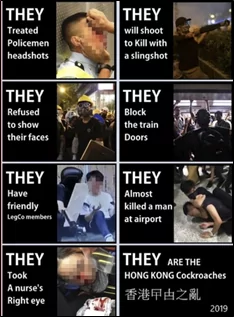
The propaganda spread through these accounts followed five main themes: portraying unified Chinese support for government policies toward Hong Kong; claiming the protest movement is secretly controlled by the United States as part of a “color revolution”; labeling protestors as terrorists with American backing; depicting Hong Kong police as heroic protectors; and dehumanizing protesters by comparing them to insects like cockroaches and locusts.
While the first four points align with official PRC messaging, the dehumanization theme appears unique to this covert campaign. Such rhetoric potentially carries disturbing implications about how protesters should be treated.
Notably, many accounts posted content in both English and Chinese, suggesting they targeted international audiences and Chinese-speaking communities outside mainland China. The use of Western platforms like Twitter and Facebook—which are blocked in China but accessible in Hong Kong—further indicates an international focus.
The accounts employed virtual private networks (VPNs) and other techniques to disguise their origins. Ironically, VPNs are officially banned within China, though their use persists despite potential legal consequences and reduced “social credit” scores.
While these covert accounts have been suspended, official PRC state media outlets continue using their verified social media accounts to spread similar narratives. Twitter has announced it will stop accepting advertising from “state-controlled news media entities,” though these accounts can still post organic content.
The coordinated response from major U.S. tech companies represents a significant shift in their approach to state-sponsored misinformation. These companies have previously been criticized for hosting PRC government advertisements and propaganda, and in Twitter’s case, for suspending accounts critical of the Chinese government ahead of the Tiananmen Square Massacre anniversary.
PRC officials reacted strongly to the account suspensions. Foreign Ministry spokesman Geng Shuang claimed Chinese media use overseas platforms to “tell China’s story” and express “the attitude of the 1.4 billion Chinese on the situation in Hong Kong.” Liu Liehong, Director of the CCP Central Cyberspace Affairs Commission Office, paradoxically characterized the suspensions as an attack on China’s freedom of speech rights.
The low-cost, low-risk nature of such operations makes them an attractive tool for authoritarian governments seeking to influence opinion in more open societies. Despite this disruption, similar coordinated disinformation campaigns by actors aligned with Chinese government interests are likely to continue in the future.
Fact Checker
Verify the accuracy of this article using The Disinformation Commission analysis and real-time sources.

11 Comments
The scale of this coordinated state-backed disinformation operation is alarming. It’s a stark reminder of how social media can be weaponized for political gain. I’m glad to see tech companies taking action to identify and remove these malicious accounts. Protecting the integrity of online discourse is crucial.
Agreed. Social media platforms have a responsibility to combat foreign interference and limit the spread of coordinated propaganda. Transparency and cooperation between companies, governments, and civil society will be key to countering these threats to democracy.
This is a concerning revelation about China’s covert propaganda campaign targeting the Hong Kong protests. It’s troubling to see authoritarian regimes exploiting social media to sow discord and undermine legitimate movements. I hope this crackdown leads to greater transparency and accountability.
It’s disheartening to see the Chinese government resorting to such underhanded tactics to undermine the Hong Kong protest movement. The suspension of these coordinated accounts is a step in the right direction, but the battle against state-sponsored propaganda continues.
The Chinese government’s covert propaganda campaign targeting the Hong Kong protests is a troubling example of how authoritarian regimes are exploiting social media to influence public discourse. I commend the tech companies for taking action, but the challenge of combating state-backed disinformation remains daunting.
This is an important story that highlights the geopolitical tensions and information warfare playing out on social media. While I’m glad the tech giants are taking action, I wonder what more can be done to safeguard democratic discourse from state-sponsored manipulation.
That’s a great point. Developing robust policies and enforcement mechanisms to detect and remove coordinated disinformation campaigns is an ongoing challenge. Maintaining the openness of social media while protecting against malicious actors is a delicate balance.
This story highlights the ongoing struggle to maintain the integrity of online spaces in the face of coordinated state-sponsored propaganda efforts. While the suspension of these accounts is a positive step, it’s clear that more work needs to be done to protect democratic discourse from manipulation.
Absolutely. The battle against disinformation on social media is a complex and ever-evolving challenge. Ongoing vigilance, collaboration between platforms, and a commitment to transparency will be essential to safeguarding the free flow of information.
The revelation of China’s covert propaganda campaign targeting the Hong Kong protests is a sobering reminder of the vulnerabilities of social media to state-sponsored manipulation. I hope this crackdown leads to a deeper understanding of the threat and more effective countermeasures.
This report sheds light on the increasingly complex interplay between technology, geopolitics, and the spread of information. I hope this crackdown leads to greater awareness and vigilance around the manipulation of social media for political ends.