


Listen to the article
China’s top ideology official has issued a directive for propaganda departments to sharpen their focus on economic matters as the nation confronts persistent challenges including sluggish growth, elevated unemployment rates, and tepid consumer spending.
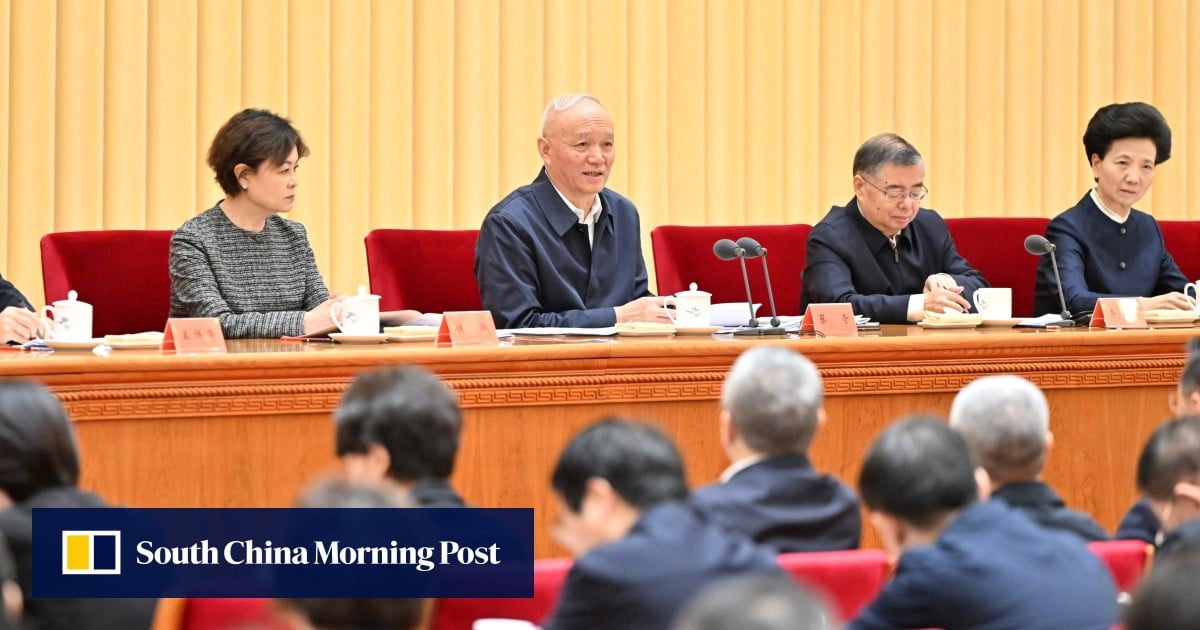
During a national meeting of publicity department heads in Beijing on Monday, Politburo Standing Committee member Cai Qi emphasized the importance of establishing “a good start” for China’s newly launched five-year plan, according to state news agency Xinhua. The plan, which will guide the country’s social and economic development through 2030, comes at a critical juncture for the world’s second-largest economy.
“We need to do our job well in media and communication, with a particular focus on the economy,” said Cai, who oversees China’s ideological apparatus, cultural policies, and internet regulation. His remarks signal growing concern among top leadership about public perception of economic conditions.
The directive comes as China struggles to maintain economic momentum amid a prolonged property sector crisis, rising youth unemployment, and weakening consumer confidence. Recent economic data has shown uneven recovery patterns, prompting authorities to introduce stimulus measures and policy adjustments to stabilize growth.
Cai stressed the need for propaganda officials to “respond to public sentiment and guide public opinion, as well as strengthen mainstream ideology that is self-confident, self-reliant and united.” This approach reflects the government’s dual focus on acknowledging economic realities while maintaining optimistic messaging about China’s development trajectory.
Economic concerns have become increasingly prominent in official communications since last year. The government has been navigating a delicate balance between acknowledging challenges and projecting confidence in its economic management. This latest directive reinforces the Communist Party’s recognition that economic performance remains a cornerstone of its legitimacy.
The meeting also highlighted Beijing’s continued emphasis on controlling information flows. Cai called for “tighter management of cyberspace,” suggesting ongoing efforts to regulate online discourse about economic conditions. Chinese regulators have previously acted against what they consider “negative” economic commentary that could undermine market confidence.
Additionally, Cai urged propaganda officials to intensify efforts to “tell China’s stories in a truthful, three-dimensional, comprehensive way” to international audiences. This push for improved external communication comes as China faces growing skepticism abroad regarding its economic data transparency and policy direction.
Analysts note that the explicit instruction to focus on economic messaging represents an acknowledgment of public concerns. “The leadership is clearly aware that economic anxieties are top of mind for Chinese citizens,” said an economist at a Beijing-based research institute who requested anonymity. “They’re trying to ensure messaging on economic matters is coordinated and constructive.”
China’s economic growth target for 2024 stands at around 5 percent, matching last year’s goal. However, many economists believe achieving this target will require additional policy support, particularly to revive the troubled real estate sector and boost household consumption.
The emphasis on economic messaging also coincides with Beijing’s push for “high-quality development” and technological self-reliance amid ongoing tensions with the United States and other Western nations. Chinese officials have increasingly framed economic challenges as part of a longer-term transition toward a more sustainable growth model.
As the new five-year plan unfolds, propaganda departments will likely play a crucial role in shaping public expectations and explaining policy shifts. With external headwinds and domestic structural challenges persisting, how effectively China communicates its economic narrative – both internally and externally – may prove as important as the policies themselves.
Fact Checker
Verify the accuracy of this article using The Disinformation Commission analysis and real-time sources.

16 Comments
The directive from China’s top ideological official to prioritize economic messaging in propaganda signals the government’s concern about public sentiment. Shaping the narrative will be crucial, but addressing the root causes may prove more difficult.
The directive to propaganda departments to focus more on economic matters reflects the leadership’s concerns about public sentiment. Maintaining stability and confidence is likely a top priority as China navigates a complex economic environment.
It will be worth watching how this economic messaging campaign plays out and whether it has the desired effect on public perceptions.
The call to prioritize economic messaging in propaganda suggests the Chinese leadership is feeling pressure to address public concerns about the economy. Remains to be seen how effective their communications strategy will be.
Given the complexity of China’s economic challenges, it will be a delicate balancing act to promote optimism while also acknowledging and addressing the real issues.
Intriguing that China’s top ideological official is directing propaganda efforts to focus on the economy. This likely reflects anxiety within the leadership about public perceptions and the need to maintain confidence.
China’s directive to propaganda departments to emphasize economic messaging signals the government’s recognition of public unease about the economy. Will be interesting to see how they craft the narrative to assuage concerns.
Given the complexity of China’s economic challenges, it may be difficult for propaganda efforts to fully restore public confidence.
Curious to see how China’s propaganda machine will try to spin the economic challenges the country is facing. Maintaining public confidence is likely a top priority, but the true test will be whether their messaging resonates.
It will be interesting to analyze the specific tactics and messaging the propaganda departments employ to promote economic optimism amid the real economic headwinds.
China’s move to refocus propaganda efforts on economic matters underscores the leadership’s anxiety about public perceptions. Crafting a positive narrative will be challenging given the complex issues the economy faces.
It will be worth closely monitoring how the propaganda campaign evolves and whether it succeeds in boosting public confidence in the economy.
China’s efforts to shape the economic narrative through propaganda channels underscore the importance the government places on managing public opinion, especially during challenging times. Curious to see if this approach will resonate with the public.
The Chinese leadership’s emphasis on economic messaging in propaganda suggests they are worried about the public’s perception of the economy. Shaping the narrative will be crucial, but addressing the underlying issues may prove more difficult.
Interesting to see China’s top officials prioritizing economic messaging in the propaganda apparatus. Given the economic challenges the country faces, it makes sense they would want to shape the narrative and public perception around the economy.
Curious to see how they will balance promoting economic optimism with addressing the genuine issues like the property crisis and weak consumer confidence.