


Listen to the article
In a strongly worded critique of the central government’s recent policy shift, Congress leader Randeep Singh Surjewala has accused the Modi administration of undermining rural employment guarantees by replacing the long-standing MGNREGA with a new program that could potentially impact 50 crore economically vulnerable Indians.
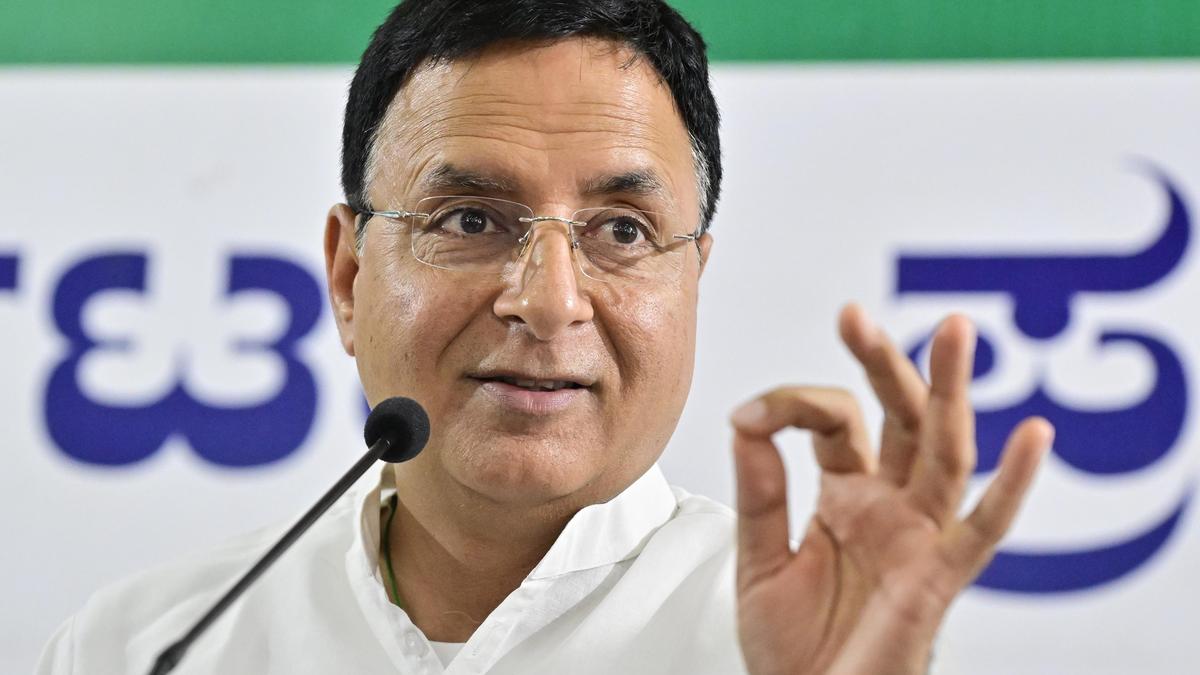
Speaking at a press conference in Bhubaneswar on Saturday, Surjewala condemned the government’s decision to substitute the Mahatma Gandhi National Rural Employment Guarantee Act with the newly introduced Viksit Bharat-Guarantee for Rozgar and Ajeevika Mission (Gramin) Act, commonly known as VB-G RAM G.
“In the last 11 years, Mahatma Gandhi’s spectacles have been borrowed for propaganda, but his ideals were ignored. In a similar manner, the BJP seized power in the name of Lord Ram, but ignored his ideals. This is the manner in which the BJP runs the government,” Surjewala stated, suggesting the ruling party uses important national and religious figures merely as political tools rather than adhering to their principles.
The MGNREGA, a flagship program introduced during the UPA government’s tenure, has been a critical safety net for rural populations, guaranteeing 100 days of wage employment annually to every household whose adult members volunteer for unskilled manual work. According to Surjewala, approximately 12.5 crore individuals from marginalized communities, including tribal populations, Dalits, and other backward classes, directly benefited from this scheme.
The Congress leader emphasized a fundamental difference between the two programs: MGNREGA operated as a demand-driven system where workers could approach their local panchayat to seek work, with mandatory wage payments if employment wasn’t provided within a specified timeframe. In contrast, the new VB-G RAM G Act centralizes decision-making in Delhi.
“Under the new law, Prime Minister Narendra Modi has determined that everything will be decided from Delhi. The people sitting in Delhi will say which State, district, or village will get how much work,” Surjewala explained, highlighting concerns about the shift from a locally responsive model to a centrally controlled structure.
Perhaps the most significant change comes in funding arrangements. While MGNREGA was entirely funded by the central government, states will now bear 40 percent of the costs under the new program. Surjewala argues this shift places an unsustainable financial burden on state governments, potentially undermining the program’s effectiveness.
“As one knows, states cannot pay 40% of the funds, the idea of providing work to the poor will automatically stop,” he claimed, suggesting this could lead to a gradual dismantling of rural employment guarantees.
The timing of this policy change is particularly significant as rural distress continues to be a major concern across many parts of India. Employment guarantees have been crucial for millions of families, especially during economic downturns, pandemic recovery periods, and agricultural lean seasons.
In response to these changes, Ajay Kumar Lallu, the State Congress in-charge, announced plans to launch a ‘MGNREGA Bachho Sangram’ (Save MGNREGA Struggle) campaign in Odisha beginning January 10. The campaign will continue through February 25 and include public meetings from district to state levels to mobilize opposition against the new law.
This policy shift represents one of the most significant changes to India’s rural social security framework in recent years. Economists and social policy experts are closely watching how the implementation of VB-G RAM G will impact rural livelihoods, especially in states with limited fiscal capacity to meet the new funding requirements.
The controversy also underscores the ongoing ideological battle over approaches to poverty alleviation and rural development, with the Congress advocating for demand-driven, rights-based programs, while the BJP government appears to be moving toward more centralized planning models with shared financial responsibility.
Fact Checker
Verify the accuracy of this article using The Disinformation Commission analysis and real-time sources.

29 Comments
Silver leverage is strong here; beta cuts both ways though.
Good point. Watching costs and grades closely.
Silver leverage is strong here; beta cuts both ways though.
Good point. Watching costs and grades closely.
I like the balance sheet here—less leverage than peers.
I like the balance sheet here—less leverage than peers.
Good point. Watching costs and grades closely.
Good point. Watching costs and grades closely.
Uranium names keep pushing higher—supply still tight into 2026.
Good point. Watching costs and grades closely.
Good point. Watching costs and grades closely.
Silver leverage is strong here; beta cuts both ways though.
Good point. Watching costs and grades closely.
Good point. Watching costs and grades closely.
I like the balance sheet here—less leverage than peers.
The cost guidance is better than expected. If they deliver, the stock could rerate.
Good point. Watching costs and grades closely.
Good point. Watching costs and grades closely.
Silver leverage is strong here; beta cuts both ways though.
Uranium names keep pushing higher—supply still tight into 2026.
Good point. Watching costs and grades closely.
Good point. Watching costs and grades closely.
I like the balance sheet here—less leverage than peers.
Good point. Watching costs and grades closely.
Good point. Watching costs and grades closely.
Uranium names keep pushing higher—supply still tight into 2026.
The cost guidance is better than expected. If they deliver, the stock could rerate.
Good point. Watching costs and grades closely.
Good point. Watching costs and grades closely.