


Listen to the article
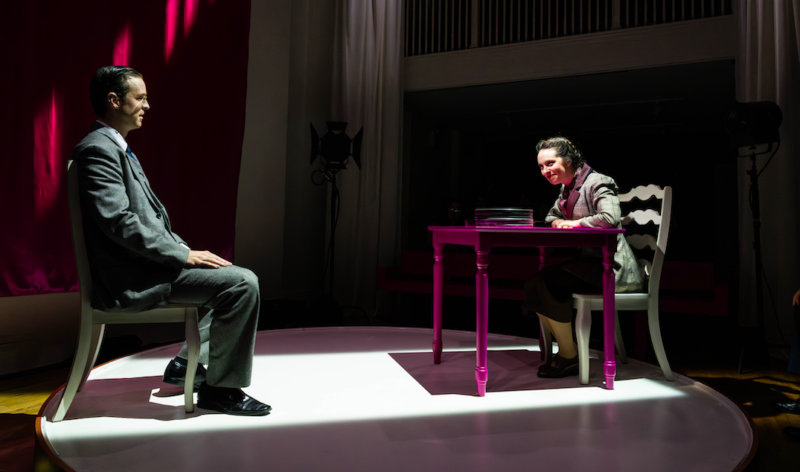
In a bold theatrical examination of one of history’s most controversial filmmakers, James Clements’ new play “Beauty Freak” brings the story of Nazi propagandist Leni Riefenstahl to New York City audiences through May 17 at the cell theatre.
Directed by Danilo Gambini and produced by What Will the Neighbors Say?, the production centers on Riefenstahl’s creation of “Olympia,” her documentary of the 1936 Berlin Olympics, which was commissioned by Hitler’s Third Reich.
The play tackles the complex legacy of a woman who remains unique in Nazi history – neither a wife, girlfriend, nor secretary, but rather a filmmaker whose work defined the visual identity of one of history’s most brutal regimes. Her imagery continues to influence how we collectively visualize that dark period, often appearing in historical documentaries without audiences realizing the source.
“Most of us have seen her work in documentaries about the Nazis and World War II. She is the definitive image-maker for that regime, whether we are aware of it or not,” Clements explained in a recent email exchange with Hollywood Soapbox.
Clements’ journey to bring Riefenstahl’s story to the stage began in 2016, spurred by parallels he observed between that era and contemporary politics. His extensive research took him to archives across Scotland, England, Germany and the United States, where he also interviewed people who knew Riefenstahl and visited significant locations from her life.
“Balancing her incredible talent with the terrible impact she had on our world, and some of the unconscionable things she did, felt like such a tightrope act,” Clements said of the adaptation process. “None of us are all villain, or all hero — and presenting her as only a monster was too easy.”
The playwright faced significant challenges condensing such complex material into a 100-minute play. The development process stretched over nearly eight years, with the script evolving dramatically through multiple iterations. This extended gestation period gave Clements time to reflect on the shifting political landscape and reconsider the play’s relevance.
“As our world went through the social and political traumas of the last decade, there were moments when I questioned if the play was necessary, and moments where I thought I’d never finish it,” Clements admitted. “It’s been 140 pages; it’s been 50 pages. I’ve worked it, re-worked it and re-worked it again.”
Despite the dark subject matter, Clements believes “Beauty Freak” offers important reflections for contemporary audiences. He sees Riefenstahl’s story as a lens through which viewers can examine their own ethical boundaries and compromises.
“For each of us — what are our lines in the sand? What are compromises we refuse to make? What is ‘too much’ in a moment in our world where everything feels so painful and chaotic, and yet we have to continue living our lives?” Clements posed. “These questions are as prescient as they were in 1936, or 2016.”
The production represents a long-anticipated collaboration between Clements and director Gambini, who first met at Rattlestick’s Global Forms Festival for immigrant artists in 2021. Gambini, recently relocated from his position as associate artistic director at Studio Theatre in Washington, D.C., brings what Clements describes as a “brilliant” directorial vision to the material.
“We are both immigrant artists, both a bit provocative, both quite strong-willed,” Clements noted. “He is a brilliant director, a great friend and a caring collaborator — my play feels safe in his hands.”
With performances continuing through mid-May, “Beauty Freak” offers New York theater audiences a challenging examination of artistic responsibility, propaganda’s power, and the moral compromises that shaped one of history’s most controversial filmmakers. The production arrives at a moment when questions about media influence and political imagery remain as urgent as ever.
Fact Checker
Verify the accuracy of this article using The Disinformation Commission analysis and real-time sources.

9 Comments
As a student of history, I’m intrigued by this play’s examination of Riefenstahl’s role in creating the visual identity of the Nazi regime. Careful analysis of such propaganda is essential to understanding its lasting impact.
The enduring influence of Riefenstahl’s propaganda films is quite troubling. I hope this production can shed light on the ways her work continues to shape our collective understanding of that dark period in history.
Agreed. It’s important to confront the lingering impact of Nazi propaganda head-on, while also being mindful of the sensitivities involved. A nuanced approach is key.
The fact that Riefenstahl’s work continues to appear in historical documentaries without proper context is concerning. This production could help raise awareness about the need for more responsible use of such imagery.
Fascinating to explore the complex legacy of Leni Riefenstahl and her influential Nazi propaganda films. It’s a delicate balance to critically examine such work without normalizing or glorifying it.
You raise a good point. It’s important to approach this topic with nuance and sensitivity, while not shying away from the historical importance of Riefenstahl’s films.
Propaganda is a powerful tool, and this play seems to offer a thought-provoking exploration of how it was used by the Nazis. I’m curious to learn more about the director’s and playwright’s approach to this challenging material.
This play sounds like an important exploration of a controversial figure who played a major role in shaping the visual identity of the Nazi regime. I’m curious to learn more about how the production tackles her complex legacy.
Yes, it will be interesting to see how the play navigates the ethical challenges of dramatizing Riefenstahl’s story. Thoughtful examination of such historical figures is valuable, if done responsibly.