


Listen to the article
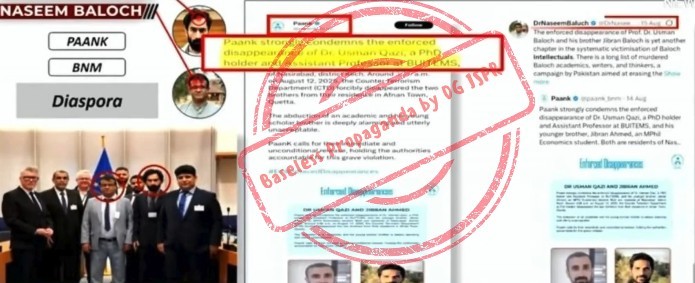
In a strongly worded statement, the Baloch National Movement (BNM) has denounced the Pakistani military for what it terms a “baseless propaganda campaign” against its leadership, escalating tensions in the already volatile region of Balochistan.
The confrontation comes as the BNM intensifies its European campaign to challenge Pakistan’s preferential trade status under the Generalised Scheme of Preferences Plus (GSP+), citing widespread human rights violations in Balochistan.
According to the rights organization, Pakistani military forces are not only perpetrating “grave crimes against humanity” through state power against the Baloch people, but are also orchestrating media trials and employing what they describe as “fifth-generation warfare doctrine” to spread disinformation about the movement and its leaders.
“The objective of this propaganda is not only to generate negative opinion on social media regarding the Baloch movement, but also to create serious and tangible difficulties for peaceful political activists both inside the country and abroad,” the BNM stated in its release.
The group specifically defended its leader, Naseem Baloch, whom Major General Ahmed Sharif, the Director General of Inter-Services Public Relations (ISPR), has accused of involvement in armed activities. The BNM maintains that Baloch advocates for freedom through peaceful political means and categorically rejects what they call “false and malicious propaganda” against him.
This dispute highlights the long-standing conflict in Balochistan, Pakistan’s largest province by area, which has seen decades of insurgency by various groups seeking greater autonomy or independence. The region, rich in natural resources including natural gas, coal, and minerals, has been a flashpoint for tensions between local populations and the central government.
The BNM’s campaign across Europe has sought to bring international attention to human rights concerns in the region, including allegations of enforced disappearances, extrajudicial killings, and torture of Baloch activists and civilians. According to human rights organizations, thousands of Baloch individuals have been subjected to these practices, though exact figures remain disputed.
The organization claims that as their GSP+ campaign gained momentum in European forums, Pakistani state institutions intensified their counter-narrative efforts. The GSP+ status provides Pakistan with significant trade advantages in the European market, making it a crucial economic lifeline for the country’s export sector.
“European institutions must now develop a clearer understanding that Pakistan not only physically harms peaceful political activists but also seeks to destroy their reputations and lives through systematic disinformation and false propaganda,” the BNM emphasized in its statement, adding that “Pakistan has a long-standing practice of portraying victims as criminals and the oppressed as oppressors.”
The Pakistani military, which wields substantial influence in the country’s political landscape, has consistently maintained that it is combating terrorism and separatism in Balochistan, while denying human rights abuse allegations.
International observers note that this exchange represents a broader struggle for narrative control in a conflict that has received limited global media attention despite its severity. Human rights watchdogs have repeatedly called for independent investigations into abuses in Balochistan, while Pakistan has largely restricted media and observer access to affected areas.
The BNM concluded its statement by asserting that the Baloch people would not be intimidated into silence by such tactics, characterizing Pakistan’s propaganda efforts as harassment and pledging to continue confronting the state “at every level.”
As this dispute unfolds, the European Union faces increasing pressure to reevaluate Pakistan’s trade status in light of human rights considerations, potentially setting the stage for diplomatic and economic consequences that could reverberate beyond the immediate conflict.
Fact Checker
Verify the accuracy of this article using The Disinformation Commission analysis and real-time sources.

14 Comments
The Baloch National Movement’s claims about Pakistani military propaganda are concerning, but I would want to see corroborating evidence from reputable sources before fully endorsing their allegations. Transparency and accountability are crucial in these types of disputes.
I hope this situation can be resolved through open dialogue and a commitment to upholding international human rights norms.
This conflict over the Baloch movement and Pakistan’s trade status is a complex geopolitical issue. I think it’s important to carefully examine the evidence from multiple perspectives before drawing conclusions about the military’s actions.
Ultimately, the Baloch people’s human rights and wellbeing should be the top priority, regardless of the political maneuvering.
The Baloch National Movement’s efforts to challenge Pakistan’s trade status over human rights concerns are admirable, though the military’s response is worrying. Disinformation campaigns can be very damaging, so transparency and accountability are crucial.
It will be important to see if independent observers can verify the claims made by both sides and determine the facts of the situation.
The Baloch National Movement’s allegations against the Pakistani military are serious, but I would encourage looking at authoritative, impartial sources to understand the full context before passing judgment. Disinformation can be a real problem on all sides.
I hope this situation can be resolved through peaceful dialogue and a commitment to upholding human rights in the region.
This confrontation over the Baloch movement and Pakistan’s trade status is a complex geopolitical issue with a lot of moving parts. I think it’s important to carefully examine the facts and evidence from multiple angles before taking strong positions.
Ultimately, the wellbeing and human rights of the Baloch people should be the top priority, regardless of the political machinations.
This is a concerning situation that highlights the ongoing tensions and human rights issues in the Balochistan region. The Pakistani military’s alleged propaganda campaign against the Baloch National Movement is troubling and deserves closer scrutiny.
I hope the international community closely monitors this situation and holds all parties accountable for their actions.
This conflict highlights the complex geopolitical dynamics in the region. While I am sympathetic to the Baloch people’s struggle, I would want to see more details before drawing firm conclusions about the military’s alleged propaganda campaign.
Ultimately, the welfare and human rights of the Baloch population should be the priority, regardless of the political maneuvering.