


Listen to the article
In a troubling development for media transparency, the Associated Press has come under scrutiny for distributing content from Iranian state-controlled sources without proper attribution or context, raising serious questions about journalistic standards.
Recent investigation has uncovered that AP, which promotes its extensive content-sharing arrangements with “more than 100 photo and video partners,” has been distributing material from sources directly controlled by the Iranian regime and designated terror organizations without adequate disclosure to readers.
In December 2024, AP shared a Houthi propaganda video claiming the Iran-backed group had targeted a military facility. Only after external pressure did the news agency clarify that the partially intercepted ballistic missile had actually struck a school in central Israel.
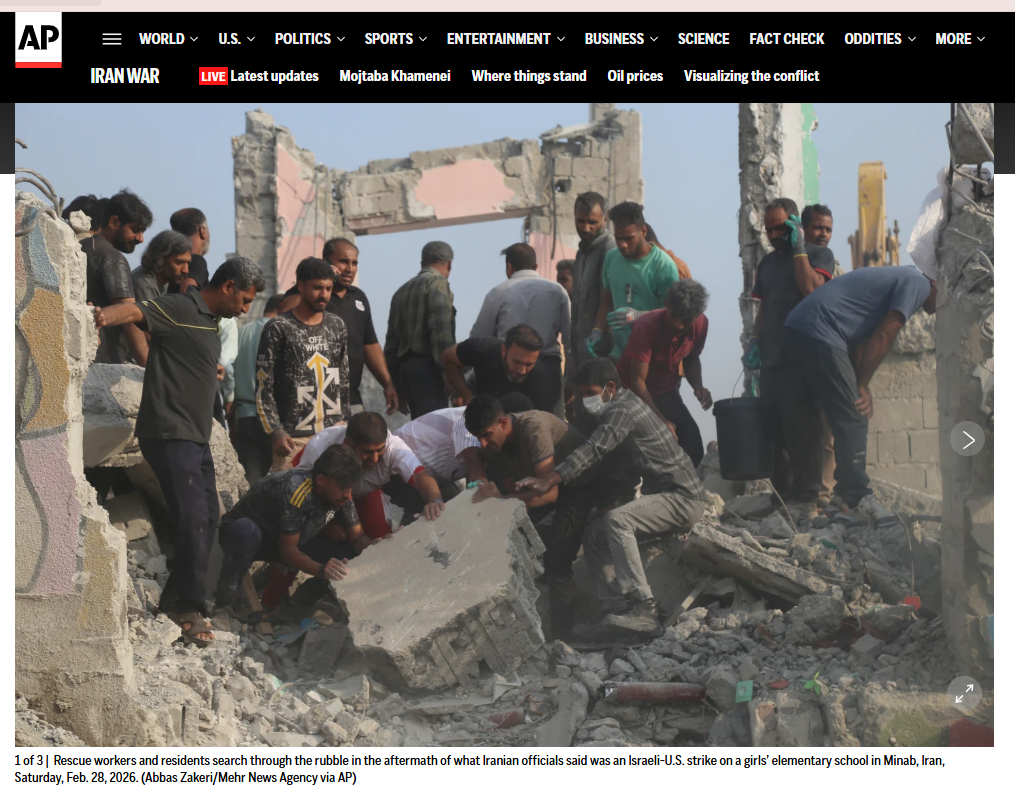
More concerning is AP’s recent handling of the February 28, 2026 strike on a girls’ school in Minab, Iran. The news agency published photos from Mehr News Agency—an organization controlled by the Iranian regime and owned by the Islamic Ideology Dissemination Organization—without disclosing to readers that Mehr functions as a propaganda arm rather than an independent news source.
The captions accompanying these images repeated disputed Iranian government claims that the deadly strike was an “Israeli-U.S.” operation, despite mounting evidence suggesting it was solely a U.S. attack targeting a nearby Islamic Revolutionary Guard Corps naval facility.
In an apparent contradiction, while AP’s own reporting published March 9 acknowledged that “all evidence concerning the devastating school strike points to a U.S. attack targeting a nearby IRGC naval facility,” it simultaneously continued distributing images with captions attributing the strike to both Israel and the United States.
The ripple effect of this reporting has been substantial. Media outlets worldwide, including Le Monde, Australia’s ABC News, and The Seattle Times, further simplified these already problematic captions, presenting the “Israeli-U.S.” responsibility as established fact rather than a disputed claim by Iranian officials.
Following inquiries from media watchdog CAMERA, AP amended some captions in its photo archive to remove references to an “Israeli-U.S. strike,” replacing them with unattributed mentions of a “strike on a girls’ elementary school.” However, as of reporting time, the original misleading captions remain in place in AP’s “Week in Pictures” feature and alongside the March 9 article discussing evidence of U.S. responsibility.
Media experts point out that when news organizations partner with state-controlled entities, transparency is essential. At minimum, full disclosure about the nature of such sources should be provided, particularly when they function as government propaganda vehicles.
This incident raises broader questions about AP’s vetting process for partner content and the potential damage to public understanding when major news distributors fail to provide crucial context about the origins and reliability of information.
The situation underscores the challenges of modern international news coverage, where pressure to provide immediate visuals from crisis zones can sometimes override thorough verification processes. However, as a cornerstone of global journalism relied upon by thousands of outlets worldwide, AP’s responsibility to maintain rigorous standards remains paramount.
As international tensions in the Middle East continue to escalate, the accuracy of reporting and transparency about information sources becomes increasingly critical for maintaining public trust in major news institutions.
Fact Checker
Verify the accuracy of this article using The Disinformation Commission analysis and real-time sources.

9 Comments
While global news coverage is valuable, it’s critical that the sources are properly vetted and clearly identified. AP should take this as a learning opportunity to strengthen their editorial processes.
Absolutely. Maintaining high standards of journalism should be the top priority, even if it means forgoing certain content-sharing arrangements. Credibility is hard-won but easily lost.
This is concerning if true. The media should be transparent about their sources, especially when dealing with state-controlled outlets. Proper attribution and context are essential for journalistic integrity.
I’m curious to learn more about the specifics of AP’s content-sharing arrangements. What oversight and safeguards are in place to ensure they aren’t unwittingly amplifying propaganda? Rigorous fact-checking is crucial.
Agreed. AP needs to be upfront about the nature of their partnerships and carefully vet the material they distribute. Credibility is on the line here.
This is a concerning development that deserves close scrutiny. The media must be vigilant in separating fact from fiction, especially when dealing with state-controlled sources. Transparency is key.
I hope this incident prompts a thorough review of AP’s policies and procedures. Distributing state propaganda, even inadvertently, undermines the credibility of their reporting.
This situation highlights the challenges media organizations face in the modern information landscape. Balancing access to global news sources while maintaining editorial independence is no easy task.
You’re right. Navigating those complexities requires constant vigilance and a firm commitment to journalistic principles. Transparency is key to maintaining public trust.