


Listen to the article
AI Propaganda Escalating South China Sea Tensions Between Philippines and China
Sophisticated AI-generated propaganda is increasingly being used to distort reality and manipulate public opinion in the disputed South China Sea, potentially fueling military escalation between the Philippines and China.
The South China Sea, a vital geopolitical flashpoint valued for its rich fisheries, crucial shipping lanes, and potential energy reserves, continues to be the center of territorial disputes between the two nations despite diplomatic efforts to ease tensions. These disputes are now being amplified by unprecedented AI-driven disinformation campaigns.
According to a Freedom House report, AI-powered disinformation campaigns have been identified in at least 16 countries, where they were deliberately deployed to “sow doubt, smear opponents, or influence public debate.” The Philippines has become particularly vulnerable to such tactics, with AI-generated media regularly exploited for scams and spreading false information.
A notable incident occurred in July 2024 when a convincing deepfake video falsely depicted Philippine President Ferdinand Marcos Jr. ordering an attack on China. The AI-generated audio so closely mimicked Marcos’ voice that it caused widespread panic before the Presidential Communications Office (PCO) identified it as fraudulent. A subsequent investigation traced the deepfake to foreign actors, prompting Philippine officials to issue warnings about the dangers of AI-driven disinformation.
This was not an isolated case. YouTube channels such as PH TV routinely employ AI and traditional media manipulation techniques to disseminate false narratives, including fabricated stories about U.S. military intervention in the disputed waters. While these channels include disclaimers labeling their content as “entertainment,” research has found that many viewers accept these fabrications as fact, evidenced by highly polarized comment sections featuring strong anti-China sentiment and support for U.S. intervention.
While the operators behind PH TV remain unknown, the channel appears to be either Chinese-sponsored or an opportunistic entity capitalizing on regional tensions. Filipino media outlet PressOne.PH has reported that Chinese state media regularly distributes AI-generated videos as part of its ongoing information battle with the Philippines.
China’s sophisticated approach extends beyond video manipulation to include what experts call “cognitive warfare” using AI-assisted personas. For example, China Daily journalists Meng Zhe and Xu-Pan Yiru have acknowledged using AI to modify their speech, claiming it makes their accents more intelligible to international audiences. Critics view these enhancements as part of a broader strategy to refine propaganda and strengthen China’s influence globally.
A report by Graphika on “Operation Naval Gazing” uncovered networks of fake accounts, some with AI-generated profile pictures, promoting pro-China rhetoric and amplifying narratives favorable to former Philippine president Rodrigo Duterte, particularly those supporting closer ties with China.
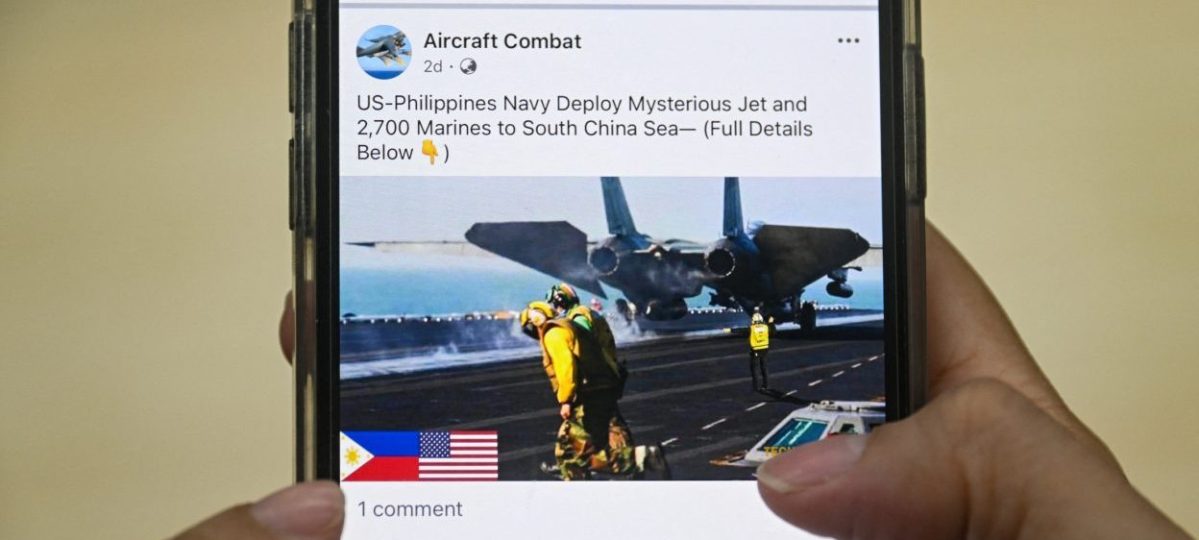
The financial incentives behind disinformation are substantial. Agence France-Presse discovered a coordinated network of Facebook pages and YouTube channels masquerading as legitimate news sources while generating ad revenue through AI-powered propaganda. These military-focused pages manipulated old footage of joint exercises to suggest the U.S. is actively preparing for war in the region. Each misleading article reportedly earns between US$20 and US$70, with the network collectively amassing over 10 million followers.
The vulnerability of the Philippine public to such manipulation is concerning. A PCO study found that 51 percent of Filipinos struggle to identify fake news, with 90 percent experiencing difficulties navigating digital information. AI-generated propaganda exploits these vulnerabilities, deepening societal divisions and potentially rallying public support for military action despite the Philippines’ limited military capabilities.
In response, the Philippine Congress is developing legislation to address AI’s role in media manipulation, particularly ahead of the 2025 elections. The proposed bills aim to establish comprehensive regulatory frameworks and impose legal consequences for deepfake activities.
China, while lacking specific AI disinformation laws, has regulations requiring clear labeling of AI-generated content that adheres to state-approved narratives. The Philippines, without enforceable AI policies, has relied on diplomatic protests against China, filing over 130 protests within President Marcos’ first six months in office, with minimal effect.
As part of countermeasures, journalists have begun accompanying Philippine missions to disputed waters in a government “transparency initiative” providing real-time accounts to combat disinformation. While promoting transparency, this approach raises concerns about journalistic independence, as reporters reliant on government access may face implicit pressure to align with national narratives.
The influence of AI-driven propaganda in the South China Sea dispute is expected to grow as technology advances and regional tensions escalate. Addressing this challenge requires coordinated efforts from policymakers, tech companies, and civil society to establish stronger regulations, develop detection tools, and enhance public media literacy.
These efforts face significant obstacles as major social media platforms reduce fact-checking operations. Meta has withdrawn from fact-checking in the region and discontinued third-party verification in the U.S., while X (formerly Twitter) has replaced professional fact-checking with its community-driven approach, which has been criticized for inconsistencies. With these platforms shifting to less rigorous moderation systems, the risk of unchecked misinformation continues to grow, threatening regional stability.
Fact Checker
Verify the accuracy of this article using The Disinformation Commission analysis and real-time sources.

10 Comments
While AI can be a powerful tool, its misuse for propaganda is extremely concerning. The Philippines and China must prioritize transparency, fact-based discourse, and diplomatic solutions to address their territorial disputes in the South China Sea.
The South China Sea is a complex geopolitical issue, and the use of AI-generated propaganda to inflame tensions is deeply troubling. Robust fact-checking and media literacy efforts will be crucial to counter these manipulative tactics.
I agree. Unchecked AI-driven disinformation could have serious consequences for the region. Strengthening international cooperation and diplomatic efforts to resolve these disputes peacefully is vital.
This is a worrying trend that highlights the need for greater regulation and oversight of AI technology, especially in the realm of geopolitics and national security. Disinformation campaigns that leverage AI could have far-reaching consequences.
Agreed. The potential for AI-driven propaganda to escalate regional tensions is alarming. Robust international cooperation and strengthening media literacy are crucial to mitigate these threats to stability and peace.
The use of AI for propaganda is a concerning development that could have serious implications for the South China Sea dispute. Both the Philippines and China must prioritize fact-based dialogue and diplomatic solutions to resolve their differences.
This is a troubling example of how AI can be misused to distort reality and manipulate public opinion. The Philippines and China must work together to address this threat and find peaceful resolutions to their territorial disputes in the South China Sea.
You’re absolutely right. The potential for AI-driven disinformation to exacerbate tensions is deeply concerning. Strengthening international cooperation and media literacy efforts will be critical to counter these manipulative tactics.
This is a concerning development. AI-driven disinformation could escalate tensions between the Philippines and China over the South China Sea. It’s critical that the public remains vigilant and fact-checks information from reliable sources.
You raise a good point. The potential for AI to be used for propaganda and manipulation is alarming. Governments and tech companies need to work together to address this threat to regional stability and peace.