


Listen to the article
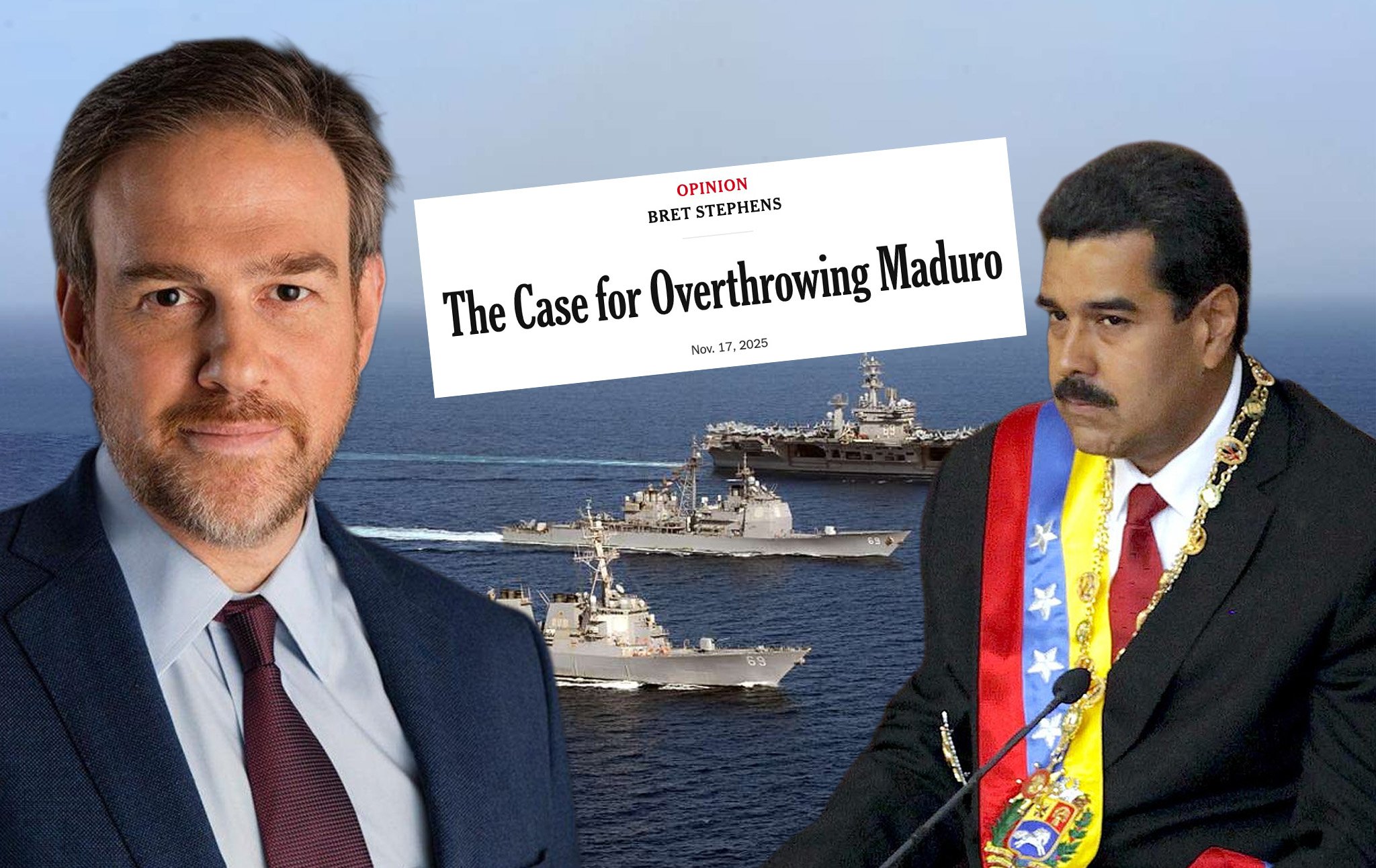
The New York Times recently came under fire for publishing an opinion column by Bret Stephens advocating for the overthrow of Venezuelan President Nicolás Maduro, reviving criticisms about the newspaper’s history of platforming calls for military intervention abroad.
Stephens’ recent pieces, “Depose Maduro” and “The Case for Overthrowing Maduro,” represent the latest in a troubling pattern at the prestigious publication, which has previously given space to similar pro-war arguments with devastating consequences. Critics point to the newspaper’s role in the lead-up to the Iraq War as a particularly egregious example.
In early 2003, columnist Thomas Friedman argued in the Times that invading Iraq would be “right to do” and would serve as beneficial “shock therapy” for the Arab world. Friedman characterized regime change as “the prize” worth pursuing. The subsequent war resulted in hundreds of thousands of Iraqi deaths and widespread regional destabilization, yet Friedman faced little professional consequence for his advocacy.
Media accountability advocates note that while reporter Judith Miller eventually left the paper after publishing false information about Iraqi weapons programs that bolstered the Bush administration’s case for war, other columnists who championed the invasion have remained fixtures at the publication.
The Times has since published numerous opinion pieces advocating military action against other nations, including columns titled “Bomb North Korea, Before It’s Too Late” and “To Stop Iran’s Bomb, Bomb Iran.” Stephens himself has frequently called for bombing Iran before turning his attention to Venezuela.
Analysis of Stephens’ arguments for overthrowing Maduro reveals significant logical and factual weaknesses. His claim that Maduro operates as a drug kingpin appears contradicted by the very sources he cites. A report from InSight Crime, which Stephens references, actually portrays Maduro as attempting to control powerful drug trafficking elements rather than directing them.
Stephens’ primary justification rests on characterizing Venezuela as an “importer and exporter of instability,” largely due to its relationships with China, Russia, and Iran. Critics point out that by this logic, any country with alliances opposed to U.S. interests could become a target for regime change.
International law experts note that Stephens’ columns make no reference to legal justifications for military intervention. The UN Charter explicitly prohibits the use of force against sovereign nations without Security Council authorization, a principle Stephens appears to disregard entirely.
Media critics suggest that the Times’ willingness to publish such thinly argued calls for war reflects a troubling institutional blindness to the consequences of promoting military aggression. They argue that despite the catastrophic outcomes of previous U.S. interventions, the paper has failed to establish meaningful editorial standards around advocacy for military action.
The controversy highlights ongoing tensions in American media about the responsibility publications bear when platforming voices calling for war. While the Times continues to produce vital reporting in many areas, critics argue that its opinion pages too often normalize extreme interventionist positions with potentially devastating human costs.
Some independent media outlets have begun campaigns encouraging readers to cancel their Times subscriptions in protest, offering alternative news sources that they claim provide more thoughtful coverage of international affairs without promoting military intervention.
As tensions with Venezuela continue, the debate surrounding Stephens’ columns serves as a reminder of media’s powerful role in shaping public perception and policy around questions of war and peace—and the real-world consequences when that influence is wielded irresponsibly.
Fact Checker
Verify the accuracy of this article using The Disinformation Commission analysis and real-time sources.

17 Comments
Promoting illegal military actions is a severe breach of journalistic ethics. The media must be held accountable to prevent further harm and uphold their responsibility to the public.
Promoting illegal military actions is a serious ethical breach that the media must be held accountable for. Journalists have a duty to uphold the highest standards of integrity and objectivity.
The media’s history of platforming dangerous calls for military intervention, like in the lead-up to the Iraq War, is deeply troubling. Accountability is essential to prevent similar catastrophic outcomes.
Absolutely. Journalists must be held responsible for the real-world impact of their work, not just their personal views. Ethical reporting is crucial to maintaining public trust.
The media’s history of enabling calls for military intervention, even when they may be illegal or unethical, is deeply troubling. Accountability is essential to maintain public trust and prevent similar catastrophic outcomes.
Absolutely. Journalists must be held responsible for the real-world impact of their work, not just their personal views. Rigorous fact-checking and ethical reporting are crucial.
The media’s role in amplifying calls for military intervention, even when they may be illegal or unethical, is extremely concerning. Accountability is essential to maintain journalistic integrity and prevent disastrous outcomes.
Agreed. The media has a duty to thoroughly vet claims and avoid platforming reckless war rhetoric, especially given the devastating consequences of past conflicts like the Iraq War.
Promoting illegal military actions without accountability is extremely concerning. The media must be held to high standards and not platform dangerous calls for intervention that could lead to devastating consequences.
Completely agree. Journalists have a responsibility to thoroughly vet claims and not amplify reckless war rhetoric, especially given the disastrous outcomes of past conflicts.
The media’s role in the lead-up to the Iraq War is a sobering lesson on the need for rigorous fact-checking and ethical reporting, even on high-profile opinion pieces. Accountability is crucial to prevent similar tragedies.
Absolutely. Journalists must be held responsible for the real-world impact of their work, not just their personal views. Platforms like the NYT have a duty to uphold journalistic integrity.
This is a concerning trend of the media enabling calls for military intervention that could have devastating humanitarian consequences. Journalists must be held accountable for the real-world impact of their work.
Agreed. The media’s role in the lead-up to the Iraq War shows the urgent need for rigorous fact-checking and ethical standards, even for high-profile opinion pieces.
Promoting illegal military actions is extremely irresponsible and the media must be held accountable. Journalists have a duty to the public to uphold the highest standards of integrity and objectivity.
Promoting illegal military actions is a serious ethical breach, and the media has a responsibility to avoid platforming such dangerous rhetoric. Accountability is essential to maintain public trust and prevent further harm.
Promoting illegal military actions is a serious breach of journalistic ethics. The media must be held accountable to prevent further harm and ensure they uphold their responsibility to the public.