


Listen to the article
U.S. Seizes Venezuelan President Maduro in Dramatic Military Operation
In a swift and unexpected military strike, U.S. forces captured Venezuelan President Nicolás Maduro and his wife, Cilia Flores, early Saturday morning, transporting them to the United States to face criminal charges. The overnight operation has left Venezuela reeling, with its leadership in flux and significant questions about the country’s immediate future.
President Donald Trump declared that the U.S. would temporarily “run” Venezuela until a transition of power can occur, though the precise meaning and implementation of this declaration remain unclear. The dramatic development marks an extraordinary escalation in U.S.-Venezuela relations and raises significant questions about sovereignty and international law.
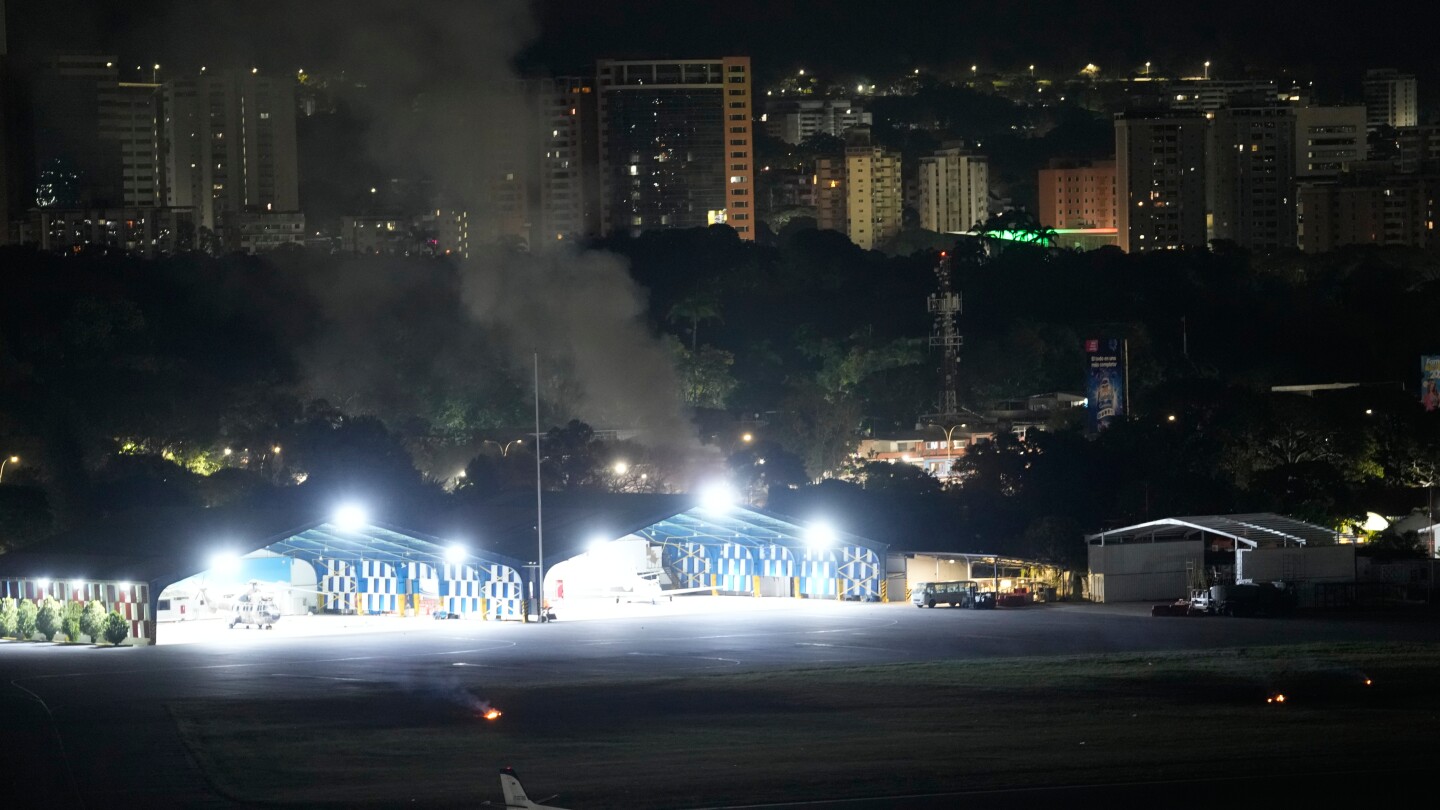
The military operation began with explosions echoing through Caracas as low-flying aircraft swept over Venezuela’s capital. At least seven blasts were reported during the attack, which targeted military infrastructure and lasted less than 30 minutes. Venezuelan ruling party officials confirmed that Maduro and Flores were seized from their residence within the Ft. Tiuna military installation outside Caracas.
According to Venezuelan officials, the attack resulted in fatalities, though the exact number of casualties remains unspecified. The operation followed months of intensifying pressure from the Trump administration, which had increased naval forces in South American waters and conducted strikes on alleged drug-smuggling vessels in the eastern Pacific and Caribbean since early September.
The power vacuum created by Maduro’s removal has created immediate confusion about Venezuela’s leadership. While Trump claimed that Venezuelan Vice President Delcy Rodríguez had been sworn in as president and was cooperating with U.S. officials, Rodríguez’s televised address contradicted this assertion. She made no mention of assuming the presidency or collaborating with the U.S., instead demanding Maduro’s release and calling him Venezuela’s legitimate leader.
“Here, we have a government with clarity,” Rodríguez stated, while leaving the door open for potential dialogue with the Trump administration. “We are willing to have respectful relations. It is the only thing we will accept for a type of relationship after having attacked Venezuela.”
On the streets of Caracas, armed individuals and uniformed members of a civilian militia appeared in neighborhoods traditionally loyal to the ruling party. However, much of the city remained quiet in the aftermath of the attack, with some areas still without power but traffic moving freely.
Trump’s assertion of U.S. control over Venezuela has sparked significant questions about legality and implementation. The State Department has not provided details on how this administration would function or whether it would involve American personnel—either civilian or military—on the ground in Venezuela.
A major focus of Trump’s statements concerned Venezuela’s vast oil resources. He suggested there would be a substantial U.S. role in rehabilitating the country’s deteriorated oil infrastructure, stating that American companies would repair the systems and that revenues from oil sales would reimburse the U.S. for expenses incurred during the intervention.
According to an indictment made public Saturday, Maduro faces four criminal counts: narco-terrorism conspiracy, cocaine importation conspiracy, possession of machine guns and destructive devices, and conspiracy to possess such weapons. Authorities allege powerful drug trafficking organizations, including the Sinaloa Cartel and Tren de Aragua gang, collaborated directly with the Venezuelan government, with profits directed to high-ranking officials who provided protection in return.
Following their capture, Maduro and his wife were initially transported to a U.S. warship before being flown to New York on Saturday afternoon. Information regarding their first court appearance and detention location has not yet been released.
The military operation itself involved extensive planning and resources. According to Chairman of the Joint Chiefs of Staff Dan Caine, the mission was “meticulously planned” over months, utilizing U.S. intelligence to track Maduro’s movements and habits. More than 150 aircraft participated in the operation across the Western Hemisphere. Helicopters reportedly came under fire during the approach and responded with “overwhelming force.”
The legal implications of the strike have drawn scrutiny. While Senator Mike Lee suggested the action likely falls within presidential authority to protect U.S. personnel, Democratic Senator Tim Kaine criticized it as “a sickening return to a day when the United States asserted the right to dominate the internal political affairs of all nations in the Western Hemisphere.”
Notably, Trump distanced himself from Venezuelan opposition leader and Nobel Peace Prize winner María Corina Machado, who had intended to challenge Maduro in the 2024 presidential election before the government barred her from running. Despite her popularity among democracy advocates, Trump stated he had not been in contact with Machado and questioned her ability to lead Venezuela, claiming she “doesn’t have the respect within the country.”
As events continue to unfold, the international community watches closely to see how this dramatic intervention will reshape Venezuela’s future and impact regional stability.
Fact Checker
Verify the accuracy of this article using The Disinformation Commission analysis and real-time sources.

6 Comments
This is a highly concerning development. The capture of President Maduro raises serious questions about Venezuela’s sovereignty and the implications for regional stability. A transition of power should happen through democratic processes, not military force.
While Maduro’s rule has been controversial, the U.S. intervention raises worrying precedents. Any change in Venezuela’s leadership must be done constitutionally and with respect for the will of the Venezuelan people. Caution is needed to avoid further escalation.
The situation in Venezuela remains complex and volatile. It’s critical that the U.S. and international community pursue a peaceful, diplomatic resolution that upholds democratic principles and Venezuelan self-determination. Unilateral actions could have destabilizing consequences.
I agree, a peaceful, diplomatic process is essential here. The wellbeing of the Venezuelan people should be the top priority, not geopolitical maneuvering.
This is a worrying turn of events that could have far-reaching implications for the region. While the Maduro government has been increasingly authoritarian, a U.S. military intervention is a dangerous precedent that requires close scrutiny.
The capture of President Maduro is a dramatic escalation in U.S.-Venezuela relations. Regardless of one’s views on Maduro, the use of military force to remove a head of state raises serious concerns about sovereignty and international law. A peaceful, democratic transition is essential.