


Listen to the article
President Donald Trump’s administration is revitalizing the Monroe Doctrine, a cornerstone of American foreign policy that had been declared dead by the Obama administration more than a decade ago. This shift represents a significant reorientation of U.S. strategy in Latin America with far-reaching implications for regional security and diplomatic relations.
The Monroe Doctrine, first established in 1823 by President James Monroe, was designed to limit European influence in Latin America and preserve U.S. interests in the Western Hemisphere. According to White House spokeswoman Anna Kelly, “President Trump has prioritized enforcing the Monroe Doctrine unlike any other President in decades.”
This revival stands in stark contrast to the position taken by former President Barack Obama’s administration, when then-Secretary of State John Kerry explicitly stated in 2013 that “the era of the Monroe Doctrine is over.” Kerry had advocated for more equal partnerships with Latin American nations rather than interventionist policies.
The Trump administration’s recently released National Security Strategy explicitly calls for reinstating the doctrine, introducing what it terms the “Trump Corollary” – a reference to Theodore Roosevelt’s expansion of the original policy that positioned the United States as an “international police power” in the region.
“After years of neglect, the United States will reassert and enforce the Monroe Doctrine to restore American preeminence in the Western Hemisphere, and to protect our homeland and our access to key geographies throughout the region,” the strategy document states. “We will deny non-Hemispheric competitors the ability to position forces or other threatening capabilities, or to own or control strategically vital assets, in our Hemisphere.”
The renewed focus on the Western Hemisphere comes as part of Trump’s broader campaign against drug trafficking from Latin America into the United States. The administration has designated several drug cartels, including Tren de Aragua and Sinaloa, as foreign terrorist organizations.
In a significant escalation, Trump recently declared Venezuelan President Nicolás Maduro’s regime a foreign terrorist organization. “The illegitimate Maduro Regime is using Oil from these stolen Oil Fields to finance themselves, Drug Terrorism, Human Trafficking, Murder, and Kidnapping,” Trump stated on social media on December 16.
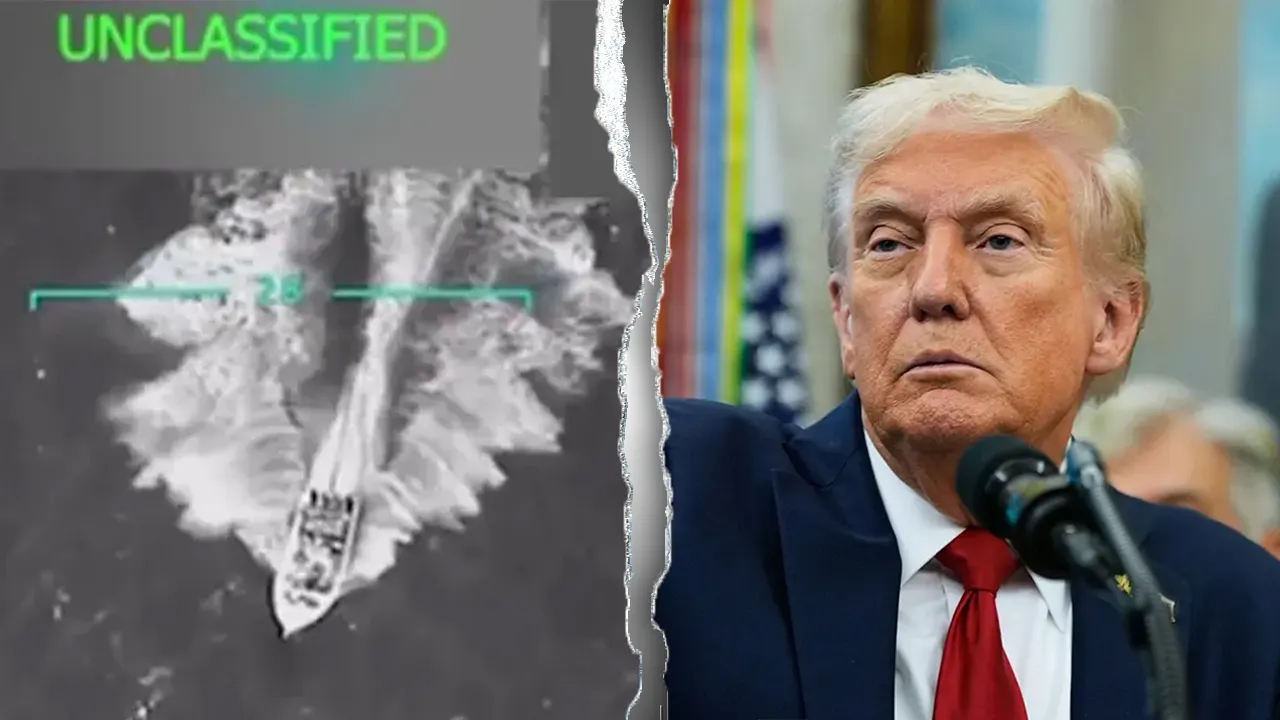
The administration has conducted more than 20 military strikes in Latin American waters since September, targeting vessels allegedly involved in drug trafficking. These operations have placed additional pressure on Maduro, whom the administration does not recognize as Venezuela’s legitimate leader, instead characterizing him as the head of a drug cartel. Trump recently suggested it would be “smart” for Maduro to step down from power.
These military actions have drawn increasing scrutiny from lawmakers on Capitol Hill, including both Democrats and some Republicans. Senate Minority Leader Chuck Schumer, along with Senators Tim Kaine, Adam Schiff, and Rand Paul, introduced a war powers resolution on December 3 aimed at preventing Trump from using U.S. armed forces against Venezuela.
The controversy intensified after reports emerged that a second strike was carried out on a vessel that initially had survivors from a previous operation in September. Critics question the legality of these actions, while the administration maintains it has full authority to conduct such operations.
The revitalization of the Monroe Doctrine represents a fundamental shift in U.S. foreign policy toward Latin America, emphasizing a more assertive American presence in what the administration considers its strategic backyard. While supporters view this approach as necessary for addressing security threats and drug trafficking, critics argue it marks a return to interventionist policies that may damage diplomatic relations with regional partners.
As the administration continues to implement this strategy, its impact on regional stability, drug trafficking operations, and U.S. influence in Latin America will be closely watched by policymakers and observers across the political spectrum.
Fact Checker
Verify the accuracy of this article using The Disinformation Commission analysis and real-time sources.

9 Comments
Interesting to see the shift in US policy towards Latin America under the Trump administration. I wonder how this will impact diplomatic relations and security in the region. Curious to see how other countries respond to the revival of the Monroe Doctrine.
The revival of the Monroe Doctrine is a bold move by the Trump administration. It signals a return to a more assertive US role in the region, but could also heighten geopolitical tensions. I’ll be watching closely to see how this plays out.
This is a significant development in US-Latin American relations. While the Monroe Doctrine has historically been controversial, the Trump administration seems intent on reasserting American influence in the region. It will be interesting to see the reactions from Latin American countries.
The Monroe Doctrine has a long and controversial history in US-Latin American relations. It will be important to see if this shift towards more interventionist policies is effective or causes further tensions in the region.
Agreed. The Monroe Doctrine has often been viewed as a justification for US interference in Latin America. It will be crucial to see if this new approach leads to more collaborative partnerships or continued unilateral actions.
As someone with investments in Latin American mining and energy companies, I’m concerned about how this policy shift could impact operations and regulatory environments in the region. Increased US intervention could create both opportunities and risks for my portfolio.
This is a bold and controversial move by the Trump administration. Reinstating the Monroe Doctrine seems to signal a return to a more unilateral, interventionist approach in Latin America. It will be crucial to see how this impacts regional security, diplomacy, and economic development.
As a commodity-focused investor, I’m curious how this shift in US policy could impact mining and energy projects in Latin America. Will it create more stability and investment opportunities, or lead to increased uncertainty and risk?
The Monroe Doctrine has long been a source of tension between the US and its southern neighbors. Reviving it under the Trump administration could be seen as a return to outdated, imperialist policies. I hope this doesn’t undermine recent progress towards more collaborative regional partnerships.