


Listen to the article
US Aircraft Carrier Approaches Venezuelan Waters in Show of Force
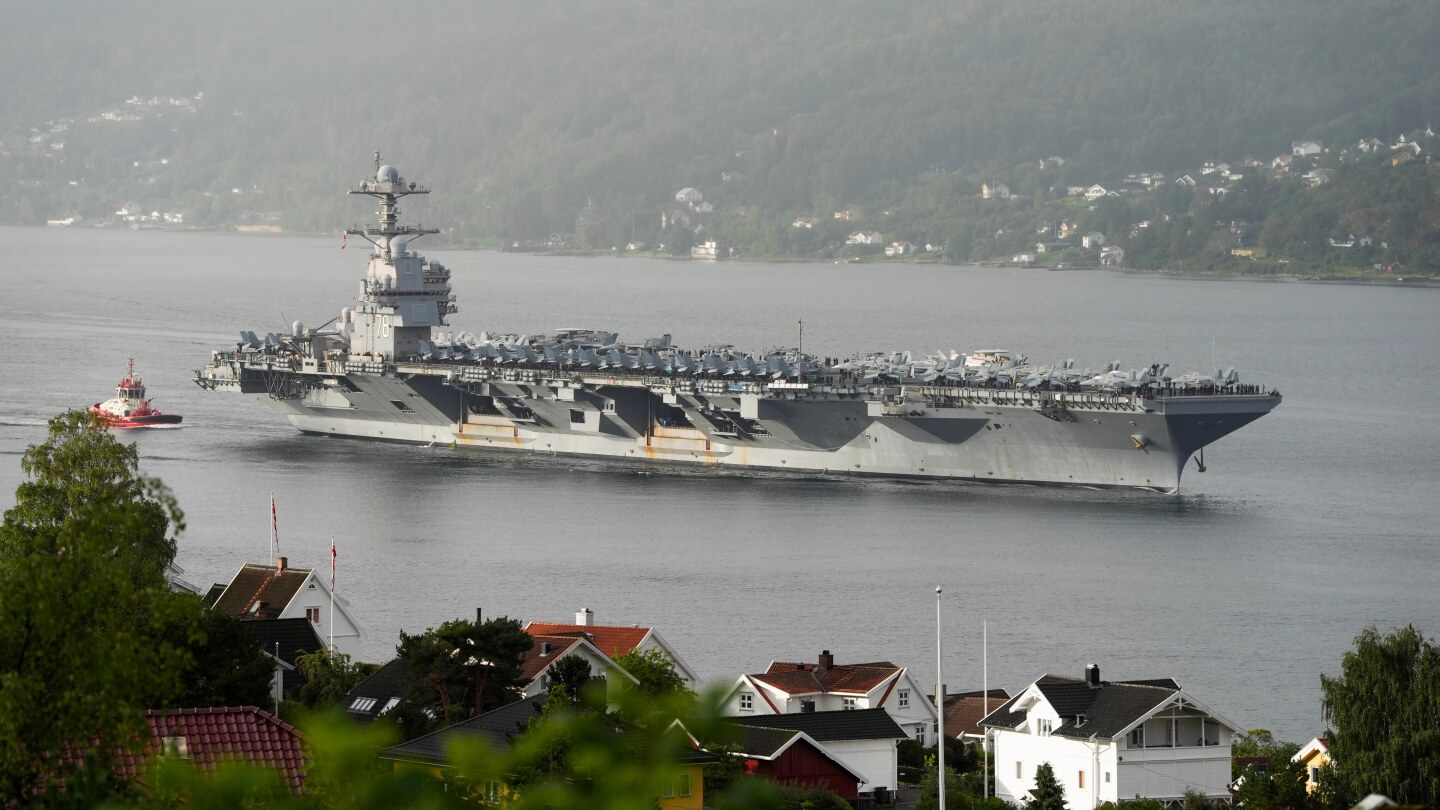
The most advanced U.S. aircraft carrier is expected to reach the waters off Venezuela within days, marking the most significant display of American military power in Latin America in generations.
The USS Gerald R. Ford, a 100,000-ton warship, will serve as the centerpiece of Operation Southern Spear, a mission that includes nearly a dozen Navy ships and approximately 12,000 sailors and Marines. The carrier’s arrival escalates the Trump administration’s military presence in the region, adding to bomber training runs near Venezuela’s coast, CIA operations inside the country, and maritime strikes that have already claimed over 75 lives.
“This is the anchor of what it means to have U.S. military power once again in Latin America,” said Elizabeth Dickinson, senior analyst for the Andes region at the International Crisis Group. “It has raised a lot of anxieties in Venezuela but also throughout the region. I think everyone is watching this with sort of bated breath to see just how willing the U.S. is to really use military force.”
Secretary of State Marco Rubio insists that President Donald Trump’s focus is combating drug trafficking by targeting “organized criminal narcoterrorists.” However, Rubio also emphasized that the U.S. does not recognize Nicolás Maduro, who was widely accused of stealing last year’s election, as Venezuela’s legitimate leader.
“That’s what he’s authorized. That’s what the military’s doing. That’s why our assets are there,” Rubio told reporters after meeting with G7 counterparts in Canada. He described Maduro’s government as a “transshipment organization” that actively cooperates with drug traffickers.
Defense Secretary Pete Hegseth formalized the mission as Operation Southern Spear on Thursday, highlighting the growing significance and permanence of American military operations in the region.
Some experts question whether drug interdiction is the true objective of deploying such overwhelming naval power.
“There’s nothing that an aircraft carrier brings that is useful for combating the drug trade,” Dickinson noted. “I think it’s clearly a message that is much more geared toward pressuring Caracas.”
Bryan Clark, a former Navy submariner and defense analyst at the Hudson Institute, suggested the deployment signals more aggressive intentions: “I think this administration is very open to using military force to accomplish particular objectives. I think they’re going to want to actually do some military operations unless Maduro steps down in the next month or so.”
After being briefed by administration officials last week, Rep. Jim Himes, the top Democrat on the House Intelligence Committee, indicated that while strikes targeting cocaine traffickers would continue, officials had not explicitly stated an intention to overthrow Maduro.
Military analysts point to significant risks in any potential operation. Mark Cancian, a retired Marine colonel and senior adviser with the Center for Strategic and International Studies, warned that Venezuela’s Russian-supplied missile defense systems could pose a serious threat to American aircraft.
“Because they have so many systems, some are relatively new, and all are mobile, we probably wouldn’t get them all,” Cancian explained. “So there’s some risk that we could lose some aircraft.”
Venezuela has responded to the U.S. buildup with shows of military preparedness. Defense Minister Vladimir Padrino López announced a “massive” mobilization of troops and civilians in a two-day readiness exercise “to confront imperialist threats.” State television broadcast images of military, police, and militia formations across the country, while Padrino delivered remarks standing beside a surface-to-air missile system in Caracas.
Maduro, who faces U.S. charges of narcoterrorism, has consistently characterized the Trump administration’s actions as aimed at forcing him from power. Meanwhile, Venezuela’s U.S.-backed political opposition has renewed promises of imminent government change.
David Smilde, a Tulane University professor with over 30 years of experience studying Venezuela, believes the U.S. lacks sufficient regional manpower for a full invasion, even with the aircraft carrier. “It’s consistent with this desire to demonstrate credible force,” he said. “It doesn’t change the equation. I don’t think that the fact that it is there means that they necessarily have to strike.”
The U.S. actions have faced criticism in Latin America and in Congress. Colombian President Gustavo Petro initially announced he was cutting off intelligence sharing with the U.S. in protest of the maritime strikes, though he later softened his stance. Rubio rejected reports that the United Kingdom had halted some intelligence sharing, emphasizing that the U.S. was not “asking anyone to help us with what we’re doing — in any realm.”
Meanwhile, Mexico has stepped up cooperation with the U.S. on drug trafficking. President Claudia Sheinbaum announced Thursday that Mexico’s navy would intercept suspected drug boats in international waters near Mexico to avoid further U.S. strikes off its coast.
Military analysts note that the Ford’s presence in the Caribbean may be time-limited. Originally deployed to the Mediterranean, the carrier still has one to two months left on its scheduled deployment. Cancian described it as “a use-it-or-lose-it kind of situation,” noting that such a valuable military asset may soon be needed elsewhere, such as the Middle East.
Fact Checker
Verify the accuracy of this article using The Disinformation Commission analysis and real-time sources.

10 Comments
While the US has legitimate security concerns in the region, deploying such significant military assets feels more like a show of force than a measured response. I hope diplomacy can prevail over military posturing.
This carrier deployment underscores the geopolitical rivalry between the US and Venezuela/its allies. Careful management is needed to prevent the situation from spiraling out of control.
Sending an aircraft carrier to Venezuelan waters is a bold move by the US. It escalates regional tensions and raises the risk of potential confrontation. Diplomacy should be the priority to resolve the crisis peacefully.
I’m curious to see if this triggers a response from Venezuela or its regional allies. De-escalation would be the prudent course of action.
The arrival of this US aircraft carrier near Venezuela’s coast is a significant escalation of military posturing in the region. While the US may have security justifications, this move risks further inflaming regional tensions and could trigger a dangerous cycle of retaliation.
I hope cooler heads can prevail and that all sides refrain from actions that could lead to an unintended military confrontation. Diplomacy should be the focus to resolve this crisis peacefully.
Sending an aircraft carrier is a dramatic move that could further destabilize an already tense situation in Venezuela. I hope the US and regional actors can find a diplomatic solution to address legitimate concerns without risking armed conflict.
The presence of this carrier will likely be viewed as a provocation by Venezuela and its allies. De-escalation should be the priority to avoid an unintended military confrontation.
This is a significant display of US military power in the region. It will be interesting to see how Venezuela and other countries in Latin America respond to the carrier’s presence off their coasts.
It’s a clear message from the US that they are willing to use military force in the region to pursue their interests.